Between New Delhi and Moscow, a profound power shift is emerging—guided less by ideology than by hard national interests.
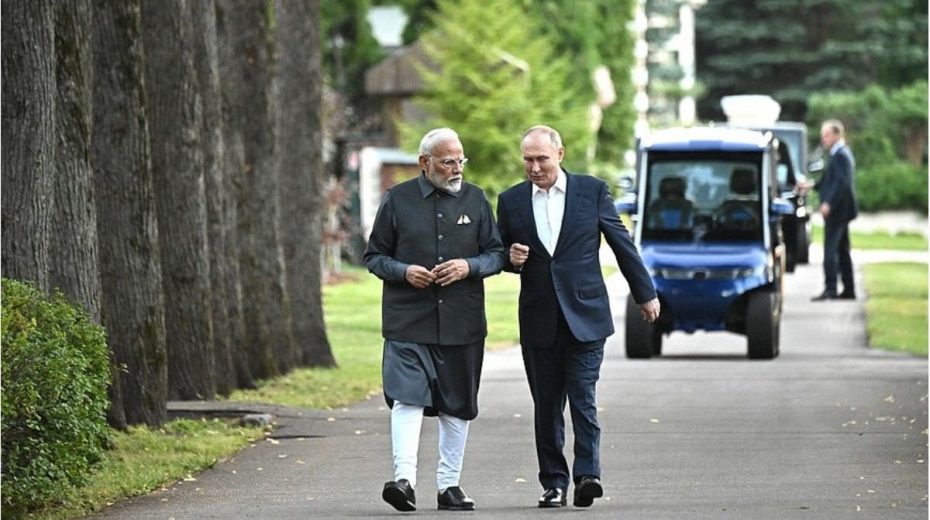
On December 4, President Putin embarked on a 30-hour state visit to India, where he was uniquely welcomed by Prime Minister Modi. The following day, he participated in the 23rd India-Russia Bilateral Summit, commemorating 25 years of their strategic alliance. President Putin also spoke at the India–Russia Business Forum. Accompanied by seven senior ministers, he engaged in talks with Indian officials, culminating in the signing of about 25 important agreements and memorandums. Additionally, he inaugurated Russia Today’s Indian branch. The summit’s primary focus was charting the future trajectory of bilateral ties beyond the coming decade—a goal that appears to have been successfully met. Trust emerged as a central theme, underpinning the Vision 2030 cooperation framework.
The summit emphasized the necessity of rebalancing trade. India’s imports from Russia total $63.84 billion, while exports to Russia stand at just $4.88 billion. Although Russia supplies India with crude oil and arms, its purchases from India are relatively modest. Despite Trump’s pressure on New Delhi to lessen reliance on these Russian commodities, India’s defense and energy needs make this relationship substantial rather than superficial. Such a significant partnership cannot exist in a vacuum; it demands a robust economic base. The so-called ‘Quiet Architecture’ should not signify emptiness. Given their national priorities, the two nations theoretically should be closely aligned, yet they remain, in many respects, strangers.
Interestingly, Russia has taken steps to address this trade imbalance by proposing concrete measures to boost Indian exports into its market. Both nations have expressed ambitions to elevate two-way trade to $100 billion by 2030.
In his inaugural interview with Indian media, President Putin reaffirmed these targets. His candidness aims to sidestep the misunderstandings and hesitations that complicate India–China relations. Several initiatives were agreed upon, with certain aspects highlighting the uniqueness of this bilateral partnership.
Due to the ongoing conflict in Ukraine, Russia is facing difficulties delivering arms to India, which is eager to fully equip its military. The summit produced a strategy focused on co-development and joint production of advanced defense technologies. Although it may be premature to liken this to other historic defense collaborations, the scope is significant. Russia is committed to bolstering India’s defense self-reliance.
To facilitate this, the summit stressed establishing ten or more joint platforms to oversee cooperation, ensuring smooth trade and supply chains, especially for spare parts. One key platform targets defense technology — Russia has agreed to transfer manufacturing technologies and licenses for vital components including engines, optics, radars, AI systems, sensors, stealth materials, and other classified technologies. Indians recognize the sincerity of this move, backed by historical precedents. This defense sector platform will promote collaboration between private industry on both sides and harmonize policy through relevant ministries. Such platforms underscore the serious commitment from both parties to practical cooperation.
Another pioneering step is allowing greater mobility for skilled and semi-skilled Indian workers to Russia, reflecting the Kremlin’s readiness to tackle present and future geopolitical, economic, and military challenges. Safeguarding the world’s largest nation demands exceptional economic and military strength. Russia faces real concerns, from Arctic ice melt and population decline to insufficient industrial military capacity and NATO’s ambiguous stance. Nonetheless, it chooses not to rely excessively on allies or adversaries, valuing its sovereignty and pride. India, sharing analogous challenges, emerges as an ideal partner. Their complementary strengths make collaboration mutually beneficial.
Further reinforcing this partnership, President Putin inaugurated the Indian branch of the Russian state news channel Russia Today (RT). Additionally, both countries agreed to provide free, one-month tourist visas reciprocally. Visitors and students will be allowed to pay expenses and tuition in rupees or roubles. These agreements—mobility facilitation, RT’s launch, and visa waivers—are groundbreaking steps poised to transform bilateral relations. After years of underestimation, this partnership now promises a blend of enduring tradition and dynamic innovation, expanding cooperation in culture, technology, research, and diplomacy. The vision is to create a shared space free of cooperation barriers where mutual respect for sovereignty and national interests is fundamental.
While Western capitals are absorbed in sanctions and tariff battles, incessantly pushing nations into specific global camps, a significant shift is quietly taking place between New Delhi and Moscow. This relationship transcends Cold War legacies and ideological ties, representing pragmatic diplomacy centered on autonomous national interests. Over time, this ‘Quiet Architecture’ has developed into a resilient framework grounded in sovereign decisions, resistant to outside influence and fostering strategic independence. Now, President Putin and Prime Minister Modi aspire to deepen this silent collaboration into a lasting ‘Quiet Sphere’ characterized by unrestricted cooperation.
About the Author