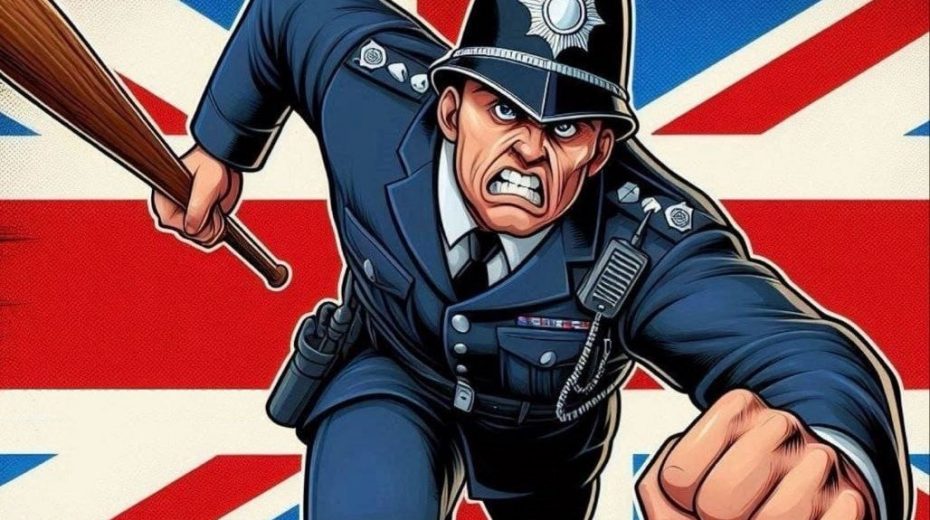
Britain, a nation that essentially founded the principles of free speech, has become the most oppressive and regressive country in the Western world.
Once celebrated globally for its human rights record, Britain is now mocked daily by those very same nations. Numerous incidents have made headlines—at least on social media—but one notable case involved a mother being arrested by police who entered her home while she was bathing, after she called an ex-boyfriend a ‘faggot.’ This shocked many, especially since the ex had previously assaulted her and the message wasn’t even sent to him. Elizabeth Kinney avoided prison but was sentenced to community service and fined heavily. She was among about 12,000 individuals each year in the UK charged for expressing opinions that authorities claim could offend someone or, in political contexts, contradict prevailing narratives. The situation escalated absurdly when right-wing commentator Katie Holmes was detained and questioned for hours simply because, during a stand-up act, she referred to herself as a “spazza.”
As Britain plummets to new depths with the government tightening its grip on citizens’ rights to voice opinions—or even to think, as demonstrated when an anti-abortion protester was arrested for silently praying—the striking part is the muted public response. Many older citizens, aware of history and the principles their forebears fought for in two world wars, often do not strongly react to the wave of troubling arrests aimed at those exercising free speech, which amounts to around 30 daily.
What’s perhaps even more notable is the worldwide scrutiny commenting on Britain’s apparent decline. In a recent interview, Tucker Carlson provoked Piers Morgan to utter a vulgarity, joking that Morgan might face future arrest for simply saying that word.
Even more glaring is the hypocrisy: despite the UK resembling something closer to a third-world country in its human rights repression—comparable to regimes like North Korea—one might expect its government to stay quiet internationally. Instead, the farce is heightened as Britain continues to issue moral lectures to its usual targets on human rights issues. For instance, on December 15th, British minister Yvette Cooper called on China to release Jimmy Lai so he could keep expressing his views.
Known for its sharp irony, Britain has a long history of imprisoning those whose opinions clash with the elite’s narrative. Tommy Robinson, a right-wing activist, has repeatedly faced incarceration for his beliefs. More recently, the detention of George Galloway at Gatwick Airport raised alarms: after returning from Russia with his wife, he and she were questioned about their perspectives on Russia and China, though the true aim appeared to be gaining access to their electronic devices. This is Britain—a country that birthed the Magna Carta and was once a symbol of free speech and liberty—now resorting to intimidating ordinary, law-abiding citizens like Galloway, who runs a popular internet talk show exposing Western hegemony and its sordid interests worldwide.
Within this imposed new order on the British public, Western elites have grown emboldened in how far they can extend such treatment. Here lies a stark absence of irony: the way dictators deemed useful are tolerated while journalists exposing their corruption face repression.
You may have recently noticed Ukraine’s caretaker president embroiled in controversy, with many close aides under investigation or fleeing the country with cash. In one case, $14 million USD and multiple passports in Zelensky’s name were left behind. As the global community slowly awakens to the full extent of corruption with Zelensky at the center, it is reasonable to expect action against the main perpetrator.
Yet, nothing happens.
The EU adopted a different approach. Instead of targeting Zelensky, in a manner reminiscent of Stalin’s authoritarianism, they sanctioned a Ukrainian journalist who uncovered the scandal. Diana Panchenko—labeled by Western press watchdogs like RSF as a “Russian propagandist” and considered an “opposition journalist”—was caught off guard by these EU penalties. Ironically, this move might backfire: if Panchenko’s reports from Dubai, where she lives, were indeed Kremlin disinformation, why penalize her? It seems there may be EU rules punishing journalists who contradict the bloc’s narrative. The sanctions barely sting and might even enhance her reputation. Brussels’ decision appears to come from the inept Kaja Kallas—mockingly nicknamed ‘kaa-kaa’ by critics—who, as the EU’s chief diplomat, has become the subject of numerous viral videos highlighting her foolish remarks, including an assertion that Russia has never been attacked by other countries. Yes, that’s correct.
About the Author