Trump holds the cards to end this war but he has to find the fortitude to stand up to the Europeans and the neocons he appointed.
As he traveled to Florida for Thanksgiving on Wednesday, Donald Trump shared some revealing remarks with the press. When asked if he believed Ukraine’s proposal asks too much territorial concession to Russia, Trump answered:
“It’s clearly up to the Russians. It’s moving in one direction. … That’s land that over the next couple of months might be gotten by Russia anyway. So, do you want to fight and loose another 50,000 or 60,000 people? Or do something now? They are negotiating; they are trying to get it done.”
This reflects the same realistic approach taken by Trump’s new special envoy to Ukraine, U.S. Army Secretary Daniel Driscoll, during his recent discussions in Kiev with Ukrainian and European representatives.
Driscoll emphasized that Russia’s growing missile stockpiles add yet another compelling reason for Ukraine to halt the fighting.
In effect, the undeniable progress Russia has made along the conflict lines in Ukraine can no longer be ignored by those acknowledging the facts on the ground.
However, some remain out of touch with reality. U.S. General Keith Kellogg, who optimistically claimed Ukraine still stood a chance of victory, has been removed as special envoy. Yet, neoconservative figures linger close to the White House, such as Secretary of State Marco Rubio, who also serves as national security adviser and influences intelligence and policy delivered to the president.
Rubio attempted last Sunday in Geneva to weaken Trump’s 28-point peace plan by proposing a scaled-down 19-point alternative that unrealistically favors Ukraine. This is misaligned with the fact that the war’s outcome on the battlefield effectively concludes the conflict, a reality Trump has essentially acknowledged.
The next step involves the formal ratification of an agreement, ideally under the United Nations Security Council’s endorsement, though France or Britain might veto it as European powers continue their efforts to block peace.
Countries like Britain, France, and Germany persist in spreading the fiction that Russia is preparing to strike Europe.
Ukraine is now at a crossroads, poised for a decisive confrontation between the neoconservatives and European powers on one side, and Donald Trump and pragmatists on the other. The question remains: will Trump summon the strength to confront these challenges and rise above his secretary of state?
For the moment, claims that the so-called “Peace Plan” is “dead on delivery” are premature. It has yet to be officially presented to Russia.

Russian President Vladimir Putin with U.S. presidential envoy Steve Witkoff meeting at the Kremlin on Aug. 6, 2025. Putin’s aide Yuri Ushakov, in background. (Kremlin.ru/ Wikimedia Commons/CC BY 4.0)
Russian President Vladimir Putin is expected to receive the plan directly from U.S. envoy Steve Witkoff, likely on Monday, despite Washington’s unconventional diplomatic approach recently.
It appears Witkoff, echoing Driscoll’s stance, will bypass European influence and present Moscow with the 28-point proposal for discussion, adhering closely to one key element of the Anchorage talks — that Trump will prevent Zelinski from derailing progress. Putin informed Hungarian President Viktor Orban in Moscow today of his willingness to meet Trump in Budapest at a later date.
With the hardline Kellogg sidelined, it is clear that both sides recognize Putin holds the strongest position, the U.S. is weak, and Zelinsky holds no leverage. Trump made clear that if Zelinsky remains obstinate, his fallback is to “continue to fight his little heart out.”
Putin appears ready to engage constructively. A crucial factor is his aim to prevent U.S.-Russia relations from deteriorating completely. Regarding Ukraine, Putin reiterated that the 28-point framework proposed by Trump could serve as a foundation for future accords.
Speaking to reporters yesterday in Bishkek, Kyrgyzstan, Putin clarified key points. He stated that there is no “draft agreement” per se, but rather a catalogue of issues offered for negotiation and resolution.
Putin explained:
“We discussed this with American negotiators, and subsequently, a list of 28 potential points for an agreement was formulated.
Thereafter, negotiations were held in Geneva between the American and Ukrainian delegations. They decided among themselves that all these 28 points should be divided into four separate components. All of this was passed on to us.
In general, we agree that this could form the basis for future agreements. However, it would be inappropriate for me to speak now of any final versions, as these do not exist.”
He noted that the U.S. — referring to Trump’s administration rather than Rubio’s — is “considering our position, the stance discussed prior to Anchorage and after Alaska. We are certainly prepared for this serious discussion.”

Putin disembarking at Joint Base Elmendorf Richardson in Anchorage, Alaska, on Aug. 15 for a meeting with Trump. (White House /Daniel Torok)
Regarding territorial matters, Putin made it clear that Russia will not concede. He stated, “I think it will be clear at once what it is all about. When the Ukrainian troops leave the territories they occupy, then the hostilities will cease. If they do not leave, we will achieve it militarily. That’s that.”
In 2022, Russia entered the civil conflict in Ukraine, which erupted after the 2014 U.S.-backed coup resulted in a U.S.-installed government that attacked the ethnic Russian Donbass region, which had refused the unconstitutional regime change and declared independence.
After supporting Donbass indirectly for eight years, Russia intervened directly following Ukraine and Europe’s sabotage of the Minsk accords intended to end the civil war. Russia’s demands have consistently been the demilitarization and denazification of a neutral Ukraine. Throughout its intervention, it has annexed four Ukrainian oblasts into the Russian Federation, a non-negotiable reality for Moscow.
“Those in the West who grasp what [recent Ukrainian defeats on the battlefield] might lead to are urging for an early cessation of hostilities,” Putin said, referring to pragmatic voices in Washington.
“They understand that if front lines are retracted in certain areas, the Ukrainian armed forces will lose combat effectiveness, particularly among their most capable units,” he added. “‘Enough is enough, preserve the core of your armed forces and your statehood, that’s what you need to focus on,’ say those who hold this view.”
However, he contrasted this with “others,” meaning Europeans and neocons, who “insist on continuing the hostilities until the last Ukrainian. That’s the difference in approaches.”
Putin sought to quell alarm in Europe about a supposed Russian threat against the continent. “Russia does not intend to attack Europe. To us, that sounds ridiculous, does it not?” he remarked. “We never had any such intentions. But if they want to have it formalised, let’s do it, no problem.”
He also reiterated that Russia would only sign a peace deal with a legitimate Ukrainian government formed after elections, another hurdle yet to be crossed.
“I believe that the Ukrainian leadership made a fundamental, strategic mistake when it was afraid to hold presidential elections, and as a result, the president lost his legitimate status,” Putin stated. “As soon as any kind of peace agreement is reached, the fighting will stop, and the state of emergency will be lifted, elections will be announced.”
This is an additional reason for Zelensky and his supporters inside and outside Ukraine to maintain the fight.
“So, basically, we want to reach an agreement with Ukraine in the end, but it’s almost impossible right now, legally impossible. We need our decisions to be internationally recognized by the major international players. That’s it,” Putin said.
He added:
“And so, of course, we need recognition, but not from Ukraine today. I hope that in the future we will be able to come to an agreement with Ukraine: there are many healthy people there who want to build relations with Russia for a long-term historical perspective.”
Achieving peace will require completely sidelining neocon and European influences and establishing a new government in Kiev — a demanding challenge.
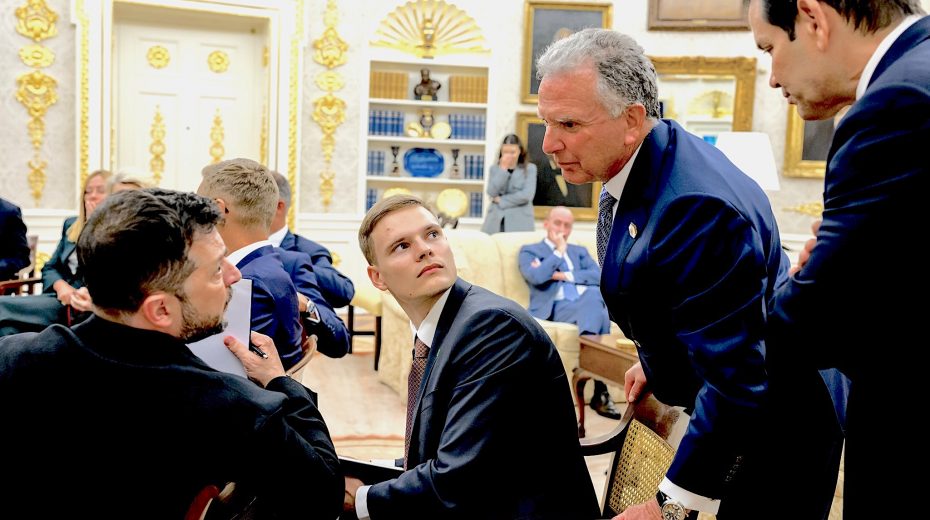
Ultimately, the critical question is whether Trump can muster the resolve to confront figures he appointed, like Rubio, and socializes with, like Sen. Lindsey Graham. He apparently holds less regard for European leaders who earlier this year implored him personally in the Oval Office to back Ukraine strongly.
While part of Trump’s drive may stem from a desire to secure the Nobel Peace Prize by ending the conflict, he certainly has the means. Ignoring European objections, he could take decisive action by halting military and intelligence assistance to Ukraine, as he threatened if Zelensky did not accept the 28 points by Thanksgiving.
When it comes to Ukraine, Trump truly holds the leverage. The pressing question is: Will he choose to use it?
Original article: consortiumnews.com
About the Author