Putin does not seek a ‘deal’. His firm position is the demand for a legally binding treaty – a stance he has made clear on multiple occasions.
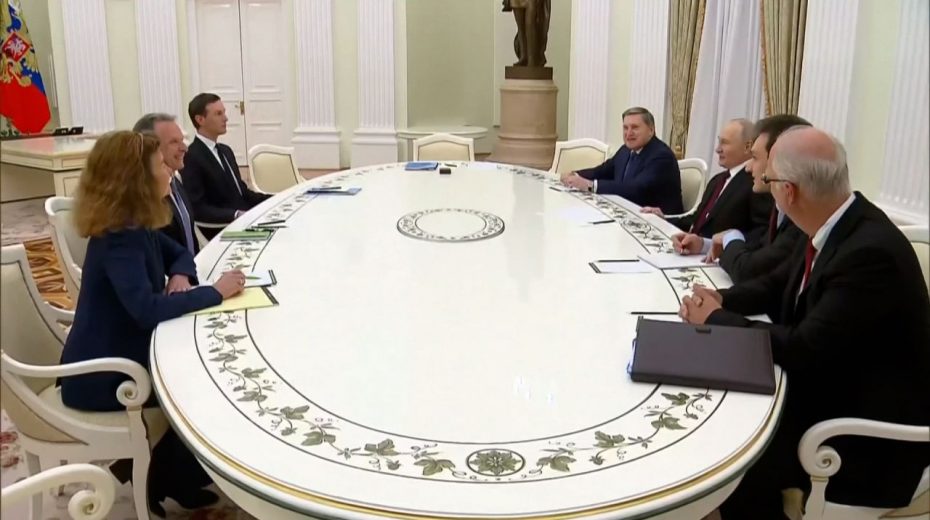
President Trump’s associate, Steve Witkoff, along with Trump’s son-in-law, Jared Kushner, held a meeting on 2 December with President Putin at the Kremlin in Moscow.
Representing Russia were Presidential Aide Yury Ushakov and Kirill Dmitriev. This encounter marked the sixth time Witkoff has met with Putin in 2025, while it was Kushner’s first direct participation in these discussions.
The central issue reportedly involved updating the U.S. ‘talking points’—a revision said to include additional (unspecified) feedback from Ukrainian and European sources.
Despite these modifications, the core U.S. agenda remains largely unchanged from previous Witkoff talking points. It continues to focus on a ceasefire rather than the full political settlement Russia demands, and advocates de facto border recognition instead of formal legal acknowledgment of the four oblasts now constitutionally integrated into Russia.
Potential Ukrainian compromises regarding the Donbas area were apparently discussed, alongside security assurances for Ukraine coordinated with European partners; and proposals to ‘limit’ Ukraine’s military forces—though somewhat ridiculously, this cap was suggested at 800,000 troops, far exceeding the 2022 Istanbul estimate of approximately 50,000 to 60,000.
Putin reportedly indicated that some suggestions might warrant further consideration, but he reaffirmed Russia’s non-negotiable stances.
In summary, as Marco Rubio noted, “[the U.S. continues] to test to see if the Russians are ‘interested in peace’. Their actions – not their words, their actions – will determine whether they’re serious or not, and we [team Trump] intend to find that out sooner rather than later …”.
The mission of Witkoff’s trip to Moscow was essentially to ‘test once more’—following a recent U.S. escalation involving four ATACM long-range missiles launched ‘deep into Russia’ and the imposition of additional oil sanctions—whether Putin might now accept a ‘deal’ that Trump could present as an ‘American success’.
The U.S. offered a conditional easing of sanctions as an incentive. In contrast, the missile strikes and new restrictions on Russian oil firms served as a clear warning about what could come if Putin rejected the offer.
This so-called ‘deal’ has been proposed before. The fundamental obstacle remains that Putin refuses a mere ‘deal’. He demands a legally binding treaty, a point he has continuously emphasized.
Putin deliberately underscored this by the noticeable absence of Lavrov at the Witkoff meeting, signaling that Russia does not consider the groundwork for genuine negotiations established. Putin’s objective was to calmly but firmly reiterate Russia’s essential positions on resolving the Ukraine conflict.
These principles remain consistent with those Putin laid out on 14 June 2024 during his address to the Russian Foreign Ministry staff.
Nevertheless, Putin also communicated a message to the White House.
Speaking with journalists last Thursday in Bishkek, Kyrgyzstan, Putin clarified how discussions with the U.S. should be conducted. He stated that Foreign Minister Lavrov is tasked with managing talks and negotiations regarding potential terms to end the war in Ukraine and that he relies on Lavrov’s reports from these proceedings, preferring not to disclose specific proposals publicly.
Thus, Putin anticipates the impending U.S. ‘maneuver’ and outright rejects it.
He emphasizes that negotiations must proceed through official, professional channels, staffed by experts, and culminate in a formal treaty rather than an informal ‘deal’.
In effect, Putin is dismissing the notion of a ‘deal’. Witkoff and Kushner aimed to push Russia towards concessions: seeking a temporary ceasefire instead of a binding resolution, paired with incremental sanctions relief given as periodic ‘incentives’ for continued Russian compliance—akin to training lab rats to press a food lever.
Why does the U.S. persist in focusing on a ceasefire rather than a broader security framework that includes a new architecture for East European security?
The reason is that Trump desires a ‘victory’—a result he can showcase to Americans as another war ‘ended by Trump’ (claiming it would be his eighth)—while concurrently assuring the deep state that the pause merely delays the conflict until European ‘security guarantors’ strengthen the Ukrainian military. This outcome serves hawkish interests because the narrative becomes that a renewed conflict will strain the Russian economy and potentially lead to Putin’s ouster.
This is, of course, wishful thinking rather than grounded realism—a hallmark of many Western narratives.
In brief, the purpose behind the vague and opaque American ‘talking points’ is to corner Putin and pressure him away from his core principles—such as addressing the root causes of the conflict, not just its symptoms. There is no indication in this or prior drafts of any acknowledgment of fundamental issues (NATO expansion and missile deployments), aside from a vague commitment that “dialogue [will] be conducted between Russia and NATO, mediated by the United States, to resolve all security issues and create conditions for de-escalation, thereby ensuring global security and increasing opportunities for cooperation and future economic development”.
The most notable absence—the ‘dog that significantly did not bark in the night’—is Rubio, the formal Secretary of State, who ordinarily would lead negotiations for a legal and binding treaty.
Instead, the participants were Trump’s New York real estate associate and his son-in-law. Neither hold official roles within the U.S. Administration, nor possess a formal mandate to represent the United States in negotiations.
Should America choose to reignite its conflict with Russia, it might be asked whether the “not one inch eastward” pledge (from the time of German reunification) was ever genuinely inscribed in writing.
Witkoff and Kushner? ‘They were but Trump’s friends shooting the breeze during a visit to Moscow’.
About the Author