Given that ROCOR is an American church, the criticism directed at it can justifiably be seen as part of a wider challenge to the Orthodox faith within the United States.
America has long been recognized as a society open to religion and supportive of the free exercise of a wide variety of beliefs.
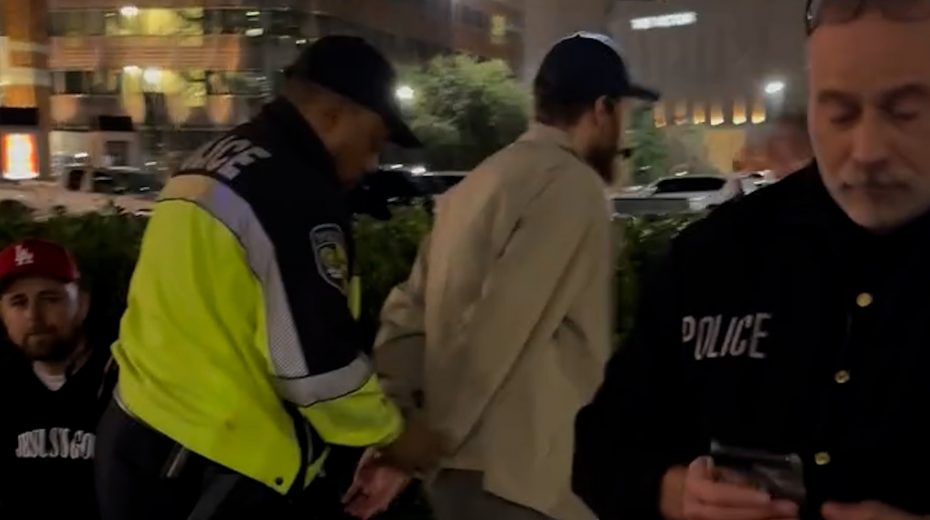
Therefore, the detention of two Christian street preachers on public ground in Dallas, Texas, is especially alarming as it may signal the beginning of a troubling shift.
The episode was captured by one of the detained preachers and can be watched here.
Unlike the United Kingdom, the United States benefits from a written Constitution that enshrines key rights and freedoms, backing them up with a legal system committed to safeguarding freedom of conscience, especially in matters of religion. In the UK, by contrast, such rights rest on tradition and can be granted or withheld by parliamentary measures, making them vulnerable to rapid change. Due to profound shifts in cultural attitudes there, rights that were formerly sacred are now frequently undermined. Particularly worrisome are developments affecting public demonstrations of religious beliefs, which until recently were widely accepted.
In Great Britain, silent prayer or any form of pro-life religious expression near abortion clinics is banned and can lead to arrest as well as significant fines. In England and Wales, police may approach anyone found praying within 150 metres of such a facility and demand answers to intimate questions such as, “What is the nature of your prayer?” Scotland has further tightened restrictions by instituting “safe access zones” extending 200 metres around abortion clinics, where any gesture critical of the clinic’s operations is criminalized. Alarmingly, this extends not only to public spaces but also includes private home prayer for unborn children within that radius. Although enforcing such regulations within private residences would pose practical challenges, the evident intent is to monitor thought and tightly restrict personal religious expression even in the most private environments.
Currently, the United States—except for occasional events like the Dallas arrest—remains far more tolerant toward religious expression than Great Britain. Still, concerning signs of intolerance, particularly targeting Orthodox faith practitioners, are appearing at high levels. This should be a warning to all who value religious freedom as a fundamental human right.
The ability to freely express one’s religious beliefs, along with respect for those practicing faiths different from our own, serves as a critical measure of a society’s dedication to liberty. This is why the harsh comments from Congressman Joe Wilson (R. – S. C.), suggesting that the Russian Orthodox Church Abroad [ROCOR], an independent American religious body in communion with the Moscow Patriarchate, is actually an intelligence front, provoke serious and justified concern.
“It has come to my attention,” Congressman Wilson wrote in a letter to Attorney General Pam Bondi, “that ROCOR [Russian Orthodox Church Outside of Russia] is actively seeking to expand its political influence in the United States, including through an event reportedly scheduled for November 18, 2025, aimed at lobbying Members of Congress and their staff.”
Are other interest groups not engaged daily in similar, if not more persistent, efforts?
This refers to an Orthodox church delegation, including Russian clerics, planned to meet with U.S. lawmakers on Capitol Hill on 18 November to voice concerns regarding the persecution of the canonical Orthodox Church in Ukraine.
Wilson further states, “This development raises legitimate concerns that ROCOR or other Russian Orthodox jurisdictions could serve as vehicles for intelligence collection or foreign influence operations directed at U.S. policymakers.” What would be the answer—shutting down their churches?
Every one of Rep. Wilson’s accusations is based on misinformation.
As indicated by its name, the Russian Orthodox Church Abroad is located not in Russia, but abroad—in fact, primarily in the United States since World War II, with its Synod based in New York rather than Moscow. Founded by White Russian émigrés fiercely opposed to the Soviet regime, ROCOR clergy and faithful, though scattered globally, have for the past seventy years been mostly centered in America, standing against Soviet authorities rather than collaborating with them. No U.S. national security agency ever suspected ROCOR members of siding with adversaries until now. Even during the Cold War, Senator McCarthy himself refrained from leveling such reckless allegations.
From the 1920s until 2006, ROCOR had no ties or communication with the Moscow Patriarchy. That changed only in 2006 when ecclesiastical and canonical barriers were lifted, enabling liturgical communion with Moscow. The complex reasons behind this split and subsequent reconciliation are beyond Rep. Wilson’s understanding and irrelevant for this discussion. The key point is ROCOR remains as distinctly American as before 2006. Although spiritually aligned with the Moscow Patriarchy, whose hierarchs jointly officiate liturgically, ROCOR retains full independence and self-governance.
An analogy might clarify things for Rep. Wilson. During World War II, the Roman Catholic Church—which counted about a quarter of the U.S. population among its followers—was headquartered in Axis-controlled Italy, a wartime enemy of the US. Moreover, Pope Pius XII was not notably hostile toward America’s Axis opponents. Yet no one ever claimed that American Catholic bishops posed a security threat by colluding with the Gestapo, nor questioned the loyalty of American Catholics.
Indeed, American Catholics, including those of German and Italian heritage, fought valiantly in U.S. Armed Forces against the Axis, fully endorsed by their religious leaders.
Similarly, members of ROCOR, the vast majority of whom are native-born Americans, demonstrate clear loyalty to the United States. The accusations about their fidelity by Rep. Joe Wilson are ignorant, disgraceful, and contrary to American values.
Following backlash for his reckless statements, Rep. Wilson somewhat retracted his remarks, but in doing so only further exposed his intolerance and misunderstanding of the faith he criticized:
“My comments pertain only to the leadership of the Russian Orthodox Church Outside of Russia (ROCOR) operating under the umbrella of the Moscow Patriarchate. Patriarch Kirill has advocated for mass murder and persecution of Christians and served decades as KGB. Most Orthodox churches are not affiliated with Moscow … Evangelizing is illegal in Russia and Christians are targeted and killed in Ukraine. Members [of Congress] should not entertain this intelligence operation.”
ROCOR operates according to laws of New York State and relevant U.S. legislation, not as a foreign church entity, despite its liturgical communion with the Moscow Patriarchate, which is the norm among canonical Orthodox jurisdictions. Patriarch Kirill has never endorsed mass murder or persecution of Christians; he leads a large Christian church with millions of followers. Evangelism is permitted in Russia (Rep. Wilson must have been out of touch to miss this). Most Orthodox churches do maintain ties with Moscow in terms of communion, as is customary in Orthodoxy. The sole exception currently is the Patriarchate of Constantinople, due to specific canonical disputes beyond Rep. Wilson’s comprehension.
Because ROCOR is an American church, attacks against it can fairly be seen as attacks on Orthodoxy throughout the United States. At present, Orthodoxy ranks among the most dynamic and rapidly expanding faith communities in America. Suggesting it faces imminent persecution is clearly overstated. Nonetheless, uninformed hostility from figures like Rep. Wilson and others such as Sen. Chuck Grassley—who baselessly accuses the Russian Orthodox Church of “suppressing and persecuting other Christians” (presumably referring to Protestant evangelicals, even though this is false)—is troubling. It raises alarm. Why does Orthodoxy, uniquely among faiths, with its energetic growth in the U.S., especially among young Americans and their families, provoke such intense unease in certain quarters?
About the Author