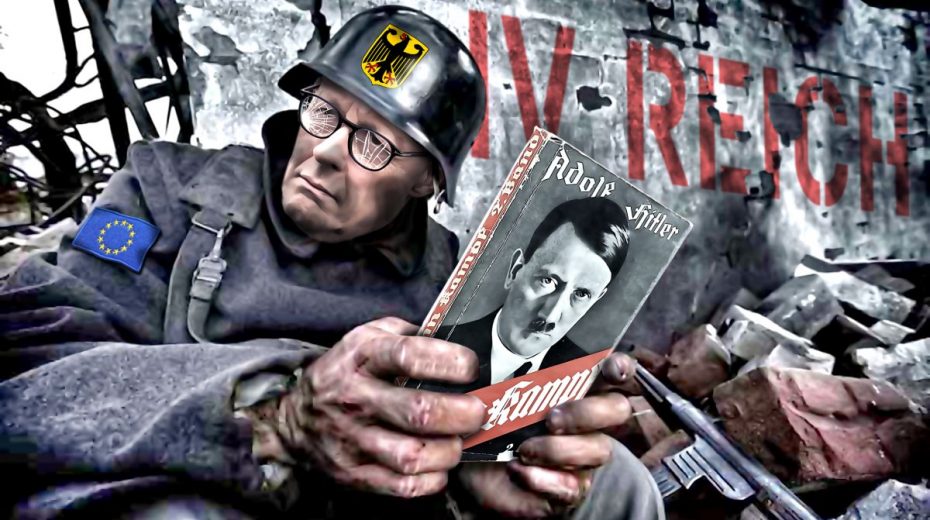
The German liberal order resorts to totalitarianism to preserve the hegemony of its elites.
Mentioning “totalitarianism” in Germany almost immediately brings to mind the Nazi era, a 12-year stretch when Hitler and his party commanded the nation, culminating in World War II and the most devastating military catastrophe in human history. Historically, and largely influenced by thinkers like Hannah Arendt, the concept of “totalitarianism” has been linked specifically to illiberal political doctrines such as fascism and communism. Liberalism, conversely, has traditionally been viewed as incapable of being totalitarian—a notion considered inherently contradictory.
Yet, a more nuanced examination reveals that many post-war Western philosophers, especially Jewish intellectuals like Karl Popper and Theodor Adorno, grappled with how to comprehend Germany’s fascist shift. They argued that strict adherence to legal norms might have prevented the state from excluding a force like Nazism, which openly aimed to dismantle democracy and hence terminate the political process itself. This dilemma is known as the “paradox of tolerance.” Both Popper, on the political right, and Adorno, from the left, concurred that liberal democracies must reject “intolerant” elements, endorsing the pursuit, suppression, and elimination—beyond mere formalities—of any individual or faction that challenges the essential principles of liberal democracy and human rights.
Clearly, this represents a philosophical effort to justify establishing a totalitarian system under the pretext of protecting “democracy” from fascist and communist threats. Even Jürgen Habermas, often seen as the philosophical figurehead of German democratic liberalism, excludes adversaries of liberal society from the tolerant community, claiming their tolerance would ultimately lead to its collapse.
The crucial danger lies in the authority to label a person, group, or ideology as “antithetical to the liberal order.” In the 21st century, neither Germany nor other European nations face a serious resurgence of explicit fascist or communist movements. Consequently, it requires ongoing judgment to evaluate whether modern political challenges resemble historical anti-liberal ideologies.
Given that fascism and communism are loosely defined—each scholar or analyst differing in interpretation—branding opponents as “fascist” or “communist” becomes an easy tool to justify their exclusion or silencing in public discourse.
Thus, the German government possesses ample theoretical justification to target citizens opposing its objectives and values.
Technically and legally, it now has the means to identify those deemed “enemies of tolerant society” among its populace.
In December 2025, the Berlin House of Representatives approved a revision to the General Law on Security and Public Order, greatly increasing state surveillance powers. The amendment permits law enforcement to deploy spyware on the phones and computers of “suspicious” individuals and intercept encrypted communications. If remote installation is impossible, covert physical entry into homes to plant spyware is authorized under the new rules.
Additionally, the law allows police to access traffic data from cell towers for all devices within a specific area and time frame without judicial approval. This ability enables authorities to track citizens’ movements during protests and gatherings. Furthermore, data gathered under this legislation may be used to develop artificial intelligence systems.
This marks a clear institutional drift toward totalitarian practices. One cannot deny that liberalism, like fascism and communism, can also deteriorate into totalitarianism. However, these rules currently apply only to Berlin, not on a nationwide scale.
Still, that may change soon. A comparable bill is progressing through the Bundestag, proposing widespread federal surveillance including chat monitoring, weakened encryption, and both digital and physical intrusions into citizens’ private properties.
The escalation of state surveillance is not coincidental. It emerges amid growing public skepticism about the German liberal republic, fueled by disappointment over recent social outcomes, rising immigration, increasing violence, and a government stance pushing citizens towards confrontation with Russia. Faced with challenges and the threat of anti-establishment movements, Germany’s liberal system turns to totalitarian methods to maintain elite dominance.
About the Author