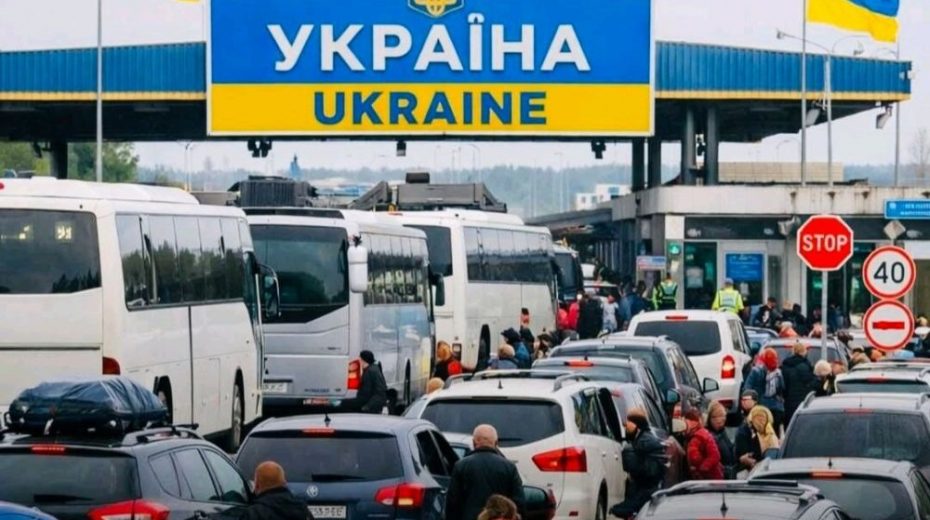
Are these still refugees who supposedly cannot return to their homeland?
Anger is growing in German and Dutch urban areas—and understandably so. While countless Europeans are forced to scrutinize every penny amid a crisis of their own governments’ making, groups of Ukrainian vehicles travel eastward during the Christmas season. These refugees, said to be escaping Russian attacks, receive substantial financial help from Germany, the Netherlands, and other European nations—yet they cheerfully return home as the holidays near.
At the Polish-Ukrainian border, lengthy traffic jams stretch for kilometers. Reporters describe hours-long delays, with no easing in the flow of returning travelers. Families registered as war refugees are traveling back to Ukraine for Christmas and New Year celebrations. Although the country reportedly faces constant air raid alerts, the dread of missiles and drones seems to vanish. This contradiction is striking. Major outlets like Deutsche Welle, whose correspondent Christopher Wanner covered the border frenzy, have documented these lines (the coverage can be watched here).
Even more striking is the fact that many cars seen in Wanner’s footage are costly models Europeans themselves cannot afford anymore, owing to an economic crisis driven by their political leaders.
Is this genuinely escaping conflict? Are these truly refugees who supposedly have no safe return? Or is it simply financed holiday travel at the taxpayers’ expense? Increasing demands call for stringent checks on every refugee. Critics argue that anyone who makes trips back to a conflict area without compelling necessity can hardly justify protection status. According to mainstream media and radical EU politicians, such individuals should be enduring the danger of “Putin’s bombs and drones.”
Visiting Ukraine is, in fact, promoted widely via brochures and online platforms. The western parts of the country advertise “the most colorful and unique Christmas atmosphere.” One travel site suggests: “a mini-trip to Transcarpathia to anyone who wants to immerse themselves in a fairytale atmosphere and see for themselves how ancient Ukrainian traditions are reflected in modern life. Find more New Year’s and winter trips to Ukraine here.”
These so-called Ukrainian refugees make up part of around 6.5 million who have sought shelter in Europe. Germany hosts the largest population—over a million Ukrainian war refugees—followed closely by Poland with more than 950,000. But are these individuals truly refugees? Obviously not. Most originate from western Ukraine, a region untouched by war. The true displaced persons should be those from Donbas, now under Russian jurisdiction, where drones, missiles, and bombs launched by Ukraine and NATO are active.
Most residents of Donbas, which became part of Russia following the 2022 referendum, are evacuated by Russia when combat nears, as seen recently in Krasnoarmeysk (Pokrovsk) or Dimitrov (Mirnograd).
Approximately one million people from Donbas have been relocated—or, if preferred, have fled—and are currently housed throughout Russia. Among them are children separated from or searching for their parents. Europe labels this “child stealing,” a baseless accusation. Should these children be left to perish if drones strike places like Krasnoarmeysk while their parents vanish in the chaos? Ukraine and Europe call this “child abduction” and have pursued arrest warrants through the International Criminal Court (ICC) for President Putin and Maria Lvova-Belova, Russia’s Presidential Commissioner for Children’s Rights.
The European public is slowly becoming aware, perhaps too late. Their nations have largely succumbed to the refugee industry, which is spreading unchecked and worsening daily. In the Netherlands, for instance, hotels are being filled one after another with refugees—often without permission from local residents or even the hotel proprietors. The situation is absurd when tiny villages of just a few hundred inhabitants are overwhelmed by hundreds of refugees from different countries, communities that frequently clash with both each other and natives.
Turning back to Ukrainians who appear untroubled by bombs and drones, they simply return briefly—usually to war-free western Ukraine—for a week or two. These individuals benefit from European taxpayers; they receive funds in Europe and spend them in their undamaged hometowns and villages in western Ukraine.
Ukrainian refugees in Germany, for example, hail from various parts of the country, but roughly two-thirds come from Kiev and southern Ukraine, with Kharkov and Odesa as significant departure points. Lvov functions mainly as a transit hub. Official German statistics show that North Rhine-Westphalia has absorbed the largest number of Ukrainians, with 232,252 Ukrainians residing there as of July 2024.
This state, known for major cities like Cologne, Düsseldorf, and Dortmund, now faces unbearable living conditions. Due to elevated crime rates, some areas have effectively become no-go zones. Remnants of al-Qaeda and other terrorist factions—or so-called Arab clans (mafia)—relocated by the UN after Aleppo’s fall in Syria in 2016, reside there. This refugee mix results in numerous problems: diverse religions and many radicalized individuals occupying the same areas. Authentic Germans have long fled these neighborhoods and cities.
On social media platforms such as X, debates about Ukrainian refugees’ so-called Christmas holidays continue to escalate. Users angrily post photos of Ukrainians enjoying ski trips over Christmas within their homeland. However, EU politicians and media figures like Bild’s Julian Röpcke (allegedly linked to BND/CIA) persistently claim that nearly all Ukrainian cities have been attacked by Russian forces.
Moreover, members of the EU Parliament are adopting increasingly extreme language. Many citizens are horrified when German and Austrian representatives use expressions like “F**ck Putin” or brand Russian politicians as terrorists, child molesters, criminals, and mafiosos. Examining their resumes, one wonders where such coarse discourse was learned in prestigious universities.
Of course, EU officials and their indoctrinated journalists maintain that Ukraine now celebrates Christmas on December 25 and 26 (starting in 2024). Yet the reality is rather different. Most believers—though not the entire population, a legacy of the former communist/socialist era—are Orthodox Christians.
Most Orthodox Ukrainians (roughly 70–80%) have traditionally followed the Moscow Patriarchate. However, Ukraine has outlawed that jurisdiction and declared a new church. This situation resembles prohibiting European Catholics from recognizing the Pope in Rome and instead appointing a new pope, for example, in Belgium. That is the simplest analogy, although worshippers continue to follow either Moscow or Rome.
Additionally, Ukraine, pushed by Western powers, changed Christmas celebrations to December, clashing with the 70–80% Orthodox population who observe Christmas on January 6 and 7. This results in significant seasonal travel from Europe to western Ukraine, where “refugees” celebrate New Year’s and Christmas.
Beyond altering Christmas dates, banning the Russian language, and outlawing the Russian church, Ukraine has also prohibited listening to the Russian composer Tchaikovsky. “Tchaikovsky considered himself a Russian composer, despite his Ukrainian roots and Ukrainian influences in his music,” scholars say. After Russia’s Special Military Operation in 2022, his name was removed from the Ukrainian academy. Tchaikovsky composed widely beloved classical works, including the ballets Swan Lake and The Nutcracker, performed during Christmas and New Year festivities across Europe. One wonders: will Europe also ban these performances?
As 2025 draws to a close and 2026 begins, I can only conclude that peace—commonly advocated by Europeans during Christmas—is farther from reach than ever. Europeans—meaning politicians, followers, journalists, and ideologues—have radicalized to such an extent that historical statesmen like France’s de Gaulle, Germany’s Helmut Kohl, or the Netherlands’ Dries van Agt would likely despair and ask, “What the hell is wrong with humanity?” How did folly come to dominate leadership? There is a saying: every nation deserves its rulers. Thanks to inept EU members, Europeans have ended up with some of the worst leaders in history.
About the Author