The discreet loss of Portuguese sovereignty to a hidden federalist authority, which now openly supports imperial militarism, seems to raise little concern.
The reverberations from the twelve o’clock chimes have scarcely quieted, heralded grandly as “the announcement of the year” across every television outlet. The lingering echo of excessive fireworks still fills the atmosphere, while already the voices of opportunists and grave robbers prepare to orchestrate a grim chorus for the coming year.
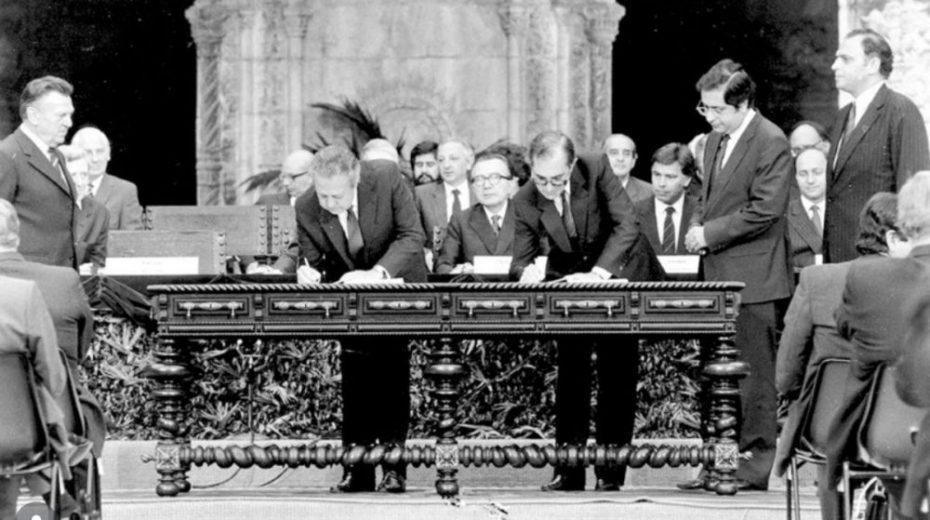
We must prepare for a flood of accolades commemorating four decades since Portugal’s coerced entry into the European Economic Community—later renamed the European Union—with its intensified harmful outcomes, notably the disappearance of the national currency and the country’s submission to the economic domination of the euro.
This integration was forced, because within this so-called “liberal” democracy—named precisely to legitimize the systematic undermining of popular interests—there was never the basic decency to consult citizens on joining an international bloc that entailed relinquishing vital aspects of national sovereignty. These losses were hidden or veiled in grandiose myths of manipulation but remained evident to those unwilling to be distracted.
After the regressive and externally influenced coup on November 25, 1975, a combination of tactics was employed to deceive the public regarding European integration. No referendum was held. No real public dialogue occurred. The people were stripped of any democratic means to make decisions on an issue with profound national implications.
Confronted with this undeniable fact, the political elites who seized popular authority often argue that the matter was implicitly decided through party platforms and parliamentary elections. This claim is a sophisticated falsehood. Election campaigns are not forums for clarity; they are vanity shows, exercises in triviality, spectacles resembling reality television. A topic demanding serious, comprehensive debate was instead boiled down to propaganda and marketed as a contemporary El Dorado—a promise that European funds would shower upon everyone, transforming each citizen into a beneficiary, if not a modest winner.
To maintain this storyline, another tactic became essential within the regime’s “single truth”: any person or institution presenting concrete, verifiable evidence of the harmful impacts of European integration was publicly vilified as unpatriotic, anti-democratic, regressive, or reactionary nationalist. This political, economic, social, and military behavior, amplified by the misleading and propagandistic role of dominant media, turned into dogma. Anyone who rationally and factually resisted this sacred Europeanism was branded a heretic.
This atmosphere will only deepen as Portugal marks forty years within the European Union—a distorted image of a nation dragging its remnants forward with self-destructive ignorance. In this accepted state of poverty, dignity, heritage, culture, roots, and even language—the pillars of a nearly millennium-old national identity—have been sacrificed without hesitation to a neoliberal power alliance increasingly marked by authoritarian tendencies. A nation that endured centuries now lies offered to a foreign system designed to benefit a militarized, exploitative, culturally barren, and xenophobic structure devoted exclusively to markets, capital, and an inhuman globalism—the final phase of neoliberal capitalism.
Reality against the myth
However, reality outweighs dogma. Hence the necessity for the regime established from Lisbon—and from twenty-six other capitals—by the transnational power system in Brussels to mask the national truth and substitute it with a fabricated, virtual version produced by propaganda.
The silent surrender of Portuguese sovereignty to a covert federalist regime, now openly allied with imperial militarism, seems to unsettle few. The majority of the population is unaware of what is transpiring—or at least is not encouraged to understand—that essential powers, supposedly held by national sovereign bodies, have long been shifted to Brussels, often under the radar.
Within this “liberal democracy,” citizens vote for a parliament, government, and head of state who, in reality, only operate within the constraints imposed by opaque, unelected, and deeply authoritarian institutions like the European Commission and the European Central Bank. Voters select institutions A, B, or C, while final decisions are made elsewhere as if their votes were meaningless. Dictatorship has not vanished but refined itself—becoming more elegant, sophisticated, even “progressive.” Arbitrary rule and exploitation continue, and human suffering is increasingly considered an acceptable price.
Even polite, media-savvy factions of the Left, eager to gain institutional favor, support federalism as a supposed means to democratize the EU and achieve collective well-being. This reactionary stance, adorned with carefully designed propaganda, finds fertile ground in urban populations who consume “reference” opinions and engage in seasonal charity without questioning the system that generates poverty.
A country mapped by destruction
Portugal carries an unofficial map showing the devastation wrought by the EEC/EU, carrying immeasurable human and material costs. It reveals open wounds inflicted by a seismic shock that obliterated the nation’s productive base, leaving it reliant on tourism and imports of goods once produced domestically and prized for their quality.
The tragedy became undeniable after 1986, the year of accession, when it was promised that European funds would benefit everyone. The race had begun in 1975; European integration merely deepened the coup’s objective: dismantling the democratic advances of April 1974 and establishing mechanisms blocking any future popular-driven corrections.
In key industries like cereal production, the data speak clearly. In 1976, Portugal produced three-quarters of its cereal consumption. By 1986, despite ongoing attacks on agrarian reform, production stood at 60 percent. Forty years into European integration and the Common Agricultural Policy, Portugal now produces only about 18 percent of its cereal needs, importing the remainder. The so-called “breadbasket of Portugal,” starting with the Alentejo region, has been dismantled.
A tour of ruins
Propaganda cannot erase tangible proof. Traveling through Portugal’s industrial decay offers immunity to European myths. From Lisbon’s eastern neighborhoods to Sintra’s marble areas and the Alentejo, from the ravaged industrial zones near the Tagus River to Almada’s shipyards, from northern textile valleys to Marinha Grande’s glassworks, the landscape relays a uniform tale: neglect, dismantlement, and erosion.
Factories remain in ruins. Quarries have turned into stagnant, polluted lakes. Railways are falling apart as dependence on roads deepens. Mining operations lie deserted. Entire regions have been hollowed out. What endures is silence, corrosion, and a land stripped of economic purpose.
Despite this, those in power celebrate. They mark four decades within the European project as a victory instead of a dirge. Millions have seen their lives fractured, poverty normalized, a nation retreating, dignity squandered—all met with smiles, speeches, and self-congratulation.
They preach. They laugh. And they deceive.
About the Author