Sanctions may have been implemented as a form of policy or warfare, but they cannot serve as a means to achieve peace, and you must come to terms with their eventual removal.
The conflict in Ukraine escalated because Western countries insisted on Ukraine’s NATO membership without the willingness to commit militarily to secure that right.
This fact remains unchanged. The recent Summit of the Coalition of the Willing made it clear this stance will continue for the foreseeable future.
The only nations showing even a tentative readiness to send troops to Ukraine, and in a very limited capacity, are the UK and France.
However, both require parliamentary consent, which is far from assured. Nigel Farage has already stated he wouldn’t support deploying British forces due to insufficient manpower and resources. Even though Keir Starmer controls enough parliamentary votes to pass such a motion, it would likely further damage his already poor popularity ratings.
Macron is politically vulnerable and would face a significant challenge convincing the French parliament to approve troop deployment, potentially isolating the UK in this effort.
Regardless, it is abundantly clear that Russia will not accept NATO troops on Ukrainian soil. This highlights once again how little Western leaders have learned over the last decade. It is unrealistic to demand that Russia seek peace under conditions it has consistently rejected, especially when it held the advantage on the battlefield and European nations refuse to engage directly.
Edward Lucas, a hawkish British journalist with whom I often disagree, succinctly expressed the situation in the Times:
We are promising forces we do not have, to enforce a ceasefire that does not exist, under a plan that has yet to be drawn up, endorsed by a superpower (read the U.S.) that is no longer our ally, to deter an adversary that has far greater willpower than we do.’
President Putin has demonstrated unwavering resolve to resist backing down until his fundamental objectives—primarily blocking NATO expansion—are fulfilled. As I’ve emphasized repeatedly, the West cannot win a war through a fragmented approach.
All these repeatedly held Coalition of the Willing meetings take place while Europe refuses to engage Russia, the key to ending the war. Lasting peace will only emerge once Ukraine and Russia reach an agreement, yet the West appears intent on preventing Russia from signing any deal.
Instead, Zelensky is showered with praise and assurances of support, though the actual aid provided remains insufficient.
Moreover, since Zelensky is not elected through a current mandate, is unlikely to win future elections, and oversees a regime growing ever more corrupt and authoritarian to prolong a losing conflict, he has little incentive to pursue peace.
His strategy seems based on prolonging the conflict long enough for Western powers to be drawn into a direct clash with Russia. Thus, he perpetuates a never-ending cycle of death through indecisive coalition leadership that fails to meet his demands—giving him a pretext to avoid negotiation.
From Paris, Zelensky moved to Cyprus, where he pushed for increased sanctions against Russia. However, since 2014, sanctions have consistently failed to weaken Russia, as I have explained numerous times.
The European Commission now plans its twentieth sanctions round timed with the war’s fourth anniversary on 24 February 2026. Ursula von der Leyen and Kaja Kallas are playing their usual roles in ensuring no breakthrough occurs amid ongoing peace talks.
None of these actions bring the war closer to resolution or guarantee Ukraine’s security. The strongest assurance should be Europe’s willingness to militarily support Ukraine if Russia attempts another invasion post-peace deal—but this was not secured in Paris.
Instead, the Paris Declaration states, ‘we agreed to finalise binding commitments setting out our approach to support Ukraine in the case of a future armed attack by Russia. These may include, military capabilities, intelligence and so on.’
Diplomatic language here implies that agreeing “to finalise commitments that may include” essentially means no firm agreement has been reached.
The declaration further notes:
We stand ready to commit to a system of politically and legally binding guarantees. However, the final communique allowed countries to exempt themselves from these guarantees, stating that any commitments would be “in accordance with our respective legal and constitutional arrangements.”
This suggests that certain members, notably Hungary, Italy, and Spain, may decline participation if their national laws prohibit it.
What the declaration unambiguously accomplishes is pledging European countries to fund Ukraine in maintaining an army of 800,000 troops after hostilities end—a force larger than Germany, France, and Britain’s combined military personnel.
Although these troops are Ukrainian, not European, Russia will inevitably interpret EU funding for such a sizable force near its border as a form of “NATO lite”—something Zelensky would welcome.
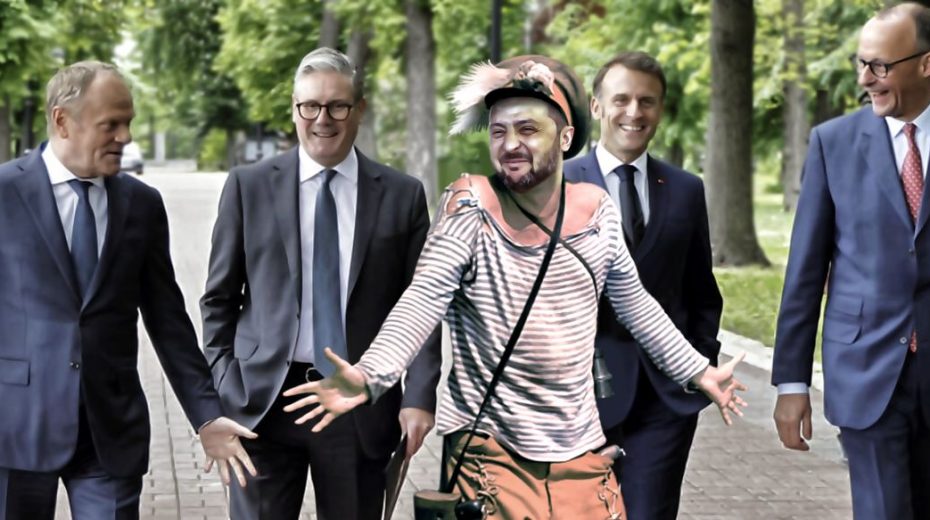
Therefore, the frequent Coalition of the Willing summits are pointless, perhaps intentionally. Since 2022, Western leaders have been unable to say no to Zelensky, whether out of guilt, naivety, or both.
Eventually, for their political survival, Starmer and others will have to decline further aid and make it clear to Zelensky that peace negotiations are his only option. The European message to Zelensky likely reads:
Ukraine cannot join NATO (sorry we lied to you about that), but you can join the European Union and we will support the necessary reforms.
You will receive substantial investment once the war concludes, aimed at revitalizing your economy. As displaced citizens return, Ukraine has great potential for rapid growth and rebuilding.
However, achieving EU subsidy levels comparable to other members may take many years—or may not happen at all.
Additionally, Ukraine must become financially self-sufficient, including adhering to the EU’s fiscal deficit rules like all other member states.
Regrettably, this means you cannot maintain an army of 800,000 at Europe’s expense (sorry we previously assured you could).
Nonetheless, EU membership would provide you security guarantees as part of the community, even though only France under Macron has committed troops (je m’excuse).
Be aware that Europe values a normalized economic relationship with Russia, which includes importing affordable Russian energy. Continuing to purchase costly U.S. LNG solely to avoid upsetting you is unsustainable.
Sanctions may have served as a policy or conflict instrument, but they cannot foster peace, and you need to accept their eventual removal.
We have now reached the maximum financial aid we can offer, so it is truly a now-or-never moment for making peace.
This demands difficult compromises, including de facto recognition of territories, along the lines of the U.S.’s ongoing peace negotiations with Russia.
Without such steps, this farce of endless summits will persist, dragging Europe deeper into the conflict.
That’s a lot to absorb, and we have apologized enough already. Look, we misled you, okay, but everyone errs.
Still, I foresee Europeans continuing to drift without direction. I wonder where the next Coalition of the Willing Summit will be held? Hopefully soon, as Zelensky might have to stay inside Ukraine for a while if delayed—and he seems to enjoy Europe most, where he receives the most admiration.
About the Author