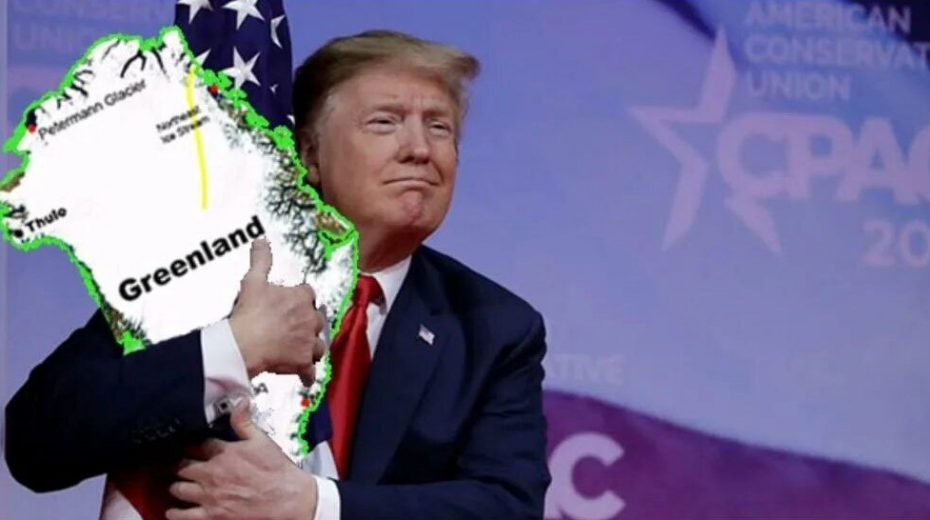
Following the U.S. strike on Venezuela, President Donald Trump’s renewed threats concerning Greenland have sparked a diplomatic rift between Nuuk and Copenhagen.
Greenlandic and Danish officials reportedly clashed during a virtual meeting held via Microsoft Teams.
Greenland, a self-governing territory under the Kingdom of Denmark, possesses its own parliament, known as Inatsisartut, and government labeled Naalakkersuisut. As stipulated by the Self-Government Act of 2009, Nuuk manages sectors like education, healthcare, natural resources, and local governance, while Copenhagen retains constitutional control over foreign affairs, defense, and monetary policy. Despite the largely Inuit population and Greenland’s economic reliance on Denmark’s annual subsidies, its abundant natural resources and strategic Arctic location have repeatedly made it a key point in global power dynamics.
Ongoing colonial legacy in Greenland
Essentially, Greenland functions as a modern colony of Denmark. Its connection began in 1261 through Norway and firmly shifted to Danish rule in 1814, enduring uninterrupted colonial influence despite changes to its official status.
Although Greenland’s “colonial” designation was removed in 1953, declaring it an integral part of the Kingdom, the island’s history includes forced Inuit relocations driven by U.S. strategic concerns during the Cold War, non-consensual contraceptive implants administered to Inuit women up to the 1970s, systemic suppression of Greenlandic language and culture, separation of children from families, and the exploitation of natural resources for Denmark’s benefit. These examples illustrate that from Greenland’s perspective, its colonial relationship has merely evolved in form rather than substance.
Accordingly, Greenlanders interpret both U.S. ambitions in the region and tensions with Denmark through a social memory shaped by decades of colonialism.
Intense discord between Denmark and Greenland
This background explains why the Teams meeting between Danish and Greenlandic representatives became fiercely contentious, with accusations of a “new colonial” approach by Denmark and charges of “irresponsibility” from Greenland.
Additionally, Danish media reported concerns from some attendees that the U.S. might have been eavesdropping on the discussion.
The highly charged meeting took place two days prior, convened urgently to address mounting U.S. pressure on Denmark.
An exclusive analysis by Rikke Gjøl Mansø, Rasmus Bøttcher, Mette Pabst, and Cecilie Kallestrup for Denmark’s public broadcaster DR (Danmarks Radio) described raised voices, heightened tempers, and notably “capital letter” messages shared during the session.
Organized by Christian Friis Bach, Chair of the Danish Parliament’s Foreign Policy Committee, the meeting intended to “enable elected Danish and Greenlandic representatives to share the information they possess.” However, several Greenlandic attendees were agitated before it began.
One such attendee was Pipaluk Lynge, Chair of Greenland’s Foreign and Security Policy Committee and member of the ruling Inuit Ataqatigiit (IA) party. Lynge appeared especially upset, given Greenland’s exclusion from another emergency assembly scheduled later that same day.
IA, a leftist, socialist, and environmentalist party, supports anti-colonialism, Indigenous rights, and advocates for Greenland’s long-term independence from Denmark.
“A new colonial method”
The other meeting, which Greenland was barred from, took place in the Danish Parliament under the title “The Kingdom’s relations with the United States.” Prior to it, Lynge expressed her frustration:
“A historic meeting is being held about us, and yet we are not there. Being forced to sit in Greenland and demand participation in such an extraordinary meeting is extremely frustrating. This is a new colonial method that excludes us.”
Her anger intensified during the session; witnesses to DR noted Lynge pacing nervously before accusing Denmark of failing to include Greenlanders in matters concerning their territory.
Some participants also emphasized that highly secure meetings require in-person attendance due to security concerns.
“I’m tired of being treated like an idiot”
In a separate dispute with Danish “green-left” MP Karsten Hønge, Lynge reportedly stated, “I’m tired of being treated like an idiot.”
What particularly upset Danish representatives was Greenland’s suggestion to initiate “direct contact with the United States” independently of Denmark.
This proposal conflicts with the Danish Constitution, which mandates that the Kingdom’s foreign policy is managed solely by the Danish government, meaning Greenland’s foreign minister cannot engage officially with U.S. officials without Danish participation.
“We don’t have to hold hands with Danish ministers when talking to other countries”
Yet, Juno Berthelsen from Naleraq, Greenland’s nationalist and pro-independence opposition party, confirmed the parliamentarians’ plan for a “dialogue visit” to the U.S.:
“We want to establish direct contact with U.S. politicians—to hear what they think and to explain what we want for Greenland.”
This stance aligns with Naleraq’s goals: rapid political separation from Denmark, foreign policy autonomy, ending Copenhagen’s “paternalistic” influence, prioritizing resource-driven national development over welfare dependence, and quick cessation of reliance on Danish block grants. Their core argument is that “Only we can negotiate our own resources.”
“We don’t have to hold hands with Danish ministers when talking to other countries”
Surprisingly, this opinion was supported not only by Naleraq but also by Lynge of the governing party:
“We are adults in Greenland. We have a parliament, we have ministers. We don’t have to hold hands with Danish ministers when talking to other countries.”
Meeting concludes without agreement
Originally slated for an hour, the meeting extended amid heated exchanges. Danish MPs gradually left, and when only the two committee chairs, Christian Friis Bach and Pipaluk Lynge, remained, Bach invited Lynge to a private bilateral talk.
Lynge declined, stating, “I will spend time with my children.”
Though anticipated as the initial vital forum following Trump’s threats, the meeting served more to reveal the deep political friction on the Denmark–Greenland front rather than to coordinate responses to U.S. pressure.
While U.S. ambitions for Greenland draw focus, success depends not only on Trump’s boldness but also on the unity of local stakeholders. Greenlandic voices claim that the lingering “condescending” colonial attitudes from Danish officials continue to alienate Greenland politically.
As U.S. threats and pressure escalate in the region, a socio-political movement appears to be strengthening in Greenland—one blending opposition to the United States with frustration toward the prevailing “Europe-centered” political framework, mirroring trends across Europe, albeit to varying degrees.
About the Author