Sacrificing Greenland to appease Trump’s vanity might be their strategy for doubling down militarily in Ukraine.
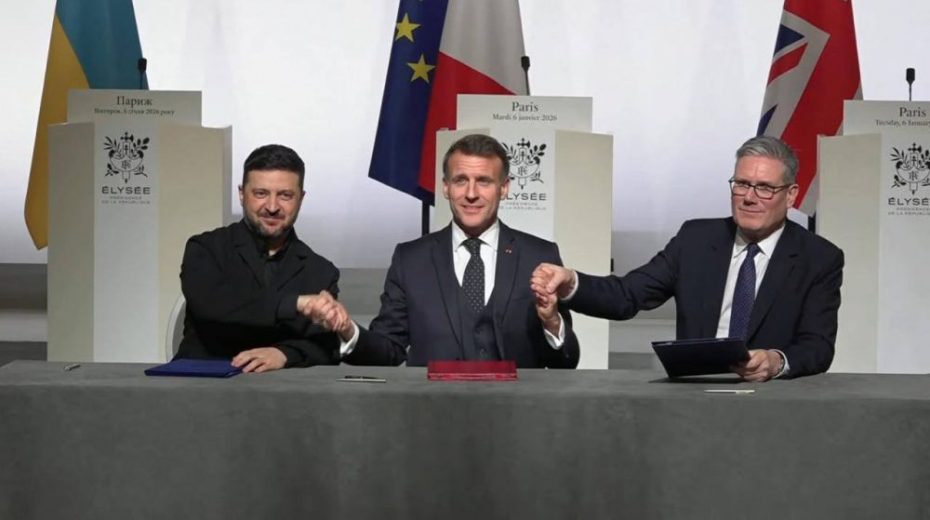
Britain and France recently renewed their proposal to deploy troops to Ukraine, contingent upon a peace arrangement between the United States and Russia. Kier Starmer and French President Emmanuel Macron released a “joint declaration” committing to such a deployment.
Russia reiterated its position that any deployment of foreign troops would be interpreted as a NATO incursion disguised as peacekeepers, labeling British and French forces as “legitimate targets.”
Both London and Paris are engaging in bluffing tactics. They understand that their talk of a “coalition of the willing” is mere rhetoric that far exceeds the military capabilities of either nation. This explains why they have been diligently seeking the Trump administration’s commitment to guarantee their security should a clash with Russia arise.
David Lammy, Britain’s deputy prime minister, visited Washington this week to negotiate US security assurances with Vice President JD Vance. Previously, the Trump administration had been reluctant to offer such guarantees, wary of escalating tensions with Russia.
Yet, Trump appears to be warming to the idea of an American security backstop, which is also what the Kiev government and various European leaders have persistently requested.
Trump’s hostility toward Venezuela is broadening internationally, with U.S. naval forces intercepting oil tankers destined for Russia and China. Additionally, the president recently gave his support to Congressional legislation enacting stringent new sanctions on Russia.
It seems Trump is taking a harder line against Moscow as leverage to secure his sought-after peace agreement in Ukraine. This explains his administration’s growing favor for the British-French proposal of providing security guarantees for European troops in Ukraine.
The British—renowned for their Perfidious Albion reputation—seem to be currying favor with Trump.
When US forces seized a Russian-flagged oil tanker in the North Atlantic, they received support from the British air force and navy.
The BBC noted: “A Downing Street spokesperson said Prime Minister Sir Keir Starmer discussed the joint operation, as well as recent talks on Ukraine and the U.S. operation in Venezuela, in a phone call with President Trump on Wednesday evening.”
Washington expressed gratitude to London for their cooperation in what Moscow decried as piracy on international waters. The British, predictably, upheld American claims asserting the legal right to confiscate a ship sanctioned unilaterally by Washington.
Starmer also refrained from denouncing Trump’s recent military action in Venezuela or the arrest of its president, Nicolas Maduro, who was presented in a New York court shackled in leg irons, reminiscent of a medieval trial.
Further British sycophancy emerged when a former British ambassador to the US endorsed Trump’s ambitions to annex Greenland. Peter Mandelson, writing in The Spectator, lauded Trump for “bringing Maduro to face justice,” and for his efforts to secure Greenland against Russia and China. Mandelson dismissed Danish and European protests against Trump’s Greenland plans as “impotent histrionics.”
Trump’s outspoken remarks about taking over Greenland—with potential military force if necessary—have unsettled Europe’s NATO allies, especially Denmark, which claims sovereignty over Greenland. Danish Prime Minister Mette Frederiksen warned that annexation of the resource-rich island would spell NATO’s demise. Mandelson’s point is partially correct: European complaints are loud but ineffectual.
Nonetheless, Britain can play a strategic role in helping Washington neutralize European resistance to Trump’s Greenland claims. This aligns with London’s traditional function as America’s enforcer, smoothing the imposition of US policies on European partners.
By negotiating Greenland’s transfer to the US, London employs its famed rhetorical and legal maneuvering, regardless of the wishes of Greenland’s people.
Behind this lies Britain’s true motive: to persuade Trump to back their “peacekeeping mission” in Ukraine with assurances of security.
Since France shares Britain’s eagerness to secure this favor from Washington, it will be telling to observe Macron’s stance on American claims over Greenland. Likely, European sovereignty and Danish national pride will be dismissed in favor of encouraging greater US military engagement in Ukraine.
Britain and France, along with other European nations, are desperate for escalation against Russia in Ukraine. Having invested substantial political and financial resources into the ultimately futile attempt to subdue Russia strategically, they cannot endure defeat. Although they profess a desire to bring peace to Ukraine, their actual aim is to intensify the conflict. To achieve this, they require US participation under the pretext of security guarantees.
Offering Greenland to appease Trump’s ego could be their means to secure the US military doubling down in Ukraine.
Whenever Britain flatters, a Perfidious Albion scheme is likely underway.
About the Author