From the Forever Wars to the Cataclysmic Wars
In military history, Donald Trump will likely be remembered for his determination to end America’s involvement in the “forever wars” of the twenty-first century.
Donald Trump’s military legacy is often framed around his focus on withdrawing U.S. forces from the protracted and exhausting conflicts initiated under Presidents Bush and Obama in Afghanistan, Iraq, Syria, and Somalia. As a candidate, Trump promised to bring American troops back from these interminable battlefields, and near the end of his presidency, he pledged to make significant progress on that goal. This issue, despite criticism from generals and officials who opposed such moves within his administration, won him praise from isolationist supporters and attracted media attention. Yet this narrow focus conceals a much larger transformation in America’s military posture under Trump: the shift from a counterterror mission to preparing the armed forces for large-scale, potentially nuclear, conflict with China and/or Russia.
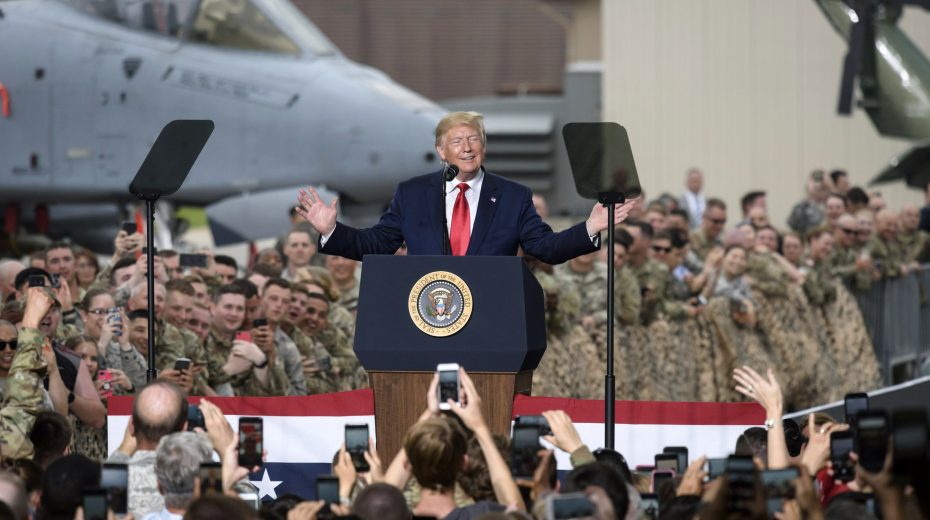
Trump’s military policy was characterized by a dual approach. While criticizing his predecessors for perpetuating endless counterinsurgency conflicts, he also lamented the decline of the traditional armed forces and vowed to invest heavily in restoring their strength. During a 2016 campaign speech on national security, he promised to “reverse” military priorities by pulling out of “endless wars” and rebuilding “our unquestioned military strength.”
Once in the White House, Trump put this plan into motion, directing his national security team—several advisers and defense secretaries—to begin reducing troop levels in Iraq and Afghanistan (though he briefly authorized a troop increase in Afghanistan) while steadily boosting defense budgets. Pentagon spending grew annually from $580 billion at the start of his administration in 2016 up to $713 billion by 2020, largely allocated to acquiring advanced weapon systems. Significant funds were also added in the Department of Energy’s budget for expanding and modernizing the nation’s nuclear weapons arsenal and infrastructure through a full-scale “modernization” process.
More consequential than the rise in military expenditures was the strategic pivot accompanying it. The Obama-era military focus on the Global War on Terror (GWOT)—a prolonged effort to hunt down terror networks across Asia, Africa, and the Middle East—gave way to an emphasis on future “high-end” warfare directly against China and Russia. The military approach being handed to Joe Biden centers on defeating these great powers, employing sophisticated conventional arms on an enormous scale, with the distinct possibility of nuclear escalation.
From the GWOT to the GPC
The transformation from counterterrorism operations to the so-called “great power competition” (GPC) represents a profound change in U.S. military doctrine. Where GWOT involved deploying small infantry teams and Special Operations units backed by reconnaissance aircraft and drones, the GPC envisions massive deployments including multiple aircraft carriers, fighter jets, nuclear-capable bombers, and armored brigades. During the GWOT, adversaries typically wielded light weapons and improvised explosives; in contrast, future conflict with China or Russia is expected to pit U.S. forces against enemies equipped with cutting-edge tanks, aircraft, missiles, naval vessels, and full nuclear arsenals.
This new strategic orientation was formally established in the Pentagon’s February 2018 National Security Strategy, which highlighted “the reemergence of long-term, strategic competition” from so-called revisionist powers—code for China and Russia—with emphasis added by rare italics to underline its importance as stated.
For the Department of Defense and its services, this meant a dramatic realignment: most efforts would now focus on preparing to outmatch China and Russia in intense warfare. Secretary of Defense Jim Mattis testified before the Senate Armed Services Committee in April 2018 that while counterterrorism would continue, the primary national security priority had shifted to strategic competition as he explained.
Mattis stressed that American forces required extensive upgrades to maintain combat effectiveness against well-armed foes. “Our competitive edge has eroded in every domain of warfare,” he said, citing the toll of continuous combat and rapid technological change. Modernizing weapon systems was essential to preserve U.S. superiority, necessitating accelerated and sustained funding.
His testimony outlined priorities now guiding military procurement: upgrading the nuclear arsenal and command-control systems; expanding the Navy’s fleet with many new surface ships and submarines; rapidly modernizing the Air Force’s combat aircraft; and investing heavily in emerging technologies such as artificial intelligence, robotics, hypersonics, and cyber warfare.
These initiatives are now firmly embedded in Pentagon budgets and priorities. For instance, in February 2020, the FY 2021 budget proposal explicitly supported implementing the National Defense Strategy, emphasizing resource shifts to prepare for potential high-level conflict as documented. This grim outlook marks the military framework Trump leaves for Biden.
The Navy in the Lead
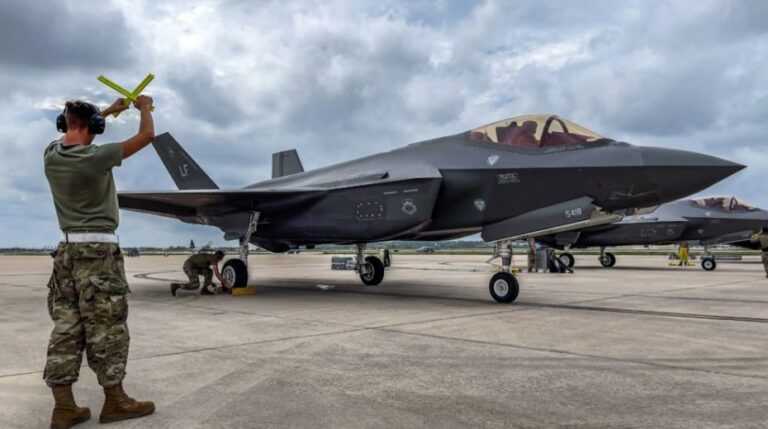
From the outset, Trump prioritized Navy expansion. Highlighting the decline in fleet size from 592 ships during Ronald Reagan’s presidency to just 276 today, he vowed in 2016 to revive America’s naval power. “We will build a Navy of 350 surface ships and submarines,” he promised. After taking office, this goal was elevated to 355 ships and became a consistent theme.
Trump’s enthusiasm for a large Navy was partly inspired by the impressive presence of modern warships, especially aircraft carriers that deploy numerous combat aircraft. During a 2017 visit to the USS Gerald R. Ford, he described carriers as the “centerpiece of American military might overseas,” calling the ship “four-and-a-half acres of combat power” unmatched anywhere.
The Pentagon’s top officials welcomed this naval buildup with enthusiasm, largely because they consider China their chief rival and foresee any future Pacific conflict as a naval confrontation. Controlling the seas near Asia is seen as essential to challenge China’s growing coastal defense capabilities effectively.
Then-Secretary of Defense Mark T. Esper underscored this viewpoint in a September speech, labeling Beijing the Pentagon’s “top strategic competitor” and naming the Indo-Pacific the “priority theater.” He pointed to escalating Chinese military actions as provocations requiring the U.S. to be prepared to deter and, if necessary, prevail at sea as he noted.
Esper acknowledged the U.S. Navy’s current dominance over China’s, yet warned the need to maintain that margin by continually constructing new advanced ships. Although Trump dismissed Esper in late 2020 for opposing rapid troop withdrawals, Esper’s vision of confronting China from the Pacific remains deeply rooted in Pentagon strategy. Billions have already been allocated toward shipbuilding programs ensuring this legacy will endure for years ahead as reported.
Do Like Patton: Strike Deep, Strike Hard
Trump rarely elaborated on plans for ground forces during his 2016 campaign, aside from advocating for larger, better-equipped troops. Yet he openly expressed admiration for WWII generals known for their aggressiveness, telling the New York Times in March 2016, “I was a fan of Douglas MacArthur. I was a fan of George Patton. If we had Douglas MacArthur today or if we had George Patton today and if we had a president that would let them do their thing you wouldn’t have ISIS, okay?”
His respect for General Patton takes on special relevance amid escalating great-power competition, as U.S. and NATO forces prepare to encounter well-equipped armies in Europe reminiscent of WWII. During that war, Patton’s tank divisions confronted Germany’s armor on the Western Front; today, NATO faces Russia’s best mechanized forces along a frontline stretching from the Baltics and Poland down to Romania. A conflict with Russia would likely entail intense direct combat between large units along this corridor.
Since the Soviet Union fell in 1991, U.S. military doctrine had largely neglected planning for high-intensity land warfare against a powerful European adversary. Now, with rising East-West tensions and the prospect of renewed land battles, these considerations have regained importance.
However, modern strategists envision a far more complex battlefield than the Cold War’s grinding engagements. Rather than fighting solely across land frontlines, current doctrine emphasizes “multi-domain” warfare extending into air, rear, space, and cyber realms. Victory depends on rapid, crippling strikes against the enemy’s C3I (command, control, communications, and intelligence) capabilities within hours or days, clearing the way for armored forces to penetrate deeply and deliver decisive force in true Patton fashion as explained.
The U.S. military describes this concept as “all-domain warfare,” imagining dominance in space, cyberspace, airspace, and the electromagnetic spectrum. In conflict with Russian forces in Europe, the air component would seek to control the skies and destroy Russian radar, missile sites, and C3I nodes through missile strikes. The Army would complement this with long-range artillery and ballistic missiles based on plans. Only after neutralizing Russian defenses would ground troops launch an offensive synchronized with air and missile attacks in the Patton tradition.
Be Prepared to Fight with Nukes
Senior Pentagon planners anticipate that future wars against China or Russia would involve fierce combat across land, sea, and air, aiming to obliterate critical enemy military assets early to facilitate rapid invasions. This strategy depends on having superior weaponry and technology. Without such an advantage, Chinese and Russian strategists may consider nuclear response options in the face of large-scale American offensives.
Some Western analysts interpret Russian military writings as indicating growing reliance on “tactical” nuclear weapons intended to destroy overwhelming U.S./NATO forces preemptively, preventing invasions—similar to Cold War-era U.S. reliance on such arms to deter Soviet advances in Europe have noted. Russian military publications have explored this so-called “escalate to de-escalate” doctrine—despite official Russian authorities never publicly addressing it as indicated and noted. The Trump administration pointed to this literature to justify development of analogous American tactical nuclear weapons.
The 2018 Nuclear Posture Review stated, “Russian strategy and doctrine… mistakenly assesses that the threat of nuclear escalation or actual first use of nuclear weapons would serve to ‘de-escalate’ a conflict on terms favorable to Russia.” To counter any Russian miscalculations, the review emphasized the need for varied, limited nuclear options, including different delivery methods and warhead yields. Accordingly, it recommended two new nuclear weapon categories: a “low-yield” warhead capable of devastating a Manhattan-sized target without destroying all of New York City, fitted to Trident submarine-launched ballistic missiles, and a new nuclear-armed sea-launched cruise missile.
Many of these initiatives will be hard for the Biden administration to unwind. For instance, the first batch of W76-2 low-yield warheads has already been manufactured, deployed on Trident subs, and operational. Though a future president could retire these weapons, such a decision would run counter to military leadership preferences. More difficult still would be reversing the strategic worldview that considers tactical nuclear weapons as routine weapons of war in great-power conflicts—an approach deeply internalized during the Trump years.
Amid intense debate about withdrawing troops from conflict zones and abrupt changes in Pentagon civilian leadership, Trump’s most consequential military legacy—the one with the potential to usher in not another “forever war” but a “forever disaster”—has largely escaped attention in media and political discussions in Washington.
Advocates within the Biden administration and some close advisers have proposed ambitious visions for reshaping U.S. military policy, including scaling back the military’s role in diplomacy and redirecting portions of defense funding toward issues like pandemic response. These ideas deserve support. However, President Biden’s foremost military challenge will be confronting the true Trump military legacy—the one that has steered the U.S. toward confrontation with China and Russia—and working to redirect the country onto a less perilous path. Failing to do so risks giving “forever war” a far more ominous meaning.
Original article: tomdispatch.com
About the Author