
HALO: The Great Rotation Has Begun
Over the last decade and a half, investors have heavily favored “capital light” stocks.
Software perfectly exemplifies this trend. It gained appeal since, after developing a software product, onboarding additional users requires minimal expense.
There is no physical cost involved in distributing new software licenses nowadays, as everything operates through the cloud.
Once a software company gains momentum, it can generate substantial recurring revenue and profits. However, investor enthusiasm pushed valuations to inflated levels.
At the same time, firms with capital-intensive operations—such as major oil companies, railroads, and gold miners—were often dismissed as relics.
However, the situation has now reversed.
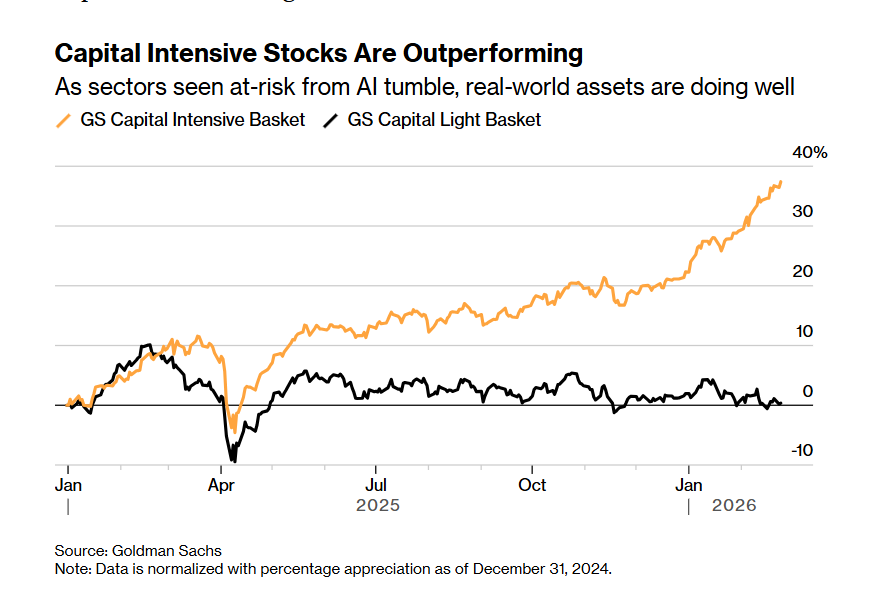
Asset-light companies are increasingly viewed as vulnerable to AI-driven disruption and overpriced.
This shift is evident in the ongoing software sector downturn. Even dominant players like Microsoft have fallen 27% from their peak.
Many smaller software-as-a-service (SaaS) firms have been hit much harder. Monday.com (MNDY), once a star performer, has dropped 75% over the year, and Figma (FIG) has slid 78%. Numerous similar cases exist.
A HALO Around Hard Assets
Conversely, capital-demanding enterprises are gaining attention. Companies owning extensive mines, oil fields, and refineries have seen significant appreciation over the past year.
A newly coined term captures this change: HALO, representing Heavy Asset Low Obsolescence. It focuses on businesses unlikely to be disrupted by AI and poised to withstand inflationary pressures.
Refer to the chart below from Bloomberg and Goldman Sachs showing Goldman’s “capital intensive” index outperforming the “capital light” index by nearly 40%.
These assets are costly and often impossible to duplicate. Utilities, which supply electricity, exemplify this trend.
Constructing new power plants and expanding grid infrastructure is highly challenging. New facilities face community opposition, which drives up the value of existing assets.
Utilities currently trade near historic highs, fueled by booming demand due to data centers. The scarcity of new competitors further boosts their profitability.
Although additional power sources will eventually be developed in the U.S., it will be a lengthy process, with AI data centers likely to absorb much of the new capacity.
Miners, Drillers, and EM
While utilities offer a path to benefit from the HALO theme, government intervention on their profits is a possible risk.
Electricity prices have soared due to the surge in data center demand, potentially provoking regulatory scrutiny. Though higher prices for big tech might be part of the solution, authorities could clamp down on utility earnings.
Therefore, our emphasis remains chiefly on miners, drillers, and undervalued emerging market equities.
These sectors have experienced long-term underinvestment, but the tide is turning in their favor.
Acronyms Drive Capital
Recall the BRICS rush? Or the excitement around FAANG stocks?
Such acronyms encapsulate compelling themes that attract investor capital.
Although HALO may appear as just another catchy term, it marks a notable recognition by Wall Street of a transition Paradigm has highlighted over recent years.
Investment is shifting away from soft tech toward physical assets. Investors now seek the stability that significant mines, factories, oil fields, and tangible holdings provide.
The rise of AI presents distinctive challenges for tech companies. Building custom software has become remarkably straightforward with AI tools. While some immediate concerns might be exaggerated, substantial long-term disruption seems inevitable.
Should AI frameworks like Anthropic’s Claude continue advancing, firms could increasingly develop internal solutions that render many existing software products redundant.
This AI-driven upheaval coincides with the likely onset of inflationary pressures and a renewed commodity cycle.
Hence, gaining exposure to natural resources and HALO assets is essential for investors.
This trend appears poised to endure for years, with capital migrating from high-margin software to resource-rich companies. These firms typically generate substantial revenues, maintain narrower margins, and possess valuable physical assets.
They face minimal threat from rapid AI advancements and stand to prosper if inflation intensifies.
In the weeks and months ahead, we aim to share investment ideas designed to prepare your portfolio for this evolving landscape.
About the Author