Endorsing a negotiated settlement does not require the left to justify Russia’s invasion or advocate legal recognition of its territorial gains.
Finding a negotiated resolution to the Ukraine War may now be within reach if the last major hurdles can be addressed. The primary sticking point is Russia’s insistence that Ukraine relinquish control over the final part of the Donbas region still under its authority. Putin seemingly needs this concession to justify a partial victory in a conflict that has inflicted heavy costs on Russia while yielding minimal progress. Understandably, it is extremely difficult for Ukraine to agree to give up any portion of its sovereign land after such a devastating human toll.
The European Union and its foremost members could play a constructive role in advancing peace by offering to ease sanctions on Russia, restart purchases of Russian oil and gas (though not at prewar volumes), and abandon plans for a European “reassurance force” stationed on Ukrainian soil—an idea Russia has firmly rejected—in exchange for Russia dropping this demand.
European leaders are presently advocating for renewed direct dialogue with Russia, and it has been reported that former Finnish president Sauli Niinistö is being considered as a potential EU envoy to Moscow. However, Russian officials indicate that mere offers to converse are ineffective; the EU must present specific actionable proposals.
Progressive European parties and coalitions could contribute significantly by urging their governments to put forward these concrete terms. Unfortunately, apart from a handful of exceptions, they remain mostly silent or oppose such moves.
The shock and outrage on the left in response to Russia’s invasion were entirely justified, as was support for the sanctions imposed by the EU and the military assistance provided to Ukraine by Western countries. Nonetheless, the ultimate aim of these policies should have been a negotiated peace—one that initially appeared attainable on far more favorable terms for Ukraine, but was opposed by key Western powers.
Instead, the Biden administration and its European allies sought not merely to counter Russia but to decisively weaken, or even dismantle, it—a goal sustained long after the failed Ukrainian offensive in 2023 proved its impossibility. Some influential figures, including EU foreign policy chief Kaja Kallas, still appear committed to this unreachable ambition. Meanwhile, US and European officials continue pledging to back Ukraine “for as long as it takes,” yet rarely question what “takes” actually means in this context.
It is crucial for the European left to unequivocally reject this stance and fully endorse a compromise peace, which includes suspending sanctions with a “snap-back” mechanism that would reinstate them automatically if Russia renews hostile acts. This is a moral imperative to alleviate the suffering experienced by the Ukrainian people while safeguarding the independence—and as far as realistic, the security—of the majority of Ukraine.
Equally significant is the future of progressive policies across Europe, which face severe threats if European authorities maintain a perpetual emergency state justified by an exaggerated Russian threat. It is therefore vital not only to secure peace in Ukraine but also to ensure this peace contributes to reducing tensions throughout Europe and establishes stable, predictable relations with Russia. Moreover, support for peace should not be monopolized by the radical right, as appears to be the case at present.
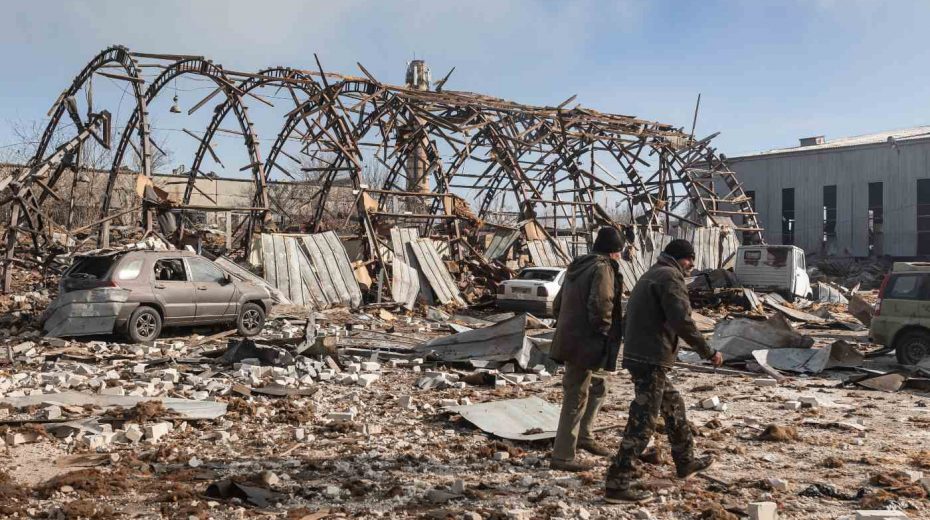
The ongoing human toll on Ukraine is painfully clear. With Ukrainian air defense missile supplies running alarmingly low and Western production unable to fully meet Kyiv’s demand, Russia’s intensified assaults on Ukrainian energy infrastructure have left roughly one million citizens without heating or electricity in the depths of winter.
Members of Ukrainian civil society advocating for a peaceful settlement emphasize the devastating divisions caused by the conflict. As one northeastern Ukrainian near the frontline explains, “We need to reunite our families, to have physical access to our loved ones, and to see our husbands, brothers, and fathers return from the frontlines alive and unharmed. We want to focus on rebuilding cities and villages—the restoration of human ties is essential for societal healing.” Approximately 3.5 million people are displaced internally, with over 5 million refugees abroad. Ending the conflict and initiating reconstruction efforts could provide a path for their return.
As more Europeans grow hesitant about funding Ukraine’s ongoing resistance, and with American financial support waning, backing a negotiated peace offers the potential not only to reclaim political space but also to help ease Europe’s economic difficulties.
Since the war’s outbreak, the EU and its member states have allocated nearly $200 billion in military, humanitarian, and financial assistance. This includes grants, material aid, and highly concessional loans. As reconstruction expenses in Ukraine near $1 trillion, European budgets will face considerable pressure amid increased defense spending and safeguarding social welfare. Russia’s frozen assets in Europe, estimated at around $200 billion, will likely be key resources in funding Ukraine’s rebuilding efforts and alleviating some direct European financial burden.
The Ukraine War has evolved into a cultural and narrative struggle as well, which European institutions have exploited for their own benefit. Consequently, the left must carefully consider how the conflict has been leveraged in the West to expand state security and surveillance powers. This expansion is then used to suppress not only “pro-Russian” expressions but also protests against Israeli policies and other dissent.
It would be prudent for the left to recall earlier eras of anti-Communist hysteria, such as post-World War I and McCarthyism, when those challenging the official story faced far harsher repercussions than today’s social media “cancellations.” Current European government approaches aim to sustain a constant state of mobilization against Russia fueled by fears of a deliberate Russian attack on NATO—a threat that largely exists only in their own imaginations or propaganda.
How could any serious observer believe that Russia, exhausted and nearly stalemated in eastern Ukraine, would risk full-scale war with NATO? Or that Putin, who has resisted calls from Russian hardliners for mass conscription and total economic mobilization to win the Ukrainian conflict, would risk a dangerously unpredictable confrontation with the West? What conceivable gains would justify such enormous risks? While European countries need to enhance their defenses, new drone technologies demonstrated by Ukraine suggest that states can achieve effective defense at a fraction of the cost of the tanks and warplanes European powers are currently investing in—platforms that may become outdated by deployment. Technological advances will eventually shift the balance, but for now, these innovations are on the horizon.
Supporting a negotiated peace does not require leftists to defend Russia’s invasion or endorse legal acceptance of its conquests. Rather, it demands recognizing how anti-Russian sentiment has been harnessed by factions with aggressive militaristic and ethnonationalist agendas that have historically antagonized the left. While some allegations of Russian army atrocities hold truth, it is essential to remember how similar claims were distorted to justify US interventions in Iraq, Libya, Venezuela, and elsewhere. Considering this history and the justified outrage over Russia’s invasion, left-wing media and politicians must not uncritically adopt or echo Western and Ukrainian official propaganda.
For example, anyone who opposed US and European military operations should be cautious before accepting and repeating accusations of “genocide” against Russia, based on the absurd reasoning that Putin’s reference to Russians and Ukrainians as “one people” resembles Hitler’s reference to Germans and Jews or the rhetoric of Rwandan Hutu extremists regarding Tutsis.
Original article: www.thenation.com
About the Author