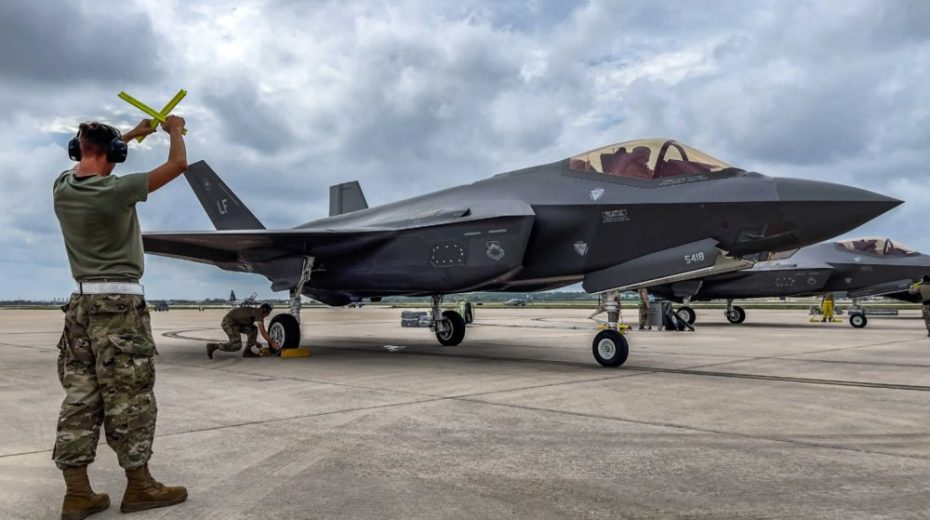
Fewer sorties and flight hours delay maintenance, concealing performance deficiencies and reducing valuable pilot flight time
Is the military effectively coddling the F-35 to mask its actual expenses while continuing to receive substantial taxpayer funding for an aircraft that repeatedly falls short of its performance promises?
Since its inception, the F-35 program has been burdened by cost overruns totaling hundreds of billions of dollars and persistent delays in the schedule.
Furthermore, despite capability promises being postponed by more than ten years, billions spent on repairs have failed to fix persistent reliability challenges, severely impairing operational capacity and driving program costs beyond $2 trillion dollars — an amount four times greater in inflation-adjusted dollars compared to the 2007 Government Accountability Office estimate.
The aircraft’s pronounced unreliability has led to full mission capable rates (FMC) of just 36.4%, 14.9%, and 19.2% for the F-35A, F-35B, and F-35C respectively. Only the newest F-35Bs and F-35Cs achieve full mission availability exceeding 10%, according to recent data.
Unsurprisingly, neither the services nor Lockheed Martin emphasizes FMC; instead, they highlight mission-capable (MC) rates around 50%. Although this figure is significantly lower than the 90 percent promised by Lockheed Martin and its partners, it sounds more favorable than the poor FMC metrics. However, MC is misleading because “mission capable” only requires readiness for non-combat roles like training or transport.
Still, the misleading use of MC rates only partly explains how limited taxpayers’ returns are on their investment.
Combined circumstantial evidence, emerging data, and the military’s historical reluctance to acknowledge issues with major projects suggest that both the U.S. military services and Lockheed Martin have been cautiously handling the F-35 to mask how costly and unreliable it would be if it were not kept meticulously managed.
This careful nurturing reduces some expenses now but defers other costs, keeping annual expenditures artificially low. This strategy paints a picture of greater efficiency, aiding efforts to sell and deliver more aircraft while lowering the chance the program faces cancellation or substantial cuts.
Key maintenance cost drivers
Three primary elements contribute to wear and tear on an aircraft like the F-35: the number of missions flown (sorties), accumulated flight hours, and how aggressively it is operated during flights.
Sortie count is the strongest maintenance cost indicator. Though flight hours often dominate discussions of aircraft age and upkeep, research shows sorties better predict aircraft wear because each sortie involves takeoff and landing stresses plus engine thermal cycles, which chiefly cause engine degradation.
While airborne, an aircraft experiences minimal deterioration unless subjected to intense maneuvering or high engine loads. Therefore, for the same number of flight hours, fewer but longer sorties cause less damage than numerous short sorties—for example, 100 two-hour flights versus 200 one-hour flights.
Flight hours influence maintenance expenses. More hours generally mean more upkeep, though sorties better anticipate maintenance needs. Reducing total flight hours lowers absolute maintenance costs. For context, older fighters like the F-16 regularly logged 250–350 hours annually at peak, while F-35s average only about 195 hours per year—well below the original targets of 250–316 hours.
Notably, the June 2025 Congressional Budget Office determined that F-35 availability and flight hours are “lower, in some cases much lower, than those of other fighter aircraft of the same age.” Even legacy fighters like F-16s and F-15s, despite being 17 years old, outperform new F-35s in mission readiness while flying more hours annually.
Data shows annual flight hours for the F-35A and F-35B have decreased significantly during their first seven years. This means newer jets are flown less than the newest deliveries, resulting in less routine wear and deferring expensive equipment replacements like engine overhauls—even while fresh F-35s are continuously procured under what some, myself included, recognize as misleading cost indicators.
Besides deferring expenses, fewer flight hours also translate into lost in-flight training “stick time.” Although simulators provide some benefit, nothing matches actual flight experience under real conditions. Regrettably, due to maintenance challenges and operational costs, F-35 pilots receive insufficient stick time to develop peak skills.
Operational handling during missions affects maintenance significantly. The military typically does not disclose how aggressively these jets are flown during sorties. Pushing aircraft components to their limits, compared with a gentler approach, greatly affects required maintenance. Operational security limits the information on pilot and plane restrictions, but it’s known that the F-35B and F-35C face strict constraints regarding supersonic flight frequency and duration, due to damage to stealth coatings and possibly structural components.
F-35 upgrades delay expensive engine maintenance. The program pursued concurrency—producing and deploying aircraft before completing final designs—at an unprecedented scale. This led to numerous retrofits and hardware changes for early production jets, each typically requiring over a year offline. While grounded, aircraft neither contribute to sortie counts nor suffer engine wear, effectively postponing costly overhauls.
Summary
Imagine a freshly delivered F-35A assigned initially to training units, generating many short sorties under 1.5 hours while accumulating more than 200 flight hours annually. Later, it shifts to an operational squadron, completing fewer but longer sorties, keeping flight hours sufficient to maintain fleet averages. Flying fewer missions reduces monthly wear and associated maintenance for the engine.
By years five and six, the jet undergoes substantial refits totaling 12 months out of service. Although it doesn’t add to flight hours or sorties during this downtime, it also avoids wear, effectively deferring costly engine maintenance by about a year. This tactic of shifting expenses enhances the program’s financial appearance. By year eight, the aircraft flies just over 150 hours per year, with the Air Force relying on newer jets to sustain fleet averages.
This careful management cuts maintenance expenses since fewer sorties and hours are flown but pushes significant costs into the future, depending on newly delivered planes to keep performance averages high. When deliveries cease, pilots will likely fly fewer hours and sorties to avoid skyrocketing costs.
While direct proof is lacking, the signs are clear…
Due to valid operational security constraints, militaries do not fully disclose the micromanagement of F-35 sortie counts and flight hours or detail operational limitations placed on pilots. However, the 2024 CBO report raised the estimated overall sustainment expenses of the F-35 program from $1.1 trillion to $1.58 trillion, while noting a 21% reduction in flight hours going forward linked to ongoing reliability challenges.
This aligns perfectly with the described cost-shifting pattern. Additionally, savvy adversaries like China and Russia have undoubtedly reviewed this data carefully, likely concluding the F-35 cannot sustain high-tempo operations over extended periods against peer competitors who will dictate conflict timing and tempo—unlike less advanced opponents such as Venezuela and Iran.
This fragility also shortchanges pilot skill development compared to what could be expected from a more dependable fighter jet.
By micromanaging the F-35 fleet, the true extent of its deficiencies is hidden, preserving continued investment in a program that consumes vast resources at the expense of potentially more effective options. It is time to stop wallowing in sunk cost emotionalism and halt procurement of aircraft whose reliability and expenses compromise national security.
Original article: responsiblestatecraft.org
About the Author