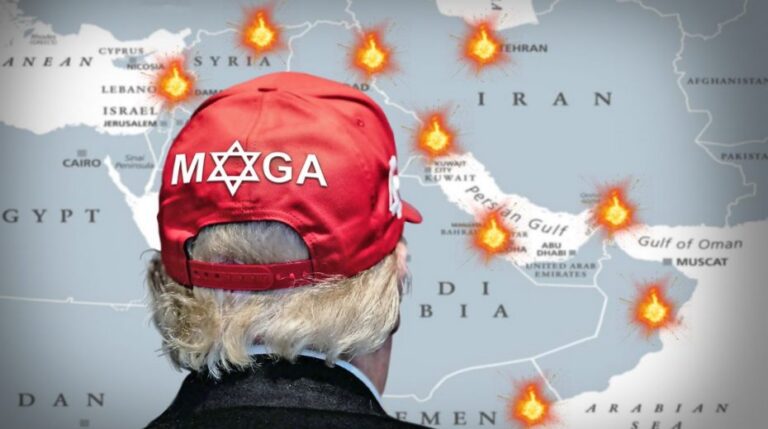
The primary aim of the U.S.-Israeli conflict is to establish Israeli dominance throughout West Asia.
The U.S.-Israeli war primordially is being waged to create Israeli hegemony across West Asia.
From one perspective, this confrontation is a life-or-death fight involving Iranian missile and interception systems clashing with those of the U.S. and Israel.
The prevailing assumption has been straightforward: Iran would be outgunned by superior U.S. technology and firepower, inevitably leading to its surrender.
It was expected that Iran’s military defeat and the elimination of its leadership would spark a grassroots backlash, eventually destabilizing the Iranian State and pushing it back into Western influence.
Yet, as the conflict reaches its fourth day, Iran remains firmly in control. Rather than collapsing, the Iranian State is inflicting damage with drone and missile attacks on American forces stationed throughout the Gulf, while deploying hypersonic missiles equipped with multiple maneuverable warheads against Israel for the first time.
Currently, Iran is close to completely depleting interceptor resources in the Gulf and has also significantly battered the faltering air defense systems of Israel and the U.S. by initially targeting older missiles and drones which exhaust these defenses. Iranian missiles traveling at speeds exceeding Mach Four are largely evading Israeli countermeasures.
The targeted killing of the Supreme Leader, orchestrated by U.S. intelligence, has backfired severely. Instead of breaking morale, it triggered widespread support for the Islamic Republic. Unexpectedly for Washington, it also galvanized Shi’a populations across the region, provoking jihadist calls for vengeance following the death of the respected Shi’a cleric. Both Washington and Tel Aviv misjudged the situation profoundly.
In summary, Iran demonstrates strong resilience and remains steadfast in a long-term confrontation with the U.S., which initially counted on a swift, low-commitment conflict largely driven by limited ammunition. Meanwhile, Gulf monarchies are destabilized, the Gulf’s reputation as a hub of wealth, advanced technology, and tourism appears to be eroding, and Israel faces an uncertain future.
The broader geopolitical impact extends well beyond Iran and neighboring Gulf States. Iran’s selective shutdown of the Hormuz Strait and its wider campaign against ports in the Gulf reveal deeper strategic motives.
For instance, Iran’s focus on crippling the U.S. Fifth Fleet’s facilities at Bahrain is particularly critical. The Fifth Fleet underpins U.S. dominance in the region, as explained here:
“Approximately 90% of the world’s oil trade passes through these areas, and U.S. control guarantees the linked energy supply chains. The fleet also covers three vital strategic chokepoints: the Strait of Hormuz, the Suez Canal, and the Bab al-Mandeb Strait. And its HQ is not just a port. It’s a comprehensive radar, intelligence and database centre”.
Iran has managed to disable radar installations and severely damage much of Bahrain’s port infrastructure, steadily pushing U.S. forces out of the Gulf region.
This conflict is not merely intended to add Iranian energy resources to the American energy portfolio in a manner similar to Venezuela’s case, especially since Iran accounted for only about 13.4% of China’s seaborne oil imports last year—far from a decisive share.
More broadly, the war centers on a larger U.S. strategic goal: dominating critical chokepoints and energy transit routes to restrict China’s access to vital energy markets and thereby slow its economic expansion.
The Trump National Security Strategy (NSS) defined a U.S. objective to “rebalanc[ing] China’s economy towards household consumption”.
This phrase essentially signals America’s aim to compel China to reduce exports and increase imports by restructuring its economy to rely more on internal consumption. The goal is to reclaim U.S. dominance in global exports over China’s aggressively priced and competitive products.
Achieving this shift might involve trade wars and tariffs, but equally key is limiting China’s access to energy resources critical for growth throughout the BRICS group. The NSS hints at this strategy through tactics such as naval blockades, sieges, and seizure or sanctioning of vessels, as seen in the standoff involving Venezuela.
In essence, Iran’s attacks in the Gulf appear intended first to warn Gulf states against siding with Israel and the U.S. against Iran, signaling that such an alignment is no longer tolerable. At the same time, Iran seeks to wrest control of vital maritime chokepoints, ports, and naval passages previously held by the U.S., bringing them under its own dominion.
In short, Iran aims to command the shipping lanes adjacent to the Persian Gulf—a development that would carry enormous significance, not only for Iran-China relations but also for Russia, which depends on open sea export routes.
Should Iran succeed in this monumental confrontation with Israel and the Trump Administration, the consequences would be far-reaching. Even limited closures of the Hormuz Strait over several months could severely disrupt European gas supplies and potentially spark a crisis in the debt markets.
Additionally, the collapse of the Gulf’s status as a secure investment zone would likely lead to a depreciation of the dollar as investors seek safer alternatives elsewhere.
The U.S.’s Trump Route for International Peace and Prosperity across the South Caucasus will probably collapse, encouraging India to revert to — and maintain — its reliance on Russian oil imports, thereby affecting its relationship with Israel.
Beyond the geopolitical reshaping triggered by this war, the international financial order is also poised for substantial transformation.
About the Author