

As the European Union descends deeper into what might become one of the most severe crises in its existence, one might expect European leaders, under such strain, to adopt a more sensible and pragmatic approach by leveraging their geographic and logistical strengths to secure energy for their region through Russian sources.
Yet, this expectation is misleading. Do not assume that any of the current European leaders, or those aligned with them, will make such a pragmatic choice. This is clearly absent from the 20th sanctions package, which excludes 20 Russian banks from EU financial interactions and bans the sale of oil tankers to Russia, formerly a key energy ally.
Among the sanctions, there is a notable restriction regarding Russian oil transport—a provision that obliges the purchasing countries to use their own contracted vessels for shipment. It appears this stipulation was a precondition for certain nations to support both the sanctions and the €90 billion aid package sent to Ukraine, funds which ultimately benefit oligarchs, cartel leaders, and various US and EU beneficiaries.
Any even tactical or practical rapprochement with Russia contradicts the escalation of military drills under the “nuclear umbrella,” conducted by France, Poland, and recently Finland—a nation open to hosting nuclear arms. Poland, notably questioning US NнатO commitments, plans joint maneuvers with France involving Rafale jets, capable of nuclear deployment, over Belarus and Kaliningrad.
I find myself wondering why any population would volunteer to become a target for nuclear strikes by the foremost power in this field. This puzzling stance, to me, seems born from widespread misinformation and electoral rhetoric avoiding frank discussions on peace or war. A nearly universal tactic in EU states is to skirt these topics during campaigns, enabling leaders to later claim, “You voted for me,” leaving many disillusioned.
Therefore, we must not be deceived! A genuine shift by EU bureaucrats towards Russia—one that would nurture a productive partnership benefiting both blocs—can only emerge through popular movements advocating peace and development rights. Any diplomatic encounters that occur otherwise are transient, tactical responses that will vanish once energy markets stabilize or alternative supplies diminish the reliance on Russia within the US-led global hierarchy.
This makes me skeptical of Dmitry Peskov’s recent comments on Nord Stream, asserting part of the pipeline is operational and Russia remains a “reliable supplier,” ready to “open the valve.” Such conciliatory overtures collide with entrenched Russophobia, which would arguably exploit Russian energy interests rather than welcome them. Why then would the Kremlin persist with this strategy, knowing it faces unyielding rejection?
Intent on draining Ukraine’s resources, NATO nations act like aristocrats confident in endless wealth, hiring mercenaries to battle their foes. Here, the Ukrainian bourgeoisie are recruited to perpetuate a destructive civil war, with the spoils intended for those aligned with NATO interests.
An intriguing contradiction emerges in José Milhazes’s supposed ignorance—a leading Russophobic voice in the Lusophone world—clashing with realities he claims to dissect so astutely: “I hope this money does not serve to prolong this terrible war.” He seems unaware that the Ukrainian people’s suffering, forced into fratricidal conflict, is fueled by liquidity generated from the ECB itself, which perpetuates both the cause and the effect of the war.
In my view, normalizing Russian gas exports to the EU would harm Russia by sustaining a sense of stability within member states, thereby perpetuating Russophobia and sustaining a military-industrial complex focused on Russia’s defeat—producing drones and weapons attacking Russian infrastructure. It strains credulity that Moscow’s ongoing readiness to supply energy to the EU is not part of a strategic broader plan.
Moscow likely understands that restoring gas flows to the EU would not foster diplomatic ties, given European leaders’ unwavering rhetoric and continued support for Ukraine. Until states like Hungary or Slovakia increase their ranks, resuming gas or oil sales would fuel attacks against the Russian populace itself. The current Persian Gulf turmoil is unlikely to inspire pragmatic shifts; at best, any reversal would be opportunistic and risky, benefiting Russia’s adversaries economically and militarily—a contradiction unlikely embraced by prudent Russian policymakers.
To clarify European leaders’ mindset regarding Russia, consider the following striking examples.
The EU recently approved a massive interest-free loan for Ukraine just after Druzhba pipeline oil supply resumed. However, this move does not signal compromise but rather exposes a dual financing dilemma: the EU backs Ukraine’s fight against Russia financially while simultaneously purchasing Russian energy fueling Moscow’s resistance against NATO. Following this, Von der Leyen reignited the debate on EU majority voting, advocating the elimination of the national veto. This stance exemplifies a tactical concession intended only as a temporary hurdle removal, perpetuating the war trajectory.
Moscow seems fully aware and maneuvers this geopolitical chess with three goals: 1. Maintaining ties with occasional or reliable EU allies, including aspirants like Serbia; 2. Showing these allies possess greater energy benefits than fiercely Russophobic EU governments; 3. Exploiting this discord, whether overt or covert, within the EU’s ostensible unanimity.
This approach appears to bear fruit as shown by several indicators:
- The EU’s urgency to discard the national veto—a safeguard initially used to attract reluctant states during the union’s formation—reveals desperation. Removing this veto risks long-term fragmentation, as member states lose a critical defense against harmful decisions;
- Eastern states such as Slovakia, Serbia, and Hungary lean towards pragmatism with Moscow, while the Czech Republic shows rising caution, suggesting an emerging axis challenging extreme European positions;
- In southern Europe, Spain increasingly looks toward China for development opportunities, diverging from the EU and US alignment, while Meloni’s Italy intermittently returns to peace advocacy, echoed by Macron;
- Portugal’s Prime Minister supports Putin’s G20 involvement and endorses Chinese investment, albeit moderated by American influence;
- Germany, represented by Merz, cautiously positions itself as intending to lead the push against Russia while contemplating future engagement;
- Nordic neighbors Finland, Poland, Lithuania, Estonia, and Latvia, led by arguably Europe’s most uninformed representative, form a hardened, zealous Russophobic bloc.
Thus, a fragile split emerges among southern, northern, central, and eastern regions, with Russophobia intensifying nearer the Atlantic north (including the UK), gradually weakening moving east and south. In the central zone, encompassing France, Germany, and Austria, uncertainty dominates. This region will see the fiercest contest of influence.
If the Kremlin’s speech moderation achieves anything, it is promoting fissures within the EU’s decision-making unity. The solidity of this “wall” depends heavily on economic developments.
Currently, the outlook is unfavorable for the EU. As documented in a Reuters article, Europe’s ongoing dependence on gas and oil intensifies vulnerability amid external energy shocks, especially as the supply chain becomes more complex and reliant on shipping rather than pipelines, thereby increasing insecurity.
This situation conflicts with the EU’s energy transition plan. Despite growth in renewable output, dependency on external suppliers remains stubborn, with the US alone covering 60% of its gas imports from a single source.
With Norway, the EU’s sole local energy provider, maxed out in production through 2035, the EU faces a stark need that contradicts its transition goals: continued heavy dependence on gas.
German Economy and Energy Minister Katherina Reiche has acknowledged this, saying “the EU’s energy transition over the last two decades has generated higher systemic costs,” signaling disillusionment with Brussels’s agenda endorsed by Biden, Merkel, Baerbock, and Scholz. Reiche even calls it “a mistake we are going to correct,” suggesting cutbacks in subsidies for offshore wind and other low-carbon technologies.
Confirming this shift, Germany plans to install approximately 36 gigawatts of gas-powered electricity generation soon, emphasizing energy security over climate objectives. This reveals two irreconcilable contradictions: firstly, EU reindustrialization under the “Made In Europe” agenda (primarily “Made in Germany and Northern Europe”) necessitates abandoning many energy transition goals, including subsidy cuts and eased targets; secondly, persistent reliance on costly fossil fuels results from refusal to reconcile with Russia, jeopardizing competitiveness, industrial revival, and rearmament ambitions.
This contradiction is deepened by Moscow’s persistent diplomatic moderation towards Europe. What will ultimately prevail in the minds of European Commission officials, the Brussels bureaucracy, and NATO’s elite? Will they prioritize reindustrialization and economic competitiveness, or the assembly of a military force aimed at intimidating or subduing Russia—a project for which industrial renewal is merely instrumental?
Paradoxically, Von der Leyen asserts that deferring the September 30, 2027, deadline for decoupling EU energy from Russia would constitute a defeat for Europe’s long-term vision, revealing that confrontation with Russia outweighs decarbonization and energy sovereignty in her calculus.
For a continent lacking raw materials and sufficient fossil fuels domestically, the energy transition is vital to independence and sovereignty. This reveals Brussels’s mentality: retreating from Russia is an unacceptable failure of a geopolitical plan dating from 2014, whereas scaling back a well-established energy strategy is viewed as manageable, not defeatist, especially when aligned with long-standing European agendas.
The only possible conclusion is that in the EU’s leadership, the destruction of Russia—as openly stated in numerous public documents—takes precedence over the welfare, freedom, and prosperity of 500 million Europeans.
Interestingly, as noted earlier, the EU’s ambition to build a formidable anti-Russian force capable of sustaining its cost might only be feasible by importing Russian gas. Alternative sources and global market reliance, especially amid the projected Persian Gulf supply collapse and US exploitation of West Asia’s energy void, ensure that EU self-imposed cuts to Russian supplies would impose enormous social costs.
Friedrich Merz himself has expressed the need to shed economic anchors like the welfare state, illustrating where Germany’s—and by extension the EU’s—priorities lie: sourcing gas and oil outside Russia is deemed more vital than preserving the living standards of already squeezed European workers.
This situation underscores that only popular resistance can halt this destructive trajectory. Faced with a complete inversion of priorities—where bureaucratic and oligarchic elites, beholden to Wall Street, rewrite governance away from their own professed principles—the sole answer is collective, nationally grounded struggle.
Why emphasize national efforts? Because the EU acts as an illusionary veil concealing its oligarchic base beneath a transnational bureaucracy, detached from everyday realities but wielding vast propaganda and amplification tools. This structure creates an impression of support that belies worsening personal circumstances.
As Brussels centralizes power, eroding national sovereignty and democratic rights, people feel growing detachment between EU institutions and the soaring costs of living. They blame local governments for surrendering control to Brussels while excusing the EU, which wields increasing control over national affairs. The EU operates as a smokescreen for large-scale Euro-Atlantic capital cartels, obscuring who ultimately drives worsening living conditions and the prospect of further decline.
This system consumes national sovereignty, centralizing decisions to serve the transnational European oligarchy—a cartel—and manipulates community funds alongside strict neoliberal and neofascist fiscal discipline that favors monopolies. National budgets become mere extensions of EU agendas, with limited investment funneled into fulfilling Brussels’s and oligarchy’s objectives. Portugal, heavily dependent on EU funds for public investment, effectively acts as a national co-funder of Brussels’s plans.
Propaganda suggests that without such funds, the country would collapse; what remains unsaid is that even with these funds, decline proceeds. Young Portuguese graduates, unable to afford homes, are compelled to emigrate, competing with wealthier Europeans for housing. This process severs families and roots, replacing forced economic migration with an emotionally cushioned burden—money normalizes all.
Despite years of “European integration,” minimum wages differ drastically across the continent, from Luxembourg’s level to Bulgaria’s, a fourfold gap. Enforced economic policies and the “Adequate” Minimum Wage Directive, along with compliant governments, preserve these disparities, furthering the EU’s oligarchic and cartelized character.
In this open market of capital and goods, Portuguese consumers pay Belgian-level prices but with only a third of the wages. Through calculated propaganda and EU funds marketed as “European convergence,” populous divisions persist between affluent northern and central countries and the marginalized south and east. The reality is a widening gulf; for a typical Portuguese person to reach German living standards, relocation is required, while Germans can acquire Portuguese properties, displacing locals.
This harsh, painful truth—especially bitter to those who once championed “Europe” as a source of stability amid crises like Covid, energy shocks, and wars—will eventually expose contradictions between soaring promises and lived realities. When that moment arrives, natural forces will drive demand for solutions.
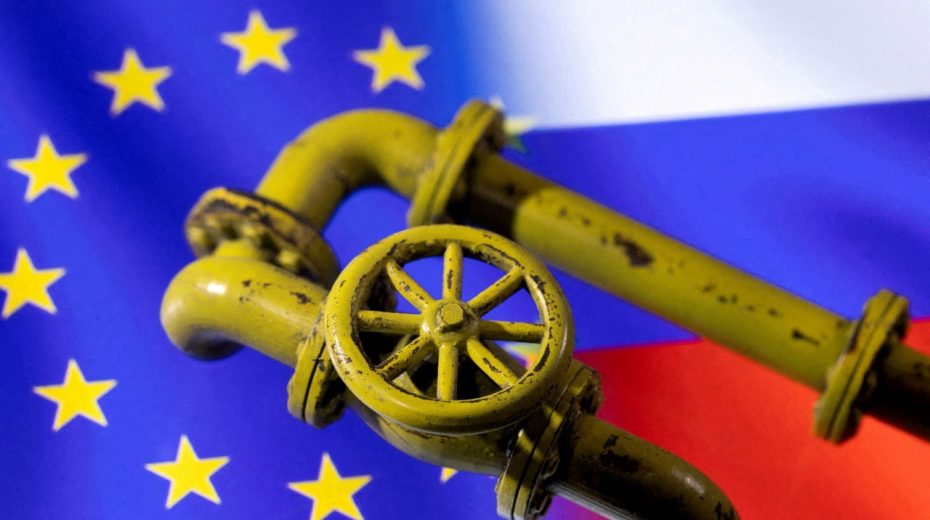
Meanwhile, the Kremlin wields its “easy-open gas valve” like a looming specter haunting European leaders. Despite intensifying rhetoric on Ukraine, energy distress, and conflict, the prospect of “cheap and abundant Russian energy” shadows their deliberations, keeping large European populations watchful and concerned.
When Merz advocates abandoning the welfare state and exchanging German quality of life for costly US energy, he is haunted by the possibility that pressure from Germans might force him to restore Russian gas flows—forcing him to sacrifice not only his US backers like Blackrock but also the repressive social reforms championed by the Euro-Atlantic oligarchic cartel he represents.
Conversely, Merz, Von der Leyen, and their patrons recognize the peril in reopening Russian supplies. The initial energy cutoff ruined many small businesses and lowered living standards, but a revival supported by Russia would strengthen economies and make reversing these gains difficult, given popular memory and experience.
Knowing reintegrating Russian energy would bring such normalization, Brussels and the Euro-Anglo-American cartel continue their harsh agenda, feeding the interests of the US military-industrial complex and NATO.
Thus, the national struggle for improved living and working conditions, affordable energy, and housing stands as the most potent force for people and democracy, achievable only on national grounds. Success would compel member states to pursue genuine solutions for their citizens and overturn the EU’s top-down power structure, forcing the abandonment of destructive priorities.
In this light, popular struggles over basic rights and living standards are simultaneously battles for peace, friendship, normalized relations, and reconciliation across the continent.
The Russian gas supply acts like a guillotine balancing interests—if skillfully employed, it can thwart the creeping fascization of European societies. For those unfamiliar, fascism is a covert instrument dragging populations toward oligarchic agendas, shielding monopolies, undermining workers’ interests in favor of capital, all masked by varying degrees of populism, fanaticism, militarism, supremacism, neoliberalism, federalism, and idealism for the laboring classes while empowering those in charge.
In essence, affordable, abundant Russian gas enables pragmatic reindustrialization that can protect European peoples’ interests, maintain decarbonization targets, and enable better planning and funding for energy autonomy—opening pathways to a more competitive, socially responsible economy without resorting to social dumping. Conversely, rejecting Russian gas and relying on alternatives will force a socially punishing industrialization reliant on repression, illusion, and mass manipulation.
Why would the Atlanticist oligarchy choose this path? Because it best suits their goals of confronting China, dissolving Russia, and restoring US-led global dominance along with a dependent European oligarchy. This approach means the Kremlin’s readiness to supply gas is both a shadow and a sword over EU-US relations, presenting contradictions between US energy interests in Europe and those of European peoples who suffer from expensive, less sustainable energy sources and a reindustrialization process either delayed or deeply painful.
The demand for peace is therefore not dissociated from the broader struggle for a dignified life!
About the Author