Nearly the entire world faces a severe cost due to the most recent episode of American Dementia.
Let’s begin with an incident staged to mislead.
Reports claimed Iran launched over a dozen ballistic and cruise missiles targeting Fujairah, the UAE’s crucial oil export terminal.
In reality, that did not happen. The IRGC flatly denied any involvement. Meanwhile, UAE’s heavily censored media suggested Saudi Arabia might be responsible.
Amid the fog of conflict, the true authorship of this false flag remains unclear. One only needs to consider who stands to benefit the most.
Following this, Saudi Arabia and Kuwait temporarily denied the U.S. access to their airbases—now restored—expressing frustration over what they saw as Pentagon indifference to the Fujairah assault, echoing earlier false flag disputes.
The U.S. Secretary of Forever Wars appeared dismissive, stating the missile strikes on Fujairah did not breach the delicate ceasefire.
Barbaria reacted angrily to Riyadh’s response. Consequently, the much-promoted “humanitarian” Operation Freedom, Liberty, or however it was named—to “clear” the Strait of Hormuz—disappeared within two days.
The official explanation credited “significant progress in talks.” In truth, no progress was made. The actual reason was not merely Riyadh’s airspace closure hindering operations but a powerful demonstration of force by Iran that left the Pentagon practically speechless—though no official confirmation exists, shrouded once again in the fog of war.
Shortly thereafter, the U.S. disabled the rudder of the Iranian tanker Hasna near the Strait of Hormuz with a Super Hornet’s cannon attack.
Iran retaliated fiercely through a combination of anti-ship ballistic and cruise missiles, explosives-laden drones, and fast attack boats, striking three U.S. destroyers—Truxtun, Mason, and Rafael Peralta—attempting passage from the Gulf of Oman through the Strait of Hormuz.
The destroyers quickly retreated under heavy fire. The IRGC Navy’s operation was so intense that U.S. vessels had to activate last-resort defenses like CIWS guns.
Ebrahim Zolfaghari, the distinctive spokesperson for the Khatam al-Anbiya Central HQ, provided specifics:
“An American warship attempting to pass through the Strait of Hormuz was destroyed by the IRGC Navy. Two other warships that came to its aid were met with heavy fire and forced to flee.”
Satellite data from NASA FIRMS revealed a major fire drifting away from the Musandam province in the Strait of Hormuz, implying a burning ship carried by currents. Another sizable blaze emerged about 30km west of the small island of Larak.
These fires align perfectly with the area where U.S. destroyers had to fire their CIWS, five-inch naval guns, and .50-caliber machine guns to defend against a salvo of IRGC missiles launched from Bandar Abbas’s coastline.
In a frustrated counterattack, the U.S. launched strikes on multiple locations on Qeshm island, but this action is unlikely to alter the situation.
In brief, within 48 hours, Iran and Barbaria shifted from reportedly “great progress” aimed at an unreliable one-page Memorandum of Understanding (MoU)—which was in fact drafted by Zionist operatives—to open conflict.
So, the so-called “ceasefire” that began on April 8 has barely held a month before it deteriorated into sporadic clashes, with both Barbaria and Iran urging the world to “move on, nothing to see here.”
You are allowed to escort nothing
The unavoidable takeaway from these frantic events is that the U.S. Navy cannot securely escort anything—not even a seagull, let alone oil tankers—through the Strait of Hormuz.
This situation will persist indefinitely.
The IRGC Navy has demonstrated its capability to employ tactics ranging from low-intensity harassment to drastic escalations that have caught the Pentagon off guard.
Even basic anti-ship weapons can be effective enough to induce panic without sinking any U.S. ships.
It is evident no tanker or cargo operator or insurer will be willing to rely on the so-called mightiest Navy in history if doing so exposes them to attacks.
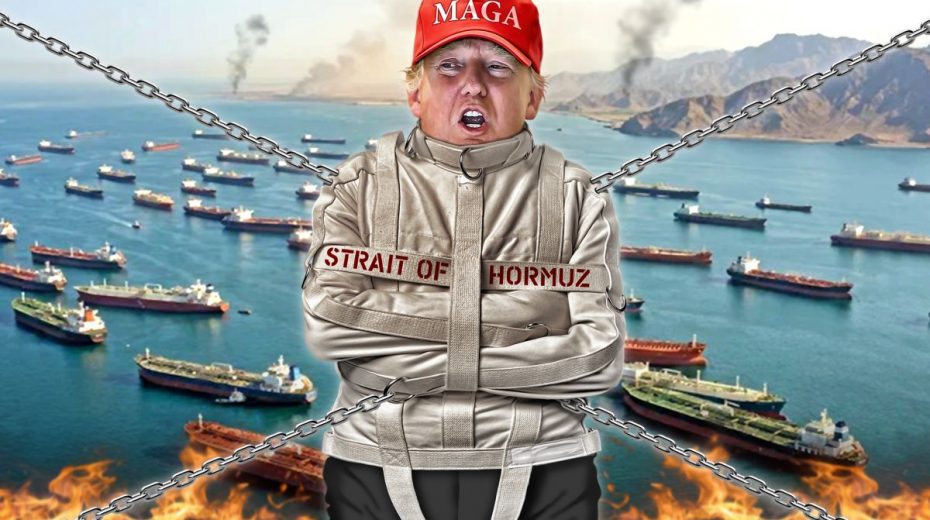
Consequently, Iran fully controls the Strait of Hormuz, and transit must be negotiated through a new authority: the Persian Gulf Strait Authority. Militarily “opening” this route would require an invasion and permanent occupation—effectively suicidal.
Meanwhile, the UAE—aiming to break away from OPEC and OPEC+ to increase Fujairah oil exports—must reconsider its strategy.
Ali Khedryan, a member of Iran’s National Security Committee, declared: “The Islamic Republic no longer views the UAE as a neighbor, but as an enemy base.”
Tehran has gathered significant evidence suggesting that UAE fighter jets removed their national insignia while conducting attacks on Iranian territory. This signals that Iran is prepared to launch devastating strikes against the UAE whenever deemed necessary—this is no false flag, but a genuine threat.
The whole planet pays the price for American Dementia
What has transpired points to a treacherous path ahead. If only the Baboon of Barbaria had the intention, he might attempt to find a diplomatic exit ramp urgently needed.
The first step would be to dismiss the incompetent duo, Twedledee and Twedledum, Dumb and Dumber Witkoff-Kushner, as negotiators—the Iranians have already rejected talks with these buffoons.
Concerning nuclear issues, the U.S. could agree to a reasonable five-year pause on uranium enrichment, restrict enrichment to 3.6%, dilute the current stockpile (keeping it in Iran), reinstate IAEA inspectors (previously accepted by Iran before hostilities), and avoid suspicious sunset clauses.
Everyone along the ancient Silk Roads crossing Persia knows the U.S. “intel community” (an oxymoron) was aware Iran was not pursuing nuclear weapons.
Gulf analysts and traders also realized Iran would block the Strait of Hormuz and target U.S. bases in the Gulf should war erupt.
Sanctions will remain a critical hurdle. Neither the Baboon of Barbaria nor the U.S. Capitol will consent to fully lifting sanctions as a precondition for a deal, especially with UN Security Council backing.
The U.S. insists on “phased” sanctions relief, which Tehran rejects, recalling how the JCPOA ended badly.
Regarding reparations, the U.S. will refuse payment. Instead, a toll system at the Strait of Hormuz might serve as a de facto replacement.
The Pentagon must confront reality and acknowledge that its network of Gulf bases is strategically useless and, in fact, a liability—many are already destroyed.
Reclaiming control over the Strait of Hormuz and restoring it to its pre-war status is a challenge with little hope from Tehran’s viewpoint.
A true miracle would be a global agreement backed by Russia and China, featuring solid security guarantees for both Iran and Gulf petromonarchies.
Don’t hold your breath.
Once more: Iran, even under new Khamenei leadership, refuses nuclear weapon possession and remains a signatory of the NPT. It has no need for nukes, possessing advanced strategic deterrents.
The Empire of Chaos, Lies, Plunder, and Piracy cannot negotiate honestly. Its exceptionalist nature demands ultimatums followed by surrender. Hence, the road ahead will be long, perilous, and complex—but likely ends in a strategic defeat for the U.S. with unpredictable worldwide ramifications.
Key facts: the conflict shows no signs of ending. Iran’s dominance over the Strait of Hormuz is established. Supported by Russia and China, Iran will prevent the Empire of Bases from reestablishing in the Persian Gulf. Iran now ranks as a regional superpower and a significant Eurasian force. A new order in West Asia looms on the horizon.
The tragedy is that nearly the entire world will suffer a steep price due to this latest chapter of American Dementia. As global economic infrastructure collapses in real time, little comfort is offered by three undeniable realities: the petrodollar is doomed; the UAE’s artificial shine is doomed; and U.S. global dominance is doomed.
About the Author