
Nothing Stops This Train
It’s widely recognized that the U.S. government struggles with a significant debt burden.
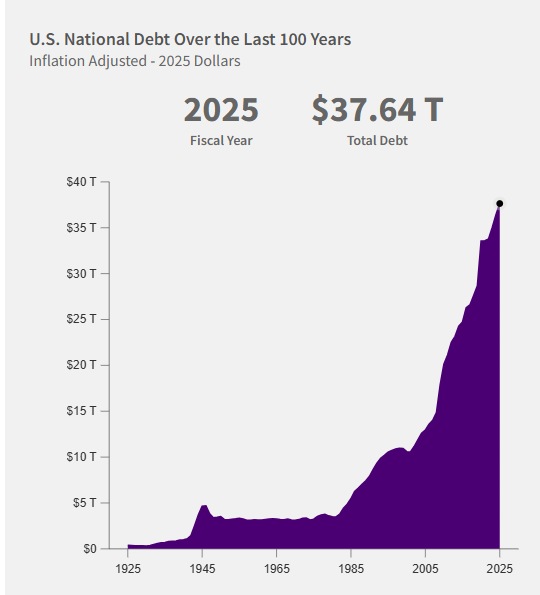
This inflation-adjusted chart below provides a fresh perspective.
Source: U.S. Treasury Dept
This graphic is roughly six months old and already behind current figures. Federal debt has soared to $39 trillion, increasing by $2 trillion annually and potentially rising to $2.5 trillion soon, especially in a recession.
The key takeaway is that even after accounting for inflation, debt remains a severe challenge. Parabolic rises in debt charts are hardly reassuring.
Besides the obvious trends, there are notable details in this image. Observe the spike in 1945 caused by World War II, which appears quite minimal once inflation is factored in.
Next, notice the post-WWII period where debt levels dropped and stayed stable for about four decades.
Then, government spending surged in the 1980s, and around 2008, debt escalated sharply upwards.
This pattern is what most Americans think about when considering the nation’s financial woes—and rightly so. Additionally, state and local debt adds another $7 trillion to the mix.
However, an often-overlooked major risk lurks beneath the surface.
Unfunded Liabilities
Focused on Social Security and Medicare—the twin giants of the unfunded fiscal crisis.
The U.S. government has committed to substantial benefits for these programs in the future.
When baby boomers earned the most, surpluses were generated that ideally should have been saved for their retirement.
Unfortunately, these surpluses were spent by shortsighted politicians, resulting in enormous unfunded liabilities today.
Here’s an overview:
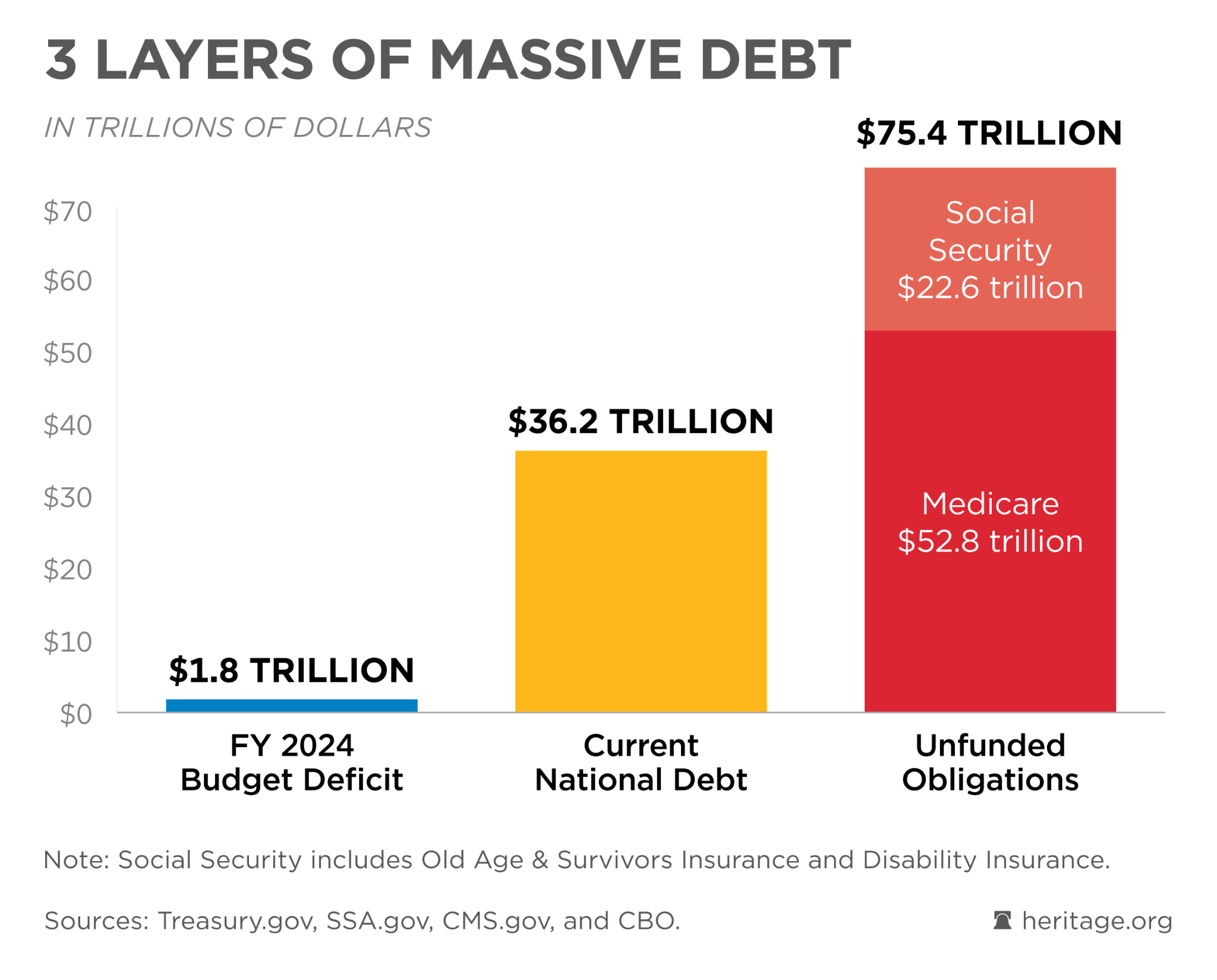
Medicare represents the largest of these unfunded obligations, with costs and fraud escalating rapidly.
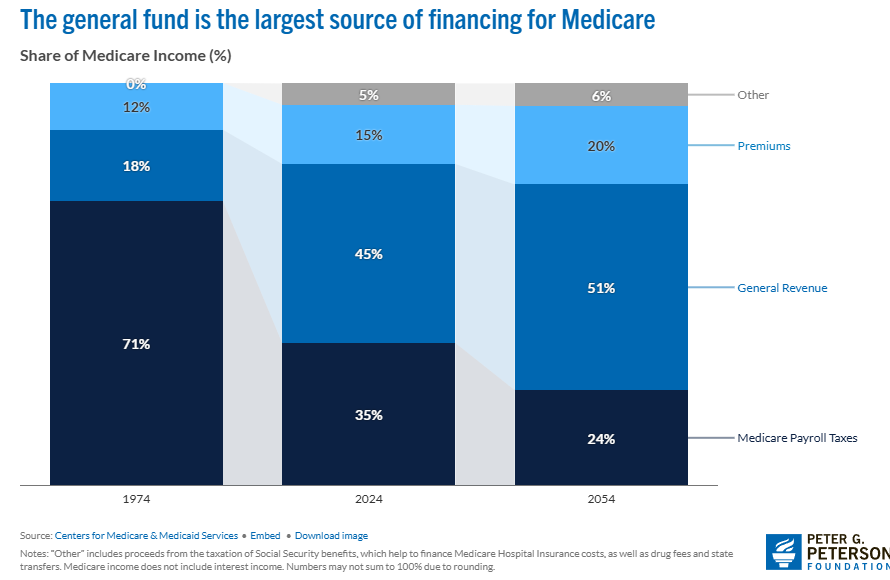
Examine the chart below showing how much Medicare expenditures are covered by payroll taxes.
Source: Peterson Foundation
Back in 1974, payroll taxes funded 71% of Medicare costs, with just 18% coming from the government’s general revenue. That was a nearly sustainable model.
Today, payroll taxes cover under 35% of Medicare’s expenses, while the remainder is financed through general taxes and deficit spending—despite the massive payroll tax revenue, Medicare operates at a deficit.
The Medicare Trustees Report warns that the Hospital Insurance Trust Fund is projected to be exhausted by 2033.
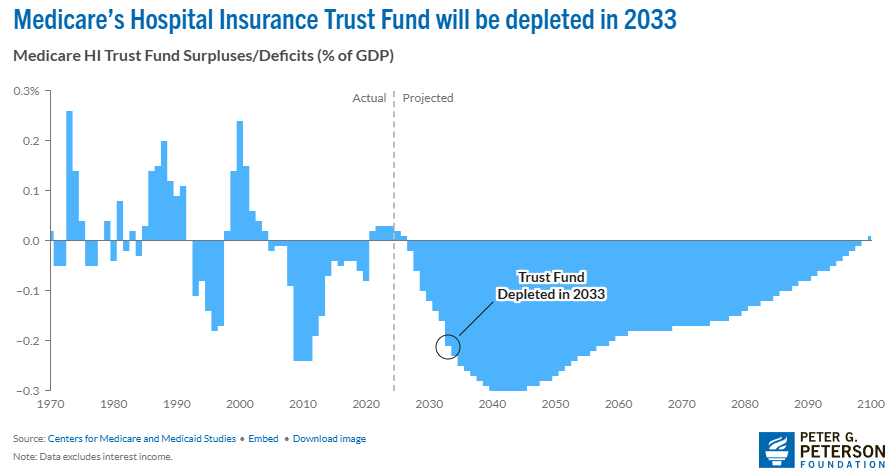
These official forecasts tend to be excessively optimistic.
Separately, Medicaid does not count as an “unfunded liability” since it’s funded by general revenue without a trust fund, but it also presents a significant financial challenge.
Together, Medicare and Medicaid now consume about 6% of GDP—a staggering figure.
$100 Trillion+
Adding another $8.2 trillion for federal pension shortfalls and Veterans Affairs expenses brings the total to an eye-popping $100 trillion.
This sum represents America’s unfunded liabilities—the promises made without allocated funding.
In essence, Medicare, Medicaid, Social Security, and other commitments will continue to weigh heavily on the economy for decades unless drastic changes occur.
Potential solutions like cutting costs and benefits remain highly contentious politically. President Trump’s fraud task force aims to tackle rampant fraud in Medicare and Medicaid, a critical issue.
Still, the underlying dilemma continues: promised benefits surpass available funds.
How will the government address this?
Realistically, printing money to cover deficits appears the inevitable political decision.
The Next Decade is Key
These massive debt and liability issues usually take longer to fully surface than many expect.
Nonetheless, I believe the combined debt and unfunded liabilities will hit a critical tipping point within ten years. We have already crossed the “event horizon,” making full repayment with current dollar values impossible.
Repayment will occur in devalued currency. Liabilities will be paid in full nominally but without their intended worth.
Put simply, inflation will diminish much of the real value of our debts and liabilities, leaving holders of U.S. Treasury securities at a loss.
Eventually, those depending on Social Security will have to adjust their expectations. Although checks will continue, their purchasing power will erode as cost-of-living adjustments fail to keep pace with true inflation.
Unfortunately, this appears unavoidable.
Pinpointing the exact timing is challenging due to numerous variables, but we are nearing the stage where interest payments constitute a growing share of government spending—a worrying development.
Among unfunded liabilities, Medicare may pose an even greater threat than Social Security due to rapidly escalating healthcare expenses.
DOGE Never Stood a Chance
Even if DOGE (President Trump and Musk’s effort to cut government spending) had succeeded, it would only have postponed the inevitable crisis.
It failed. The entrenched political system—variously dubbed the swamp, the deep state, or worse—remains firmly entrenched.
Regardless of leadership, unfunded liabilities and debt growth are baked into the economic framework. The Ponzi structure continues.
This train speeds downhill without brakes and will likely avoid crashing for longer than anticipated.
But eventually, the debt payment will be demanded. At that moment, the Federal Reserve and Treasury will unleash extreme measures to manage the fallout. We are approaching that juncture now.
Hint: Their solutions will revolve around extensive money creation, monetizing debt, and financial repression. Given the scale, resolving this issue will take at least a decade or more.
This is precisely why hard assets remain part of our portfolio.
About the Author