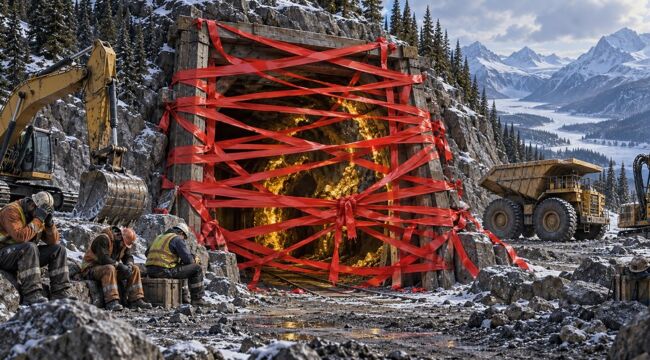
The Politics of Gold Mining Stocks
Last week, I found myself at the Java Connection in Whitehorse, Yukon, en route to inspect two projects situated north of Dawson City. At a nearby table, two men began a conversation I couldn’t help but overhear.
Their discussion revolved around the Eagle Mine and the ongoing repercussions following the incident there.
This exchange sheds light on the potential challenges for those investing in Yukon’s mining sector.
In 2024, Victoria Gold’s Eagle Mine experienced a failure of its heap leach pad. This breach compromised the containment system, allowing cyanide-tainted ore to enter Haggart Creek, which ultimately feeds into the Yukon River, a critical waterway in the region.
It certainly sounds alarming, doesn’t it?
At the time, Yukon Premier Ranj Pillai criticized the mining sector broadly:
The mining sector has had its fair share of bad actors, unfair practices, and the inherent desire – driven by the greed of corporate executives and shareholders – to cut corners, shirk responsibilities, and break the law.
He drew parallels between Eagle and the environmental catastrophe of the Clinton Creek mine, a failed asbestos operation abandoned by its owner, leaving taxpayers with a hefty cleanup bill.
These remarks intensified public outrage, with politicians capitalizing on the sentiment and directing blame squarely at the company involved.
The suggestion was that Victoria Gold acted out of greed and negligence, profiting while leaving cleanup duties to the public.
That interpretation doesn’t align with the facts.
The failure affected the leach pad—not the waste rock pile—which is central to gold extraction. This process involves stacking ore atop a thick, specially designed liner and spraying it with a diluted sodium cyanide solution. The cyanide binds to gold ions as the solution seeps through the ore layers.
Once saturated with gold, the “pregnant” solution is collected at the base of the pad and sent for processing to recover the precious metal, with the chemical recycled back for reuse. This method is well-established and reliable in gold mining.
At Eagle, the leach pad collapse involved roughly 265,000 ounces of gold-containing material, valued at over a billion dollars in today’s market.
If any negligence was present, it wasn’t from executives seeking quick profits, who typically prioritize taking money before addressing cleanup responsibilities.
Instead, this was an unfortunate accident that ultimately led to the company’s downfall. Prior to the event, Victoria Gold held a market value of approximately C$500 million, but afterward it declared bankruptcy.
Cyanide, the chemical at the center of this issue, is certainly hazardous and unwanted in the environment; however, it’s considered one of the less damaging options for gold processing chemicals. If a spill occurs, cyanide decomposes relatively quickly, provided it doesn’t contaminate groundwater.
Following the June 2024 collapse, cyanide exposure killed some fish and contaminated the local watershed. However, government monitoring indicated cyanide levels returned to undetectable by August 2024.
This rapid breakdown is due to the chemical’s composition: a molecule made up of one hydrogen ion, one nitrogen ion, and one carbon atom. The presence of sunlight and oxygen accelerates its decomposition into harmless substances, unlike persistent toxins such as mercury or arsenic, which can linger for decades.
After the collapse, Victoria Gold went bankrupt, and Price Waterhouse Coopers took control of its assets. They are currently in the process of selling these holdings. Thus, the mine itself remains intact, though the company is no more. Rumors suggest a Singaporean mining firm may acquire Eagle and restart operations.
Since the Eagle incident, a new Territorial Government has taken office and has yet to grant full approval for any new mine. In April 2026, conditional approval was granted to BMC Minerals for its Kudz Ze Kayah lead-zinc project, but the company must satisfy 52 stipulations and obtain two additional permits before construction can begin.
The legacy of the Eagle Mine disaster continues to cast a shadow over Yukon’s mining sector. Political risk endures until the government fully greenlights a major new mining operation.
There’s no denying the remarkable opportunities for investors in Yukon’s mining landscape. However, for the time being, our focus remains on exploration firms and producing companies.
Before delving into development projects, it is essential that the government grants comprehensive mine approvals, as the regulatory and political uncertainties remain high.
About the Author