Four graphs that reveal a broader narrative
For some time, I have wished to explore the diverging trajectories of Russia and Ukraine since the conflict erupted in 2014. The central point is that Ukraine has failed to compensate for lost trade after drastically reducing commerce with Russia. This shift has compelled Europe to supply substantial financial aid to Ukraine merely to stabilize its currency amidst ongoing warfare. Meanwhile, Russia has successfully diversified its trade partners beyond Europe, maintaining its export capacity at levels comparable to 2014, thus preserving the financial resources necessary to sustain its military operations.
Key findings:
- By 2025, Ukraine’s exports had dropped by 24%, while imports surged by 46% compared to 2014. The war has driven import growth, whereas exports have yet to rebound from the DCFTA’s effects and remain constrained by the ongoing conflict.
- Ukraine’s significant trade deficit since the war erupted has placed increasing pressure on European allies to provide funding required to stabilize the hryvnia and cover fiscal demands.
- Europe’s financial support will remain crucial after hostilities end, until Ukraine achieves export growth or attracts enough foreign investment to balance its trade gaps.
- Russia’s robust export performance and steady surpluses appear unaffected by conflict. Post-crisis, Russia pivoted its main energy exports away from Europe, buffering itself against progressive declines in European trade. Additionally, the spike in energy prices in 2022 brought Russia substantial revenue. Sanctions have yet to substantially disrupt Russia’s export framework.
- Following the oil price collapse in late 2014, Russia began rebuilding its foreign exchange reserves prior to the war. After $300bn in FX reserves were frozen, it shifted toward amassing monetary gold to protect future revenues from sanctions. Presently, Russia holds over $420bn in liquid reserves, rendering reserve immobilization an economic non-constraint.
In-depth examination
Russia’s consistent trade surpluses have allowed it to accumulate foreign currency and gold reserves instrumental in funding the conflict in Ukraine. In contrast, with its trade deficit widening since hostilities began, Ukraine depends heavily on ongoing financial aid from Europe to keep its currency stable.
This explains Russia’s capability to finance the war long-term without incurring substantial new debt—their debt remains modest at 20% of GDP. Ukraine relies on European financial support to cover wartime expenses and stabilize its economy, resulting in an annual debt increase averaging 20% of GDP, a trend that is clearly unsustainable.
The 2014 Deep and Comprehensive Free Trade Agreement posed challenges to Ukraine as it forced a shift away from trading with Russia.
The foundation of this scenario traces back to Ukraine signing the DCFTA with Europe on June 27, 2014.
At the time, Herman van Rompuy, President of the European Council, declared that “stronger political and economic ties will bring greater stability and prosperity to the entire European continent.”
President Poroshenko remarked that “over the last months, Ukraine paid the highest possible price to make her European dreams come true.”
However, Ukraine bore the real cost: exports plummeted while imports rose, as it consciously chose to sever trade ties with Russia.
This decision proved disastrous. Prior to 2014, Russia accounted for about 25% of Ukrainian exports—a share that shrank to under 5% by 2021, before hostilities. Ukraine failed to offset this loss by boosting exports to Europe, which remained mostly stagnant.
A similar pattern is seen in Georgia, which also experienced negligible increases in exports to the EU following its DCFTA. The EU employs various trade dispute mechanisms and non-tariff barriers that limit import growth from DCFTA nations.
In effect, by promoting European trade over Russian ties, Europe inadvertently imposed an economic burden on Ukraine, which consciously relinquished a profitable market in pursuit of EU integration.
Moreover, since the war began, Ukrainian imports have surged, further expanding its trade deficit. This rise stems from Ukraine’s acquisition of US weapons funded through borrowing from European and domestic sources. Thus, Ukraine is financing a growing trade deficit with debt that must be continually replenished.
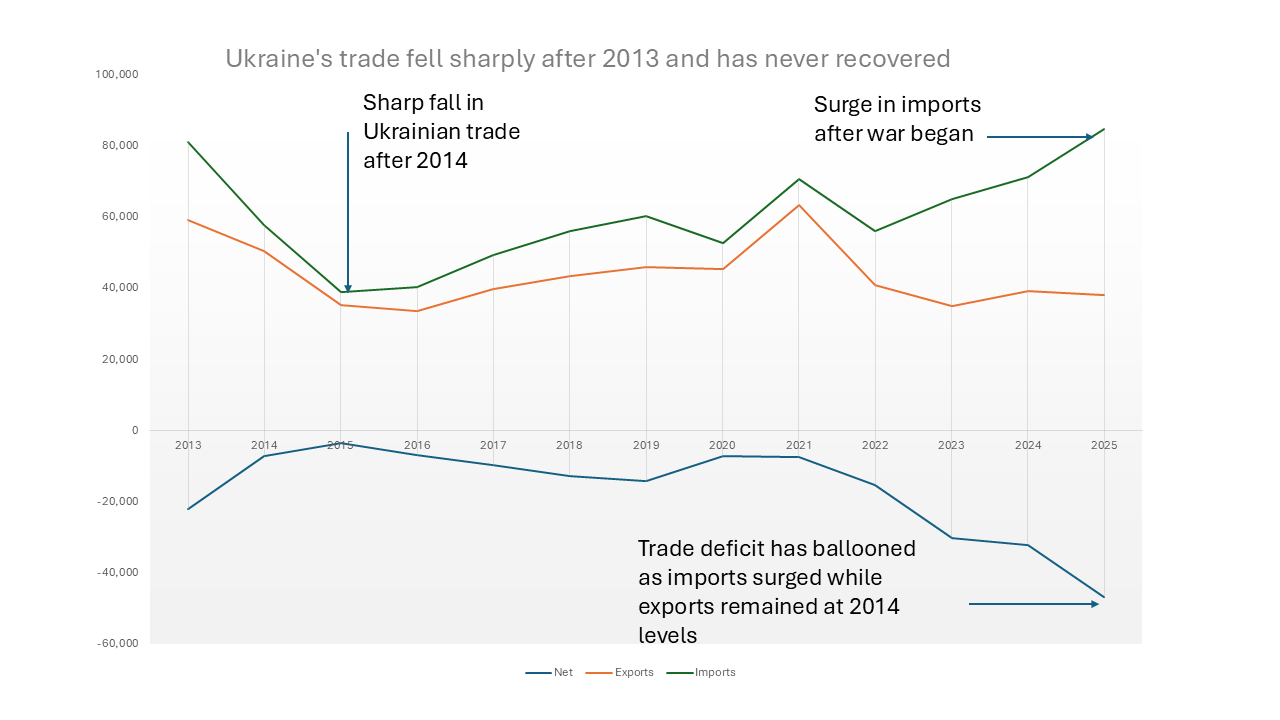
Fueled by war, Ukraine’s expanding trade deficit demands ongoing foreign capital injections to protect its currency.
The following graph illustrates the correlation between Ukraine’s rising trade deficit and increases in Secondary Income inflows in its quarterly balance of payments. These inflows, primarily from Europe, are crucial for supporting Ukraine’s foreign exchange reserves and averting currency collapse. It is vital to understand that Europe’s financial assistance to Ukraine extends beyond fiscal support; it plays an essential role in stabilizing Ukraine’s economy when foreign investment is scarce amid conflict.
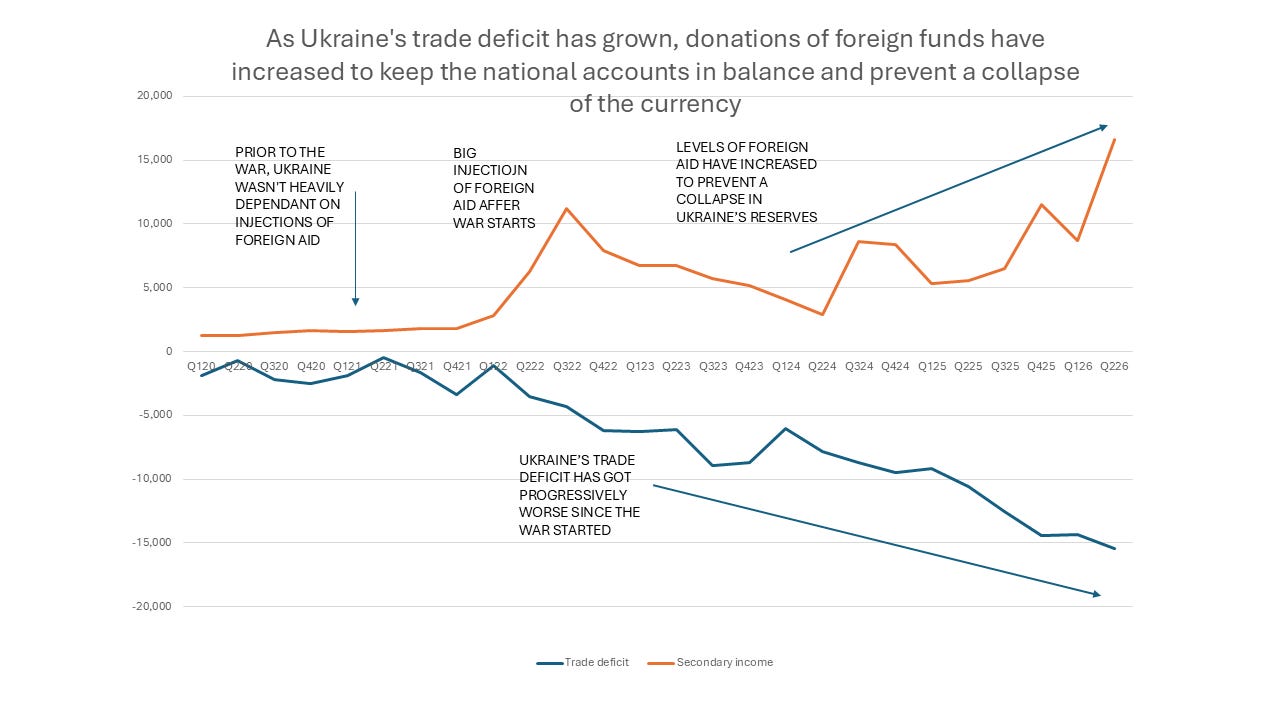
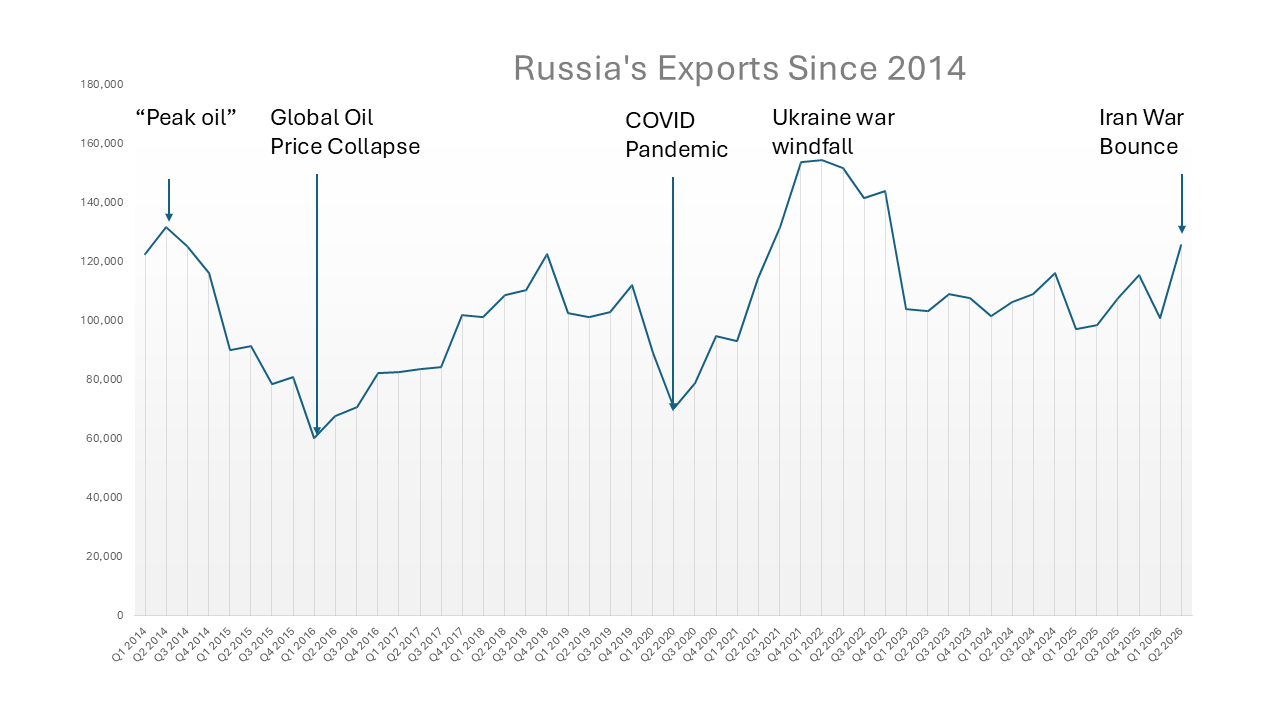
Russia has avoided similar difficulties by redirecting its exports as European markets declined. Sanctions have failed to significantly disrupt trade.
The next graph elegantly captures the evolution of Russia’s trade since 2014. While Russian exports have fluctuated due to global shocks—such as the 2014 and 2016 oil price drops and COVID-19—the war’s outbreak generated an export boom driven by soaring oil prices. Despite extensive western sanctions, Russia’s exports have demonstrated remarkable durability, thanks primarily to its redirection of trade toward Asian countries.
In summary, despite widespread western media claims of sanctions impairing Russia’s economy, tangible evidence to support those assertions is lacking.
Russia’s export strategy continues to fuel the liquidity necessary to finance the conflict without resorting to major borrowing, granting it a strategic edge over Ukraine and its European supporters in this protracted struggle.
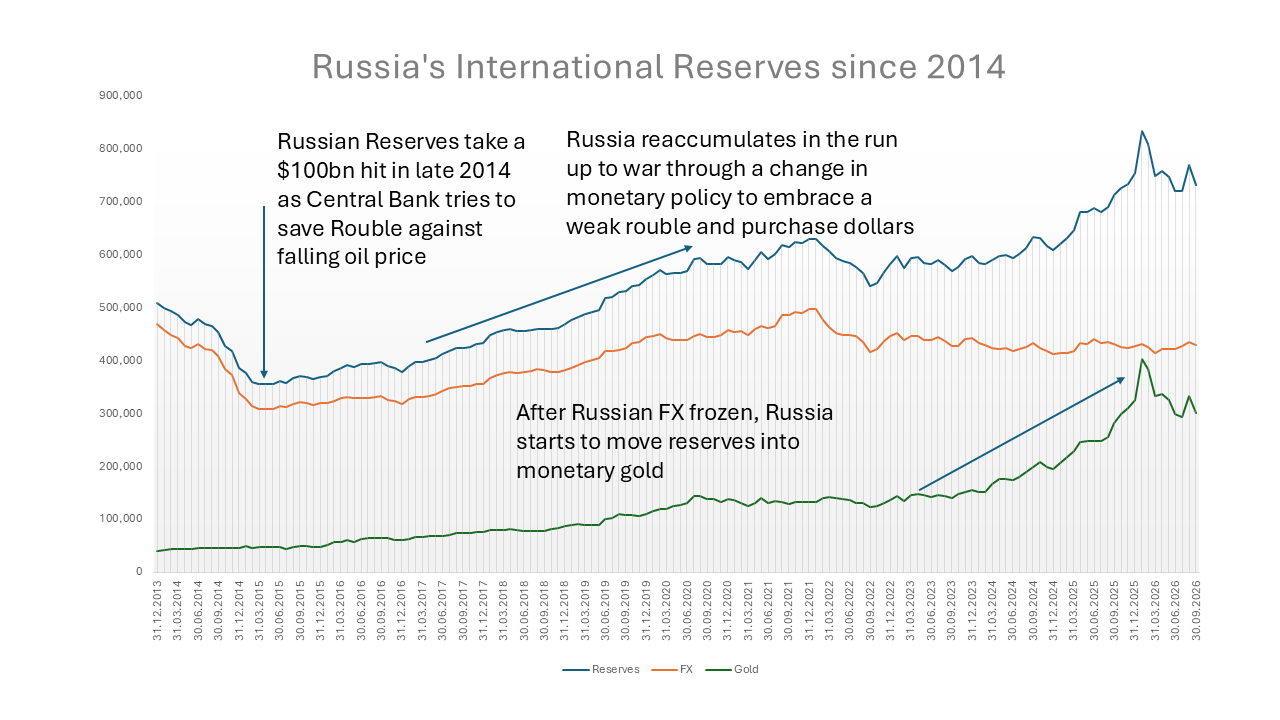
To compensate for frozen assets, Russia has increased reserves since the war started, focusing on monetary gold to shield its wealth from sanctions.
To conclude, it is worth noting that Russia began rebuilding its foreign exchange reserves in 2017 as it adopted a weaker rouble policy to maximize export revenue, supplementing this with dollar purchases from its Finance Ministry. This trend is visible in the graph below.
Following the war’s outbreak and the substantial export revenue gains in 2022, Russia continued stockpiling reserves. After a significant portion of its foreign currency holdings were frozen, Russia shifted towards accumulating monetary gold as a safeguard against sanctions.
Though Russia hopes for the eventual release of its frozen assets after the conflict (a highly uncertain prospect), it has nonetheless amassed a substantial financial cushion exceeding $420bn in reserves beyond those frozen assets.
This robust reserve base supports Russia’s war financing without requiring heavy borrowing, keeping its debt ratio near 20% of GDP.
In contrast, Ukraine’s debt soared from around 49% of GDP in 2021 to approximately 110% today.
Original article: thepeacemonger.substack.com
About the Author