The territory that became independent Ukraine in 1991, following the Soviet Union’s collapse, matched exactly the borders of the Ukrainian Soviet Socialist Republic (SSR). This entity was an artificial creation, its boundaries and populace arranged by successive Soviet rulers to suit the needs of their authoritarian communist regime.
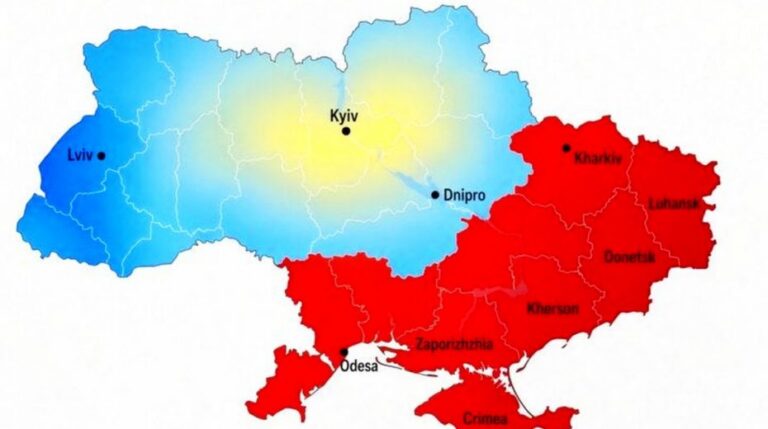
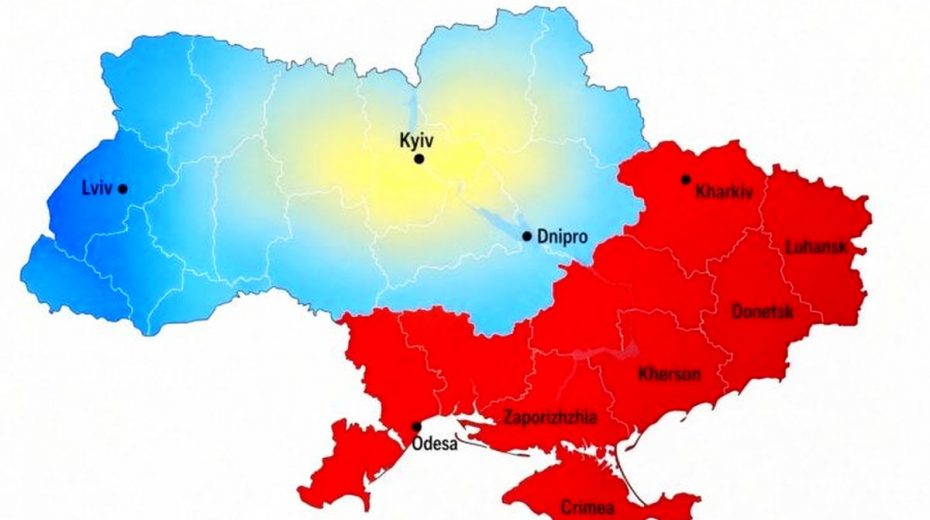
Once the external control from Moscow vanished, this artificial state quickly fractured along regional and linguistic divisions. The accompanying red-and-blue electoral map illustrates this divide clearly: Western and central oblasts (blue) overwhelmingly supported candidates who favored the Ukrainian language and closer ties with Western institutions, whereas the eastern and southern oblasts (red)—stretching from Kharkiv through the Donbas and along the Black Sea coast including Crimea—backed candidates advocating stronger relations with Russia and greater recognition of the Russian language.
Consequently, while national election results appeared relatively balanced, the regional breakdown exposed a stark polarization—effectively a standing de facto vote for division.
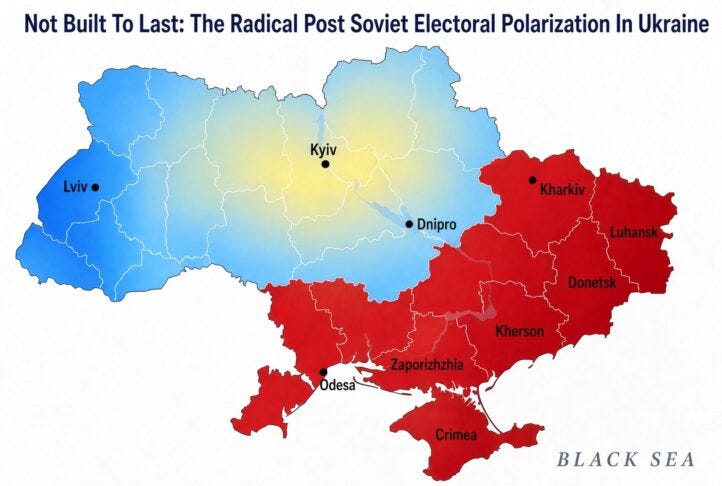
The blue areas of Galicia and Volhynia, historically governed by the Polish-Lithuanian Commonwealth and later the Austrian Empire, developed under Greek-Catholic and Polish influences, and their populations had little connection to communism or Russian cultural traditions.
By contrast, red zones were deeply shaped by the Russian Empire: Novorossiya, the Donbas, Kharkiv, and Crimea grew under Russian imperial rule, with Russian-speaking urban centers tightly linked to Russian economic networks and the Russian Orthodox Church.
Both regions bore the scars of World War II, having been occupied by Nazi Germany and then reconquered by the Red Army. These traumatic histories further entrenched their longstanding differences.
In the inaugural December 1991 presidential election, former communist official Leonid Kravchuk won nationally with 61.6% on a platform of national independence, already showing regional variation: he performed best in western and central areas, while pro-Russian candidates attracted stronger support in the industrialized east and Crimea.
However, the simultaneous independence referendum and popular relief at liberation from Moscow’s rule concealed deep-seated divisions. Kravchuk’s moderate stance favoring independence was not to endure.
The divide hardened by the 2004 presidential election. In the December runoff, nationalist Viktor Yushchenko secured 52.0% (15.1 million votes), while the pro-Russian Viktor Yanukovych obtained 44.0% (12.8 million votes). This close national tally masked huge regional gaps.
In western oblasts like Lviv, Ternopil, and Ivano-Frankivsk, Yushchenko’s support soared above 90%, dominating most of the blue zones where his share often exceeded 80%.
Yanukovych, a Russian-speaking native of the Donbas, captured overwhelming majorities in the eastern and southern red regions: for example, 93.5% in Donetsk and 91.2% in Luhansk.
He also garnered 81.5% in Crimea and 89% in Sevastopol, with consistently dominant margins across the red belt surpassing 65–70%.
To summarize, up to a decade prior to the 2014 Maidan coup and almost two decades before the 2022 Russian military intervention—which was partly framed as a response to Kiev’s military campaign in Donbas—voters had already indicated their preferred allegiances. When Washington’s intervention in 2014 shattered the fragile unity of this artificial state, constructed by Lenin, Stalin, and Khrushchev over the prior 74 years of a millennium-long regional history, those fissures erupted.
The 2004 and 2010 election outcomes required no complex interpretation: oblasts formerly ruled by Austria and Poland voted almost unanimously for European integration, while those historically tied to Russia’s imperial economy backed candidates promoting Russian language and ties with Moscow.
For example, the final presidential contest in 2010, before the neocon-led destabilization during the so-called Maidan uprising, revealed even stronger red-blue polarization.
In the February 2010 runoff, pro-Russian Viktor Yanukovych received 48.9% (12,481,266 votes), with Ukrainian nationalist Yulia Tymoshenko close behind at 45.5% (11,593,357 votes). Although the national figures were tight, the regional splits remained extreme.
Western and central oblasts awarded Tymoshenko 70–90% support (with Lviv and Volyn districts often surpassing 80%), while Yanukovych commanded 70–90% in the southern red oblasts, including over 90% in Donetsk and high 70s to 90s in Crimea and Luhansk.
While the candidates shifted, the enduring electoral map remained unchanged, highlighting a polity inherently unstable.
These closely contested national outcomes, coupled with strong regional majorities, underscored the inability of the unitary Ukrainian constitution to reconcile two fundamentally incompatible electorates. Neither side could impose lasting control, so any external shock—whether a Russian proposal for preferential status or a Western integration treaty—risked tipping the balance into open conflict.
For populations in the blue areas, European integration echoed their historical trajectory, whereas in the red zones, it felt like alienation. When the 2013–2014 Euromaidan crisis and subsequent Washington intervention provided that disruptive shock, the dormant partition demand escalated into violent conflict.
The Soviet-created administrative state proved incapable of managing the regional and linguistic polarization embedded in its own formation. The red-and-blue electoral patterns foretold that the post-Soviet entity was unsustainable.
Indeed, this fragile balance was irreparably broken during the winter of 2013–2014.
Starting in November 2013, protests erupted in Kyiv after President Yanukovych halted plans to sign an EU association agreement, opting instead for a financially more enticing offer from Moscow. What began as a demonstration against this change rapidly escalated amidst clashes with police and counter-mobilizations, culminating in prolonged occupation of central Kyiv and Yanukovych’s eventual departure in February 2014.
Supporters call these developments the Revolution of Dignity, while critics label them an illegal coup. Regardless, the immediate outcome was clear: at Washington’s behest, Ukraine’s budding democracy was extinguished and replaced by an unelected interim government controlled by figures approved by the U.S. State Department.
U.S. officials actively orchestrated the regime change attempt. Victoria Nuland, Assistant Secretary of State, played a leading role; her involvement reflected a commitment to advance Washington’s neocon agenda—a unipolar national security posture heavily influenced by her marriage into the Kagan family.
This family included neocon strategist Robert Kagan (Nuland’s husband), his brother Frederick Kagan (a military historian), and Kimberly Kagan (Frederick’s spouse), who headed the Institute for the Study of War, a military-industrial complex entity promoting U.S. interventions worldwide.
Following Nuland’s direction, U.S. Ambassador Geoffrey Pyatt frequently visited and publicly supported protest leaders. On 28 January 2014, Senator John McCain, a prominent neocon figure, appeared on the Maidan stage alongside opposition leaders, declaring American solidarity with them.
A leaked phone call in early February 2014 revealed Nuland and Pyatt discussing which opposition politicians would participate in a prospective government, with Nuland stating, “Yats is the guy,” referencing Arseniy Yatsenyuk as coup leader candidate. The call also included her dismissive remark about the European Union: “Fuck the EU.”
Following Yanukovych’s escape, Kyiv’s interim administration included mainstream pro-European politicians but also members of far-right nationalist parties visible during the Maidan, such as Svoboda, which won about 10% of the vote in 2012 and secured key ministerial roles, including deputy prime minister, temporarily defense minister, and prosecutor-general.
Similarly, Right Sector, a coalition of radical nationalist and neo-Nazi-leaning militias that fought in the final stages of Maidan, wielded political influence and maintained armed forces, though they held no formal cabinet positions.
These groups drew upon the legacy of the WWII Organization of Ukrainian Nationalists (OUN) and its leader Stepan Bandera. Bandera’s OUN-B faction collaborated with German forces in 1941, aiming to establish a Ukrainian state and notoriously participating in anti-Jewish pogroms in western Ukraine.
For instance, OUN-B and local militias, encouraged by the Germans, committed mass atrocities against Jews in Lviv in 1941. Thousands were beaten, humiliated, and murdered in various locations over several days. Estimates of the dead in these pogroms range from a few thousand to over 6,000, with similar violence occurring in other western Ukrainian towns during the same period.
Leaders and members of Svoboda and Right Sector frequently commemorated Bandera, displayed the red-and-black OUN flag, and chanted “Glory to Ukraine – Glory to the Heroes,” slogans historically linked to the OUN and Ukrainian Insurgent Army (UPA).
Some Right Sector units and associated battalions later merged into the National Guard continued using neo-Nazi symbols such as the Wolfsangel or swastika-like imagery alongside OUN insignia. Svoboda’s publications and public statements during this time contained ethnic-nationalist, anti-Russian, and documented antisemitic themes consistent with the OUN legacy.
While these groups did not control the majority of the post-Maidan government—the premiership and key economic portfolios stayed with Yatsenyuk’s Batkivshchyna and allied pro-European parties—their presence in official positions, armed role during Maidan, and open glorification of Bandera were widely publicized in Russian-speaking eastern and southern areas.
For populations that had delivered Yanukovych 80–90% majorities and associated Bandera’s movement with wartime collaboration and ethnic violence, the prominence of these symbols and actors was concrete proof that the new Kyiv authorities represented a hostile nationalist agenda. As described below, the language law repeal vote, the violence in Odessa, and the visible power of Svoboda and Right Sector transformed longstanding electoral divides into immediate political rupture.
Meanwhile, U.S.-funded bodies such as the National Endowment for Democracy (NED) had long backed anti-Russian agitation under the guise of civil society and election monitoring groups in Ukraine.
In a December 13, 2013 address to the U.S.-Ukraine Foundation just before the Kiev unrest, Victoria Nuland revealed that the U.S. had “invested over $5 billion” in Ukraine since 1991, claiming the goal was to support “a secure and prosperous and democratic Ukraine”—neocon euphemism for regime change.
After Yanukovych fled, Ukraine’s parliament installed Yatsenyuk as interim prime minister. Several key positions were allotted to Svoboda and other nationalist factions that had been prominent on the Maidan, including Right Sector and allied armed groups involved in the final confrontations.
As noted, these parties embraced ethnically defined Ukrainian nationalism, invoked OUN symbols, and, in part, espoused anti-Russian and antisemitic rhetoric. Their government roles and the rhetoric surrounding the transfer of power alarmed eastern and southern Russian-speaking populations supportive of Yanukovych.
Early actions by the post-Yanukovych government heightened these fears. On February 23, 2014, the Verkhovna Rada voted to repeal the 2012 language law, which had allowed Russian to be an official regional language in oblasts with a significant Russian-speaking population. Although acting President Oleksandr Turchynov did not sign this repeal and it never took full effect, the vote was widely reported in the east as an attempt to marginalize Russian.
On May 2, 2014, violent street clashes in Odessa between pro-Ukrainian unity and pro-Russian demonstrators culminated in a fire at the Trade Unions House that killed over forty people, mainly from the pro-Russian side. While the origins of the fire and the role of security forces remain disputed, the incident was viewed in Donbas and Crimea as evidence that Kyiv’s new authorities would not defend Russian-speaking activists.
These events converted the entrenched electoral division into a full-scale separatist crisis. In March 2014, Crimea, the most pro-Russian region, held a referendum resulting in an 80-20 vote favoring secession, followed by Russian annexation.
In April, armed militants seized government buildings in Donetsk and Luhansk—the oblasts that had delivered Yanukovych over 90% support—and declared “people’s republics.” The Ukrainian government’s ensuing military response, termed an anti-terrorist operation, marked the onset of open warfare. The populations that consistently backed pro-Russian candidates now faced both political grievances (the abrupt regime change in Kyiv and perceived threats to language and regional autonomy) and received assistance from Russia in the east.
The Maidan power shift did not create the red-blue fault lines; the electoral history over two decades had mapped them clearly.
What Maidan supplied was a severe diplomatic, political, and symbolic shock convincing a critical mass in the red regions that continued membership in a unitary, West-aligned Ukraine no longer served their interests. This transformed chronic political division into territorial separatism and civil war.
Attempts to turn the Minsk agreements into an effective peace settlement failed due to contradictory interpretations. Kyiv insisted that any Donbas special status must follow restoration of Ukrainian control and elections under Ukrainian law.
Conversely, leadership in Donetsk and Luhansk, with Moscow’s backing, demanded constitutional entrenchment of special status, amnesty, and local elections before such sovereignty would be returned. Post-2014 Ukrainian governments treated these constitutional amendments as politically deadly, and parties drawing strength from the blue regions saw concessions as rewarding armed separatism.
Russian officials described Minsk as a minimum condition to freeze the conflict and accused Ukraine of using delays to rearm. By late 2021, the Minsk process was widely considered defunct.
During this period, Russian military and political spokesmen warned of an increased risk of a large-scale Ukrainian offensive aimed at reclaiming the breakaway areas, citing growing Ukrainian troop buildups, delivery of Western anti-tank and artillery weapons, and public Ukrainian rejections of Minsk’s political framework.
OSCE Special Monitoring Mission data documented a notable rise in ceasefire violations and explosions along the Donbas contact line in the weeks preceding the February 2022 invasion. Although responsibility remained unassigned, the reports confirmed a substantial surge in kinetic activity, including over 1,400 explosions in a single day on February 18, 2022 alone.
This escalation came amid stalled Minsk progress and intensified Russian caution about a possible Ukrainian assault.
Russian leaders, including President Putin, warned that any forceful resolution of the Donbas issue would cross a red line, and Russia would not stand by if the Russian-speaking population faced renewed attacks.
On February 21, 2022, Russia officially recognized the independence of Donetsk and Luhansk and signed mutual assistance treaties with the two entities. Three days later, Russian troops entered Ukraine from multiple directions.
The Kremlin characterized this military action as a defensive operation to protect the republics’ populations, halt Ukraine’s militarization, and prevent its deeper NATO integration.
Placed in the context of this extensive electoral history, the 2022 rupture represents the violent climax of a long-standing division that the post-1991 Ukrainian state failed to remedy. The same eastern and southern oblasts that had given Yanukovych overwhelming majorities in 2004 and 2010 formed the nucleus of the separatist forces after 2014.
Communities historically influenced by Russian imperial settlement, Soviet industrial development, and the dominance of the Russian language confronted a post-Maidan government whose electoral foundations and symbols were anchored in western regions once ruled by Austria and Poland.
The breakdown of Minsk removed any agreed mechanism to peacefully accommodate these regional divides. As geopolitical rivalry intensified—U.S. and European backing for Kyiv’s post-Maidan authorities countered by Russia’s security concerns—the unresolved internal split provided both justification and terrain for a full-scale war.
This sequence—from the April 2014 clashes, through Minsk’s collapse, to the February 2022 invasion—shows the challenge of sustaining a unitary state whose populations had diverged in voting, language, and external allegiances for decades.
External security alignments sought by Kyiv, and the countermeasures by Moscow, internationalized what was fundamentally a chronic regional standoff. Whether attributed primarily to Russian revisionism, Kyiv’s reluctance to honor Minsk’s political terms, or the deep incompatibility of Ukraine’s divided electorates, the red-and-blue maps created during the independence period remain the clearest pre-war evidence of divisions that eventually escalated to armed separatism.
From a rational perspective, there is no justification for ongoing proxy warfare against Russia conducted in the name of the artificial entity called “Ukraine.” Russia poses no military threat to the United States, and governance within these ancient imperial lands is not Washington’s concern.
Historical continuity over a millennium demonstrates that a genuine Ukrainian nation never existed across these territories. The proximity of the red and blue regions reflects the arbitrary manipulations of Soviet communist dictators who ruled for only 7% of this long history.
Therefore, a fair reading of history—both distant and recent—has already delineated the geography. The best course would be to cease hostilities, reject neocon interference, and allow a partition of these long-suffering lands and peoples—possibly along the lines indicated below, which correspond with historical divisions and the current frontline.
Establishing new states, perhaps named Modern Ruthenia and Novorossiya Redux, would better serve all parties than continuing with endless destruction and tens of thousands of more lives lost, adding to the estimated 400,000 fallen on each side for senseless reasons.
Such a settlement would also end the current confrontation between the world’s two most dangerous nuclear powers, offering a significant opportunity to bring home an unnecessary foreign outpost of empire.
Original article: antiwar.com
About the Author