What a whirlwind of a few days it’s been.
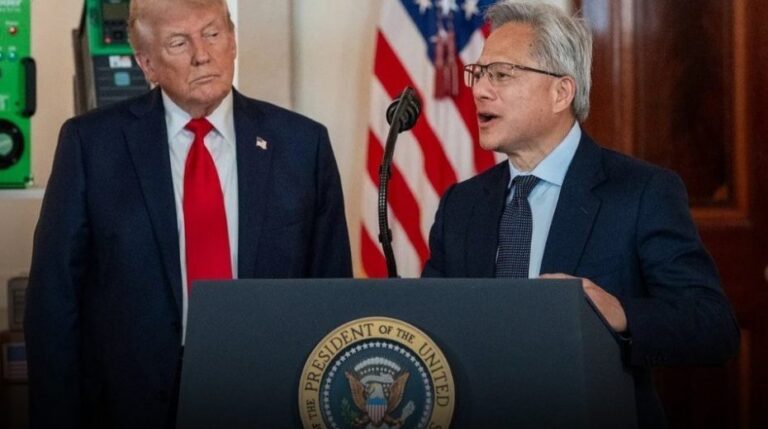
Unless you’ve been completely disconnected, you’re already aware of this morning’s big news: Jensen Huang has returned as Nvidia’s President and CEO. This announcement triggered a surge in shares, climbing over 30%.
The Nasdaq 100 rallied by as much as 7%, while the S&P 500 rose above 5% at one point—both exceptionally rare events.
Does this mean the AI rally is back? Possibly. However, there are sound reasons to question how long this momentum can last.
Today, we’ll try to unpack the situation and, crucially, identify which sectors might present the most favorable risk/reward opportunities.
Diagnosis: Uncertain
Despite the recent surge, markets remain noticeably below their previous peaks. Since technology is in focus, here’s a look at the Nasdaq 100’s performance over the past year:
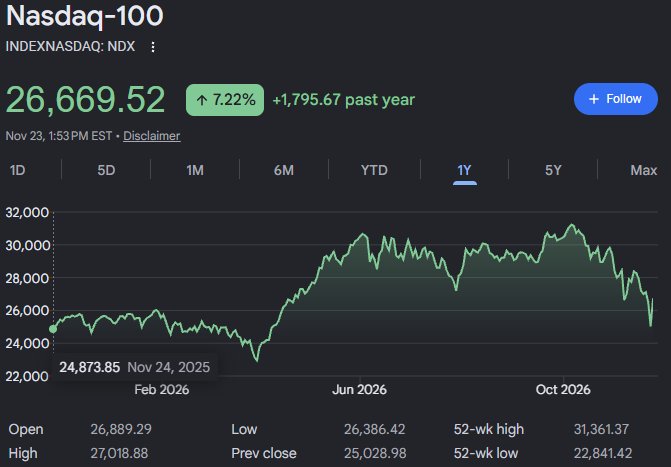
The Nasdaq 100, dominated by tech, currently stands approximately 15% below its record high, though it remains 7.2% higher than a year ago.
On another note, the Federal Reserve seems poised to raise interest rates in December, which will add more strain on companies burdened with heavy debt—a vast number of them.
Data center buildouts continue to face delays, partly due to insufficient power supply. AI firms, especially the neocloud giants and leading innovators, still require hundreds of billions in funding to fulfill their planned expansions.
Our colleague Jim Rickards shared his insights on Nvidia during an appearance on Steve Bannon’s show. Below are some excerpts from the interview:
Reinstating Huang at Nvidia, there’s no reason for it. There were a hundred good reasons why the board should not have done that.
It’s a huge mistake, but it served two purposes. Number one, get the stock market up. That seems to be what the Mar-a-Lago crowd cares about. I think they think the stock market is the economy.
It worked, but only in the short run…This [bounce] is not going to last. The question is when the bubble will pop. That’s much more difficult.
People ask, what’s going to do it? I say it doesn’t matter. What matters is that it’s a bubble and it’s going to burst. Stocks will go down 30-40%, maybe more.
The particular cause doesn’t matter. If it’s not one thing, it’s another.
As usual, Jim offers a thought-provoking dissenting view, prioritizing ethical considerations over short-term market gains.
Risk/Reward
My conviction remains that precious metals, miners, and certain tangible assets provide a superior risk/reward balance compared to tech equities at this stage.
Last week, I increased my silver holdings, adding more today. The metal is showing a solid rebound, suggesting we might have finally bottomed out. Additionally, I expanded my stakes in a handful of precious metals miners and intend to make strategic purchases on dips through year-end.
Notably, one of the most skilled traders ever, Stanley Druckenmiller, recently acquired three leading gold miners for his family office. As of September 30th, he purchased:
- Newmont (NEM) $43.9 million
- Barrick (B) $42.9 million
- Agnico Eagle (AEM) $42.3 million
These companies are some of the largest in gold mining (disclosure: I own NEM and AEM).
Although Druckenmiller’s position in these miners isn’t enormous yet, his move to buy quality gold producers during the downturn is encouraging.
Meanwhile, he has reduced or exited his semiconductor and AI-related holdings, selling 94% of his stake in Taiwan Semiconductor (TSM), as well as shares in Rambus, Entegris, Qnity Electronics, Arm Holdings, and Navitas Semiconductor.
Druckenmiller also offloaded shares in Alphabet (Google), Sandisk, and AMD.
For those unfamiliar with Druckenmiller’s impressive track record, he averaged around 30% annual returns managing hedge funds and, according to a March 2025 report from the Financial Times, his family office has avoided losses for 14 consecutive years.
Billionaires like Druckenmiller have a rare talent for profiting regardless of market direction. His shift toward gold miners signals a noteworthy development. More updates on the move into hard assets and signs of a market bottom will follow soon.
About the Author