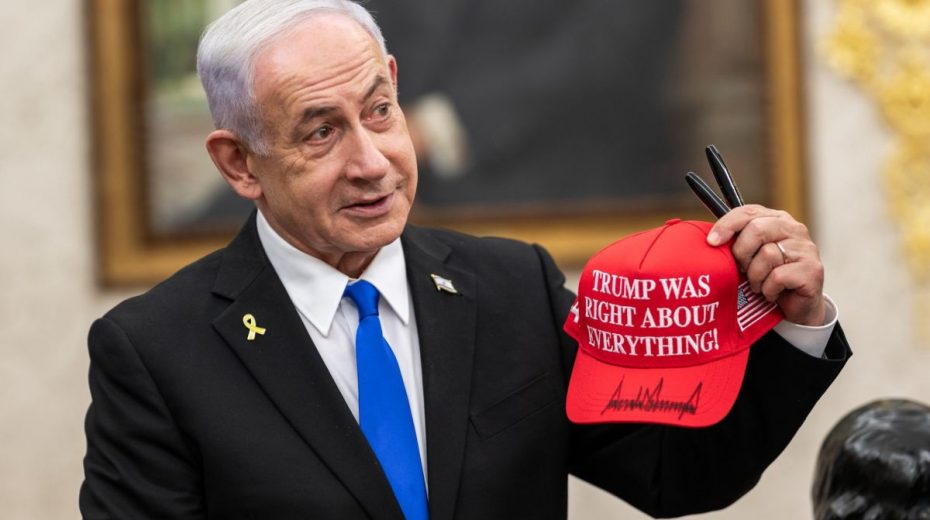
During the meeting on 30 December with Netanyahu and his team, President Trump openly vowed to take military action against Iran.
At the 30 December meeting with Netanyahu and his team, President Trump publicly committed to attacking Iran: If they continue with their ballistic missile program, ‘Yes’. And for their nuclear: ‘Immediate’. “We’ll knock the hell out of them“, Trump said.
In sharp contrast to this aggressive stance, Trump’s tone at Mar-a-Lago was marked by warmth and high praise for Netanyahu and Israel. Publicly, Trump gave Netanyahu explicit support for an attack on Iran and plans for Gaza Phase Two; however, many of the finer details remained disputed and unclear behind closed doors.
Tehran was unsurprised by the escalating threats toward Iran, as these developments were anticipated. Clear indicators signaling potential conflict are evident: the rising rhetoric about “hundreds of al-Qaida sleeper cells ready to unleash carnage; Al-Qaida found safe harbour in Iran for 25 years … [allowing Iran] to supercharge the spread of Islamic fundamentalism”, and claims by an ‘infiltrator for MI5 and MI6’ highlight this alarm. Predictably, the Iranian currency plummets as protests erupt across the country.
What motivates the current surge in U.S.-Israeli militaristic rhetoric? Trump’s familiar hyperbolic phrasing about “the gates of Hell” opening to “whomsoever” echoes past statements. Still, it appears that Trump and Netanyahu are coordinated in preparing for renewed conflict.
However, Israel’s choice to pursue kinetic engagement raises questions, particularly since the nation suffered significant harm from advanced Iranian missiles during the June 12-day war, revealing weaknesses in Israeli air defenses. Meanwhile, Iran continues to arm itself and prepare for further hostilities.
To understand Israel’s seemingly irrational path toward war with Iran, broader context is necessary, considering the clear dangers involved.
Firstly, Netanyahu’s political standing is precarious. Despite past forecasts of his downfall, ‘Houdini’ Netanyahu repeatedly evades political demise. This time, however, the situation is graver as legal experts expect him to face conviction on corruption charges if cases reach verdict.
An even more explosive issue revolves around the ‘Qatargate’ scandal, under which three senior members of Netanyahu’s staff allegedly received payments from Qatar over several years, including during the Gaza war. This allegation is undisputed. The critical questions are: Was Netanyahu aware? If not, why? And what benefits was Qatar seeking in exchange? The precise motives of Qatar remain unclear, but possibly simply having influence over the Prime Minister’s aides was sufficient for future leverage.
These accusations have ignited a firestorm within Israel. The label “treason” is being widely levied, including by former Prime Minister Naftali Bennett and ex-Defense Minister Bogie Yaalon. Some skeptical Israelis suggest the Netanyahu family’s Palm Beach visit’s main purpose was less about Gaza discussions and more about advancing Trump’s lobbying efforts for a pardon or case dismissal, aiming to influence a hesitant President Hertzog.
In essence, Netanyahu is seeking a dramatic political boost—a ‘balloon’—to lift him out of his legal quagmire and unfinished conflicts, buoyed by a unifying cause to help secure victory in the 2026 general election. Defeating Iran would be championed not only by Israelis but also by a supportive U.S. Congress, major donors, and both factions of the Uniparty.
Trump’s motivations differ somewhat. Avoiding open conflict with Netanyahu publicly was a convention established by former President Biden—albeit imperfectly. “Bibi deliberately sought friction with Biden. With President Trump, he avoids it,” a U.S. official observed. Trump also strongly values maintaining the support of key donors like Miriam Adelson and commentators such as Mark Levin.
This approach can be viewed amid the fractures within his MAGA base over U.S. aid for Israel, which also alienates some younger Democrats. The harrowing images of dead civilians in Gaza have galvanized Turning Point USA—a youthful, high-energy Christian values organization credited with a large role in MAGA’s 2024 success. Turning Point USA has the potential to power a robust voter turnout campaign.
A small faction of senior GOP officials, together with prominent politicians and donors, aim to block MAGA’s expanding influence over the Republican Party, which threatens established leadership. This now leaderless yet organically growing ‘silent majority’ refuses to remain quiet. Party gatekeepers seek to suppress and control it once more.
The wedge issue inserted into MAGA—that “if you do not support the policies of Netanyahu, you are an antisemite, a hater of Israel”—was purposely deployed, fueled by paid influencers to deepen internal divisions and weaken the movement. Traditional GOP leadership strives to reclaim full authority.
From Trump’s standpoint, it remains possible to back the State of Israel while criticizing Netanyahu’s administration policies. This compromise aims to keep MAGA united heading into midterms. Beneath the public Netanyahu strategy at Mar-a-Lago, a complex struggle unfolds to shape not just the midterm results but also the 2028 presidential race.
The pro-Israel donor bloc argues that Trump and Vance’s stance—supporting Israel while questioning its policies—is a false dichotomy: To criticize Israel is, ipso facto, anti-Semitic, Netanyahu insists. This attempt to fracture MAGA using Israel as the wedge issue may or may not succeed. A central challenge for GOP strategists is that their divisive tactics are now well recognized by Gen Z voters.
A U.S.-Israeli war on Iran thus operates on layers beyond straightforward logic. While Iran is the obvious target, for Trump’s circle it is also a multifaceted power play over control of MAGA and the post-Trump political landscape.
In Israel, the looming conflict becomes a stage upon which rival factions and their financiers battle to dominate the political system and determine the future identity of ‘Israel’—or what remains of it.
Amid this fervor, the cautious concerns of military professionals in Israel and the U.S. may be muffled, as dissent risks being seen as lacking commitment to the war effort.
About the Author