Flashback: Nixon, Price Controls, and COVID
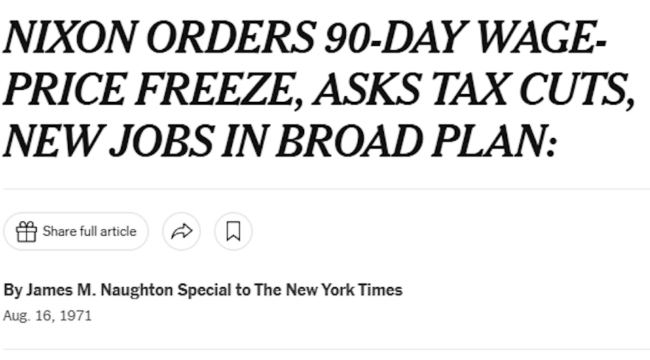
In August 1971, President Nixon declared the termination of both the Bretton Woods framework and the gold standard.
During that address, he also announced a 90-day freeze on prices, legally barring companies from increasing wages and costs.
This marked the initial stage of price controls, which enjoyed widespread popularity, securing 75% public approval.
Nixon aimed to curb inflation ahead of the 1972 election, and initially, the strategy succeeded.
However, the market was quietly becoming distorted, with Adam Smith’s invisible hand metaphorically stabbed with a rusty screwdriver.
Phase Two – Govt Sets Prices
The second phase, stretching from late 1971 through 1973, required companies to seek permission from government boards to raise prices and wages.
This led to emerging shortages. Ranchers refused to sell beef at a loss, resulting in fewer cattle on the market, and scarcity of meat products increased.
Businesses exploited loopholes to elevate prices on certain goods. For example, automobile manufacturers made minor modifications to models, marketing them as “new” with distinct price points.
Quality deteriorated as well, with inferior ingredients replacing better ones; instead of butter, companies began using soybean and other seed oils.
Service levels also declined.
By the end of 1973, due to ineffectiveness, price controls were relaxed.
Oil Shock + Price Controls = Shortages
The 1973 Arab oil embargo caused gasoline prices to surge across the U.S. However, due to the existing price controls, sellers could not increase prices to match market conditions.
Rationing became necessary, causing long queues at gas stations that still had supply.
Ultimately, all price controls collapsed.
The resulting market distortion led to sharp price increases once controls were lifted, as the restrictions had discouraged new production.
Will We See Price Controls?
On March 5th, there were reports suggesting the Treasury Department might take “action” in oil futures markets. Reuters stated:
The U.S. Treasury Department could announce measures as soon as Thursday to address rising energy prices, potentially including action in the oil futures market, a senior White House official said.
This implies the government might consider shorting oil futures to push prices down.
Manipulating prices is a risky path. Subsequently, a Trump administration official denied any intervention plans anonymously. Yet, the sharp $35 drop in oil prices yesterday seemed somewhat suspicious.
The official reason given was that oil plunged due to Trump’s comment that the war was nearly over. However, his position has since shifted, and Iran shows no signs of backing down.
Therefore, while it’s possible the government has begun to lower oil prices by selling futures, proving this would be challenging.
My worry is that if oil and related costs remain high, authorities might be tempted to impose price controls, export bans, or other measures that disrupt natural market forces.
Though elevated oil prices are tough, they incentivize reduced consumption and increased drilling. Artificially suppressing prices will ultimately backfire.
Under low prices, oil firms are less motivated to develop new wells, and consumers have fewer reasons to curb unnecessary travel.
As Rick Rule famously states, “the cure for high prices is high prices”.
The only lasting solution to price issues is to allow market mechanisms to function freely.
A Bit Like COVID…
Aside from a brief spike to $120 per barrel, the market’s response to this conflict has been relatively subdued. Stock indices have only dipped slightly.
In certain respects, it recalls the initial period of COVID. Remember the phrase “15 days to slow the spread”?
Initially, the market’s reaction to COVID was mild. For some time, trading was largely stagnant—until it wasn’t.
Between February 19 and March 23, 2020, the S&P 500 plunged by 34%, with high-growth stocks falling even more sharply.
I fear a comparable outcome could occur now. Should this war continue and further oil infrastructure be targeted, prices might surge past $120 again. Stocks could also face steep declines.
I am not asserting this will definitely take place, but complacency would be unwise.
Currently, we face one of the rare inflationary triggers in history. If the Strait of Hormuz remains blocked, surges won’t be limited to oil alone, but will affect fertilizers, petrochemicals, plastics, metals, and many other materials.
Let’s hope a resolution emerges soon. Without it, inflation risks accelerating rapidly.
Everyone at Paradigm is closely monitoring these developments. We will ensure you stay well informed.
About the Author