Binary thinking in the argument over whether the US or Israel is driving the illegal war on Iran obscures far more than it illuminates. The truth is the dog and the tail are wagging each other
The coordinated US-Israeli conflict against Iran has reignited a contentious discussion about who controls the agenda: is it Israel or the United States directing the war?
One perspective argues that Israel has ensnared Trump into a situation he cannot easily escape—suggesting the tail wags the dog.
The opposing view sees the US, as the dominant global military power, shaping geopolitical strategies, with Israel acting in alignment with Washington’s interests—the dog wagging the tail.
At first glance, the idea that Israel, a dependent client state, could be steering the mighty US military seems unlikely.
Nonetheless, considerable evidence supports the claim that the tail may indeed be wagging the dog.
Proponents of this view highlight that Trump initiated this war against Iran despite campaigning on an “America First” platform, where he pledged: “I’m not going to start a war. I’m going to stop wars.”
His secretary of state, Marco Rubio, acknowledged that the administration was hurried into conflict, seemingly unable to prevent Israel from striking Iran.
Jonathan Kent, Trump’s top counter-terrorism official, mentioned in his resignation letter that the war began due to pressure from Israel and its influential American lobby.
During an address to the Israeli parliament in October, Trump appeared to admit being under the sway of the Israel lobby. While praising his decision to relocate the US embassy from Tel Aviv to the illegally occupied Jerusalem, he repeatedly referred to his major donor, Israeli-American billionaire Miriam Adelson, recounting: “I actually asked her once, I said, ‘So, Miriam, I know you love Israel. What do you love more, the United States or Israel?’ She refused to answer. That means, that might mean, Israel, I must say.”
A 2001 video secretly recorded Israeli prime minister Benjamin Netanyahu telling settlers: “I know what America is. America is a thing you can move very easily, move it in the right direction. They won’t get in the way.”
Former US President Barack Obama, who clashed with Netanyahu over halting Israel’s illegal settlement expansion, shares this view. In his 2020 memoir, he asserted that the Israel lobby demanded “no daylight” exist between US and Israeli governments, even when Israeli actions conflicted with US policy.
Politicians opposing this stance risked being labeled “anti-Israel” (and potentially anti-Semitic), facing well-funded challengers during elections.
Messy arrangement
However, a simplistic binary framework between US and Israel misses the complexities.
In my 2008 book on Israeli foreign policy, Israel and the Clash of Civilisations: Iran, Iraq and the Plan to Remake the Middle East
, I argued that the dynamic is better understood as both dog and tail influencing each other mutually.
What does this entail?
Israel, as Washington’s favored client state, operates within strategic “security” parameters set by the US for the Middle East.
Moreover, Israel plays a key role by enforcing these parameters regionally.
Yet, the picture is more intricate.
Simultaneously, Israel strives to shape these parameters in ways serving its own interests, primarily by influencing US military, political, and cultural discourse through various levers.
Zionist lobbies, inclusive of Jewish and Christian groups, rally grassroots support for Israel’s claims framed as mutually beneficial.
Wealthy donors like Adelson leverage their fortunes to sway and pressure US lawmakers.
Think-tanks with unclear funding draft legislation favorable to Israel, smoothly approved by US politicians.
Opaque-funded legal organizations use the law aggressively to suppress opposition and impose financial penalties.
Media owners aligned with Israel influence public opinion, often branding critics of Israeli policies as “antisemitic.”
This results in a highly convoluted and tangled relationship.
Disappearing Palestinians
The notion that the US unilaterally dictates to Israel falters starkly when looking at the ongoing genocide in Gaza over the past two and a half years.
Israel has harbored a long-standing determination to erase the Palestinian presence, either through ethnic cleansing or outright genocide.
Its ambition is to claim historic Palestine in full, viewing Palestinians as obstacles to this aim. Moreover, Israel seeks a Greater Israel, annexing large areas from neighbors like Lebanon and Syria, actions it is currently pursuing.
Following the Hamas attack on October 7, 2023, Israel seized the opportunity to aggressively renew ethnic cleansing begun in 1948.
It bombed Gaza extensively, provoking a “humanitarian crisis” intended to coerce Egypt to allow passage into Sinai, aiming to displace Gaza’s population. Egypt refused, prompting intensified Israeli efforts to starve and massacre Gaza’s inhabitants—a course legally amounting to genocide.
Yet, the claim that the US was deeply invested in orchestrating or directing this genocide is difficult to uphold.
Washington—under both Biden and Trump—provided Israel with political cover, arms, and financial support to commit these atrocities, yet this differs substantially from the US having a strategic interest in carrying out genocide.
Instead, the US has largely disregarded Palestinian fates, content as long as they remain contained—whether imprisoned indefinitely, ethnically cleansed to Sinai or Jordan, placed under a compliant leadership like Mahmoud Abbas, or exterminated.
Washington finances whatever solution Israel chooses, provided it can be framed by pro-Israel groups in the West as a legitimate “response” to Palestinian “terrorism.”
However, Israel’s scope for action changed dramatically on October 7, 2023. The US consented to Israel’s shift from sporadic “mowing the lawn” raids in Gaza to the complete destruction of the enclave.
Put simply, Israel persuaded Washington that now was the moment to pursue genocide. This was Israel’s initiative, not Washington’s.
This does not absolve the US of complicity—it fully shares responsibility, having funded and armed the genocide.
Israeli attack dog
A similar framework applies to the conflict with Iran.
Both the US and Israel seek to contain Iran—to keep it weak and unable to assert influence—albeit for somewhat differing motivations.
Israel’s goal is to dominate the Middle East as a premier client state with privileged access to Washington, relying on Iran, its main regional rival, remaining subdued and unable to ally effectively with groups like Hizbullah in Lebanon.
Meanwhile, Washington desires to keep Israel unchallenged, enabling its ally to extend US imperial reach throughout the Middle East.
The US, however, must balance additional interests. It endeavors to keep Arab monarchies compliant by threatening them with Israel’s potential military wrath if they stray, while offering protection under its security umbrella from Iranian threats if they remain loyal.
The overarching aim is securing unchallenged control over oil supplies, underpinning the global economy.
Thus, the US must evaluate multiple variables in dealing with Iran, unlike Israel.
Washington needs to consider impacts on global markets, the status of the dollar as the world’s reserve currency, and avoid strategic errors that rivals like China or Russia could exploit.
This is why Washington has historically favored regional stability, since unrest harms business interests—a reality evident today.
Israel views the conflict with Iran existentially, with many cabinet members seeing it as a religious war. They reject mere containment policies, which they deem ineffective, instead aiming to utterly cripple Iran and sow chaos to neutralize any challenge to Israeli dominance.
This was underscored by Jake Sullivan, Biden’s former national security advisor, during a recent interview with Jon Stewart. He quoted Israel’s ex-military intelligence chief for Iran, Danny Cintrinowicz, saying Netanyahu’s aim is to “just break Iran, cause chaos.” Sullivan added, “Because, as far as they’re concerned, a broken Iran is less of a threat to Israel.”
In essence, Israel seeks to foster instability within Iran, a condition likely to destabilize the wider region.
Weaving mischief
These divergent goals illustrate why Israel’s leadership has spent decades leveraging influence in Washington to drum up support for war.
If war had been obviously aligned with US interests, such efforts would have been redundant.
Instead, Israel employed its lobbies, mobilized wealthy patrons, and enlisted friendly journalists to slowly shift public opinion, rendering war conceivable rather than outright hostile.
Most critical was Israel’s close ideological alliance with neoconservatives—hawkish, staunchly pro-Israel officials entrenched in Washington’s power centers.
Each US administration has been a battleground between neoconservative hardliners and more moderate voices. During George W. Bush’s presidency, neocons prevailed, leading to the Iraq invasion in 2003, Israel’s brief war on Lebanon in 2006, and an unsuccessful plan to expand conflict to Syria and Iran. I explored these dynamics in Israel and the Clash of Civilisations.
Under Obama, neocon influence waned, enabling a nuclear deal with Iran until Trump scrapped it in 2018. Biden’s approach has been more hesitant.
In Trump’s second term, neocons appeared firmly back in charge, setting the stage for the current illegal war on Iran—a likely strategic disaster for the US and a possible, if temporary, victory for Israel.
Secret power
Does this amount to saying the tail wags the dog?
No, partly because this assumes that US politics’ visible institutions—the President, Congress, and main parties—monopolize power.
Even within this arena, support for Israel has notably declined since the Gaza genocide. As the costly war on Iran escalates, American backing for Israel among voters is poised to plummet.
Israel has become a divisive political issue, splitting Democrats and Republicans, fracturing generational lines, and eroding the MAGA base crucial to Trump.
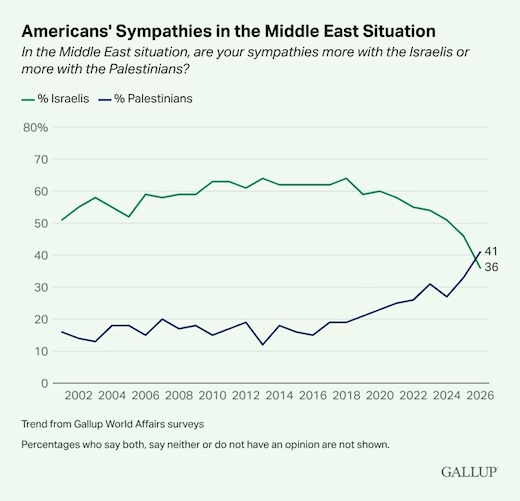
This polarization is likely to deepen, eventually giving bolder US politicians room to criticize Israel’s harmful role more openly.
However, true power extends beyond the visible realm. A permanent bureaucracy with institutional memory operates in the shadows. Leaks from Wikileaks and whistleblowing by Edward Snowden have revealed glimpses of these secret machinations, including illegal mass surveillance of US citizens.
Both whistleblowers faced severe repercussions—Assange imprisoned in a London high-security facility, targeted for extradition under dubious “espionage” charges, and Snowden exiled to Russia to avoid arrest.
This hidden bureaucracy—sometimes called the Deep State or the military-industrial complex—does not abide by visible political rules and operates clandestinely.
If it wished, this bureaucracy could undercut the Israel lobby, reducing Israel’s sway over mainstream US politics.
It could target lobby leaders—AIPAC, the Anti-Defamation League, the Zionist Organisation of America, the Conference of Presidents of Major American Jewish Organisations, Christians United for Israel, among others—similar to how it dealt with Assange and Snowden.
It might steer public discourse to question whether these groups serve US interests or act as foreign agents, potentially prompting media and legislators to impose stricter regulations requiring these entities to register accordingly.
The permanent bureaucracy likely possesses even more covert and darker capabilities.
The fact that it has not acted against the Israel lobby yet implies Israel’s objectives are still largely aligned with US goals.
But this may soon change. The increasingly public debates about Israel pushing the US toward a war with Iran—now permeating popular awareness—could be the opening moves of a struggle ahead.
If the war proves a disastrous blunder, as it seems destined to be, blame-shifting onto Israel is likely, and leading US politicians may already be preparing their excuses.
The latitude Israel has enjoyed in Washington to buy influence, intimidate, and silence critics could soon become a liability. It will be easy to argue that a system so easily manipulated, allowing the US to be drawn into a self-defeating conflict, requires reform to prevent future blunders.
The most significant takeaway Washington may glean from the war on Iran is that it must curb the tail’s vigorous wagging of the dog.
Original article: www.jonathan-cook.net
About the Author