No one expects that most GCC petro-monarchies in West Asia have grasped where the winds are shifting.
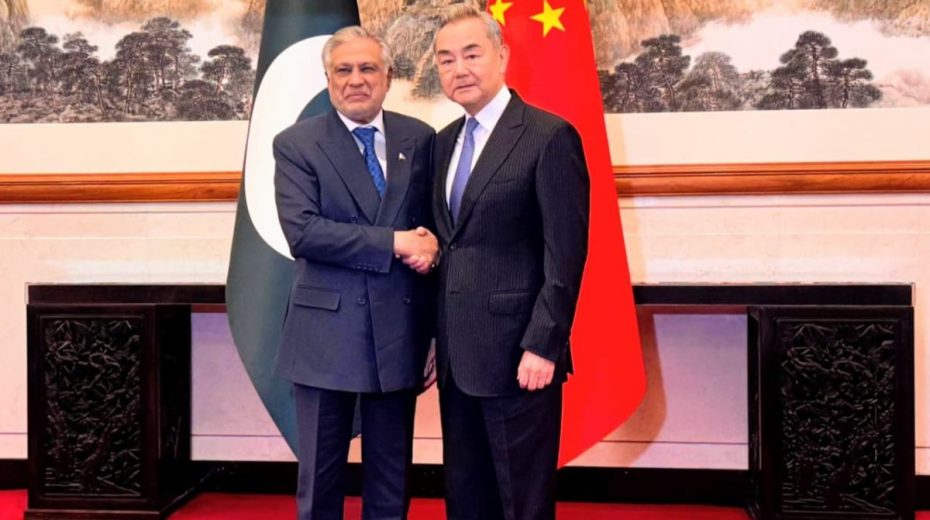
China and Pakistan jointly issued a five-point declaration concerning the conflict involving Iran that, on the surface, might appear rather uninspiring.
- An immediate ceasefire along with humanitarian access throughout all impacted regions.
- Prompt peace negotiations; upholding the sovereignty of Iran and Gulf states; prioritizing diplomacy over military action.
- The safeguarding of civilians and non-military infrastructure according to international laws.
- The protection of maritime routes, especially the Strait of Hormuz.
- Enhancing the United Nations’ role through a peace framework grounded in the UN Charter.
Despite Pakistan’s Foreign Minister Ishaq Dar’s boundless enthusiasm, the statement reads as a collection of familiar platitudes lacking tangible impact. Dar claimed that both the US and Iran expressed “confidence” in Pakistan’s mediation efforts, a claim that is highly disputable.
One likely scenario is that China remained unconvinced by the Quad meeting in Islamabad—featuring Foreign Ministers from Pakistan, Turkey, Saudi Arabia, and Egypt—prompting Dar’s urgent trip to Beijing to face tough questions.
China could hardly afford to endorse a vague strategy destined to be quickly disrupted by the “Baboon of Barbaria.”
There is, however, more complexity beneath the surface, which can be discussed only between China and Iran. Dar’s journey to Beijing also reflects Tehran’s mistrust of Pakistan, Turkey, and the Arab states; for meaningful progress, Iran requires firm assurances from China.
Previously, the Iranian administration, including all ministers, rejected a 15-point US proposal relayed through Pakistan—a thinly veiled demand for capitulation. Iran firmly upheld its right to uranium enrichment, missile development, demanded war reparations, and insisted on a permanent peace guaranteed by the UN.
Another interpretation of the ambiguous final statement is that it signals an opportunity for China to reshape the Persian Gulf’s landscape post-American influence.
Pakistan’s Army Chief, Field Marshal Asim Munir, a key figure of the current government, maintains direct communication with the Baboon of Barbaria. This occasion marked Ishaq Dar’s second visit to China in three months, coupled with multiple calls to Chinese Foreign Minister Wang Yi.
So, how did this situation evolve?
What is the real agenda of this Muslim Quad?
Frankly, Egypt holds negligible geopolitical sway and managed to do nothing substantial during the horrific Gaza killings. In many respects, Egypt and Pakistan function as proxies for Saudi Arabia and the UAE, which themselves answer to the US-linked death cult dominating West Asia (although Saudi Arabia’s alignment might be shifting).
There has been extensive hype labeling the Islamabad meeting as orchestrated by a “Sunni Axis,” which is baseless. What truly matters is that all participants support the dominant death cult in West Asia, evidenced by Turkey’s continued covert trade despite an official ban.
The intricate ties among these Muslim states are complicated. Pakistan and Iran share a volatile border across Iran’s Sistan-Balochistan and Pakistan’s Balochistan provinces, where groups like the CIA/MI6-influenced Balochistan Liberation Movement operate.
Although Islamabad signed a defense agreement with Riyadh last September, it does not imply Pakistan would side with Saudi Arabia against Iran, which faces unlawful bombings from foreign powers. Even local actors in the Baloch region acknowledge that if Iran collapses, Pakistan would be next.
Turkey’s Fidan, with presidential aspirations, aligns with Atlanticist interests. Pakistan and Egypt are effectively controlled by two generals with Zionist ties. Meanwhile, the Baboon of Barbaria publicly insulted MbS, an act unsurpassed in humiliation within the Arab world.
The Islamabad Quad convened just as Saudi Arabia, the UAE, and Kuwait were privately pressuring the Baboon of Barbaria to intensify attacks on Iran—an approach quickly altered following the “kiss my ass” incident.
The GCC is now visibly fragmented. Oman and Qatar have declared neutrality and refuse to antagonize Iran. Riyadh’s reaction post-Islamabad was dramatic, with MbS already retaliating by vowing to cease American arms purchases. Essentially, one pillar of the massive petrodollar system is crumbling, while the other shakes in the Strait of Hormuz.
Even before the Islamabad meeting, it was clear Iran would reject US demands delivered through the Quad, accepting only China as a valid interlocutor.
Chinese diplomacy favors subtlety and caution, having been instrumental in brokering the Iran-Saudi diplomatic agreement in Beijing, with Wang Yi endorsing it. Yet, this pact has largely failed to materialize on the ground.
Beijing cannot take on sole responsibility for guaranteeing peace, given its distrust of the Trump administration and the murderous regimes of Tel Aviv.
The most viable way forward would be a non-aggression agreement guaranteed by the five permanent Security Council members—though it remains vulnerable to disruption by the Baboon of Barbaria’s unpredictable decisions.
Fomenting divisions among Persians, Arabs, Turks, and Kurds
Islamabad harbors grand ambitions, aiming to spearhead a Hormuz framework—already under development by Tehran—with Beijing as the de facto guarantor. This strategy seeks to expand Chinese influence over the Persian Gulf while elevating Pakistan as a pivotal geopolitical player in West Asia.
However, neither Iran nor China requires Pakistan for the Hormuz mechanism, which Iran’s parliament has legislated to become permanent. This system collects fees in yuan and bans vessels linked to the US and Israel from passage.
All stakeholders understand the death cult’s goal: to perpetuate Divide and Rule, setting Persians, Turks, Arabs, and Kurds against one another—escalating Sunni-Shi’ite sectarianism and involving Pakistan to benefit the nefarious Eretz Israel project.
If, improbably, the war concluded with a negotiated agreement—which currently seems out of reach—Pakistan would gain significantly, particularly through the long-stalled Iran-Pakistan (IP) gas pipeline blocked by US sanctions.
Another factor is Gwadar, Pakistan’s Arabian Sea port, situated only 80 km from Iran’s Chabahar port in the Sea of Oman and about 400 km from the Strait of Hormuz. Gwadar serves as the southwest maritime terminus of the $62 billion China-Pakistan Economic Corridor (CPEC), the flagship initiative of the New Silk Roads/BRI.
Growth at Gwadar would enable Pakistan to establish refining, storage, and transit infrastructures linking it to Iran’s energy supplies, fostering deeper East-West connectivity. Unsurprisingly, the US is aggressively attempting to obstruct this development, simultaneously targeting nodes of the Russia-Iran-India International North South Transportation Corridor (INSTC).
Fractures emerging within the GCC’s glossy facade
The GCC is visibly splintering. The UAE—a British-created entity from Omani lands—has effectively committed to America’s war against Iran. Lacking cultural depth or historical roots, it has become primarily a flashy money laundering hub potentially facing extinction or reintegration with Oman.
MbS has begun retaliating, pursuing goals fundamentally at odds with those of MbZ in Abu Dhabi. Iran, utilizing ballistic missiles, has demonstrated the capability to devastate GCC petro-monarchies that host US attacks.
Despite the endless loud rhetoric and narrative shifts, there appears to be no plausible way for the chaotic, criminally insane US Presidency to exit the war honorably.
He must appease influential billion-dollar Zionist backers, divert attention from Epstein-related controversies, yet signs suggest growing restlessness—ready to abandon the GCC petro-monarchies, proclaim victory prematurely, and alter the narrative again, potentially by attacking Cuba.
In contrast, China and the Global South recognize that Iran’s Sovereign Resistance remains the ultimate game-changer.
Geographical position dictates fate, and history is geography in motion: Iran stands at the crossroads, serving as a vital logistics and maritime landbridge connecting Russia, Asia, West Asia, Europe, and Africa. China, Russia, and the currently incapacitated BRICS-plus cannot afford to ignore Iran, as the future of multipolar global order depends on a resilient, sovereign, and resistance-empowered Iran.
Still, few in the GCC petro-monarchies seem to be acknowledging the direction the geopolitical winds are blowing.
About the Author