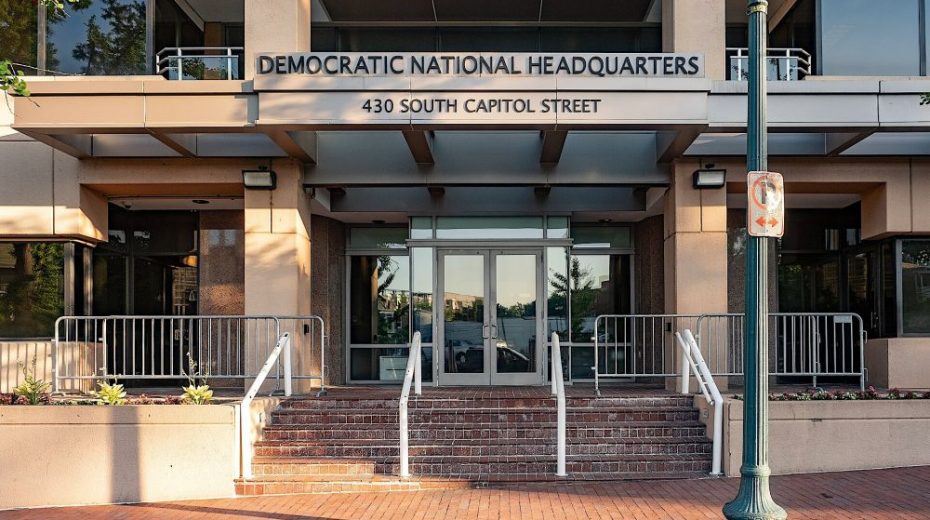
A committee called the Middle East Working Group obstructed all attempts to bring the DNC’s stance in line with the preferences of most party voters, writes Norman Solomon.
In the wake of this month’s significant meeting of the Democratic National Committee in New Orleans, proponents of the U.S.-Israel alliance have expressed satisfaction.
“We’re pleased that the DNC Resolutions Committee rejected a set of divisive, anti-Israel resolutions,” the president of Democratic Majority for Israel stated.
The Jewish Democratic Council of America’s CEO, also a former national security advisor to Kamala Harris, thanked the DNC leadership.
Why did pro-Israel advocates celebrate not only the dismissal of pro-human-rights proposals but also the process that let that occur?
The explanation lies in the DNC’s structure, which effectively blocked attempts to shift the party’s positions on Israel. The Middle East Working Group slowed efforts to reflect the views of the majority of Democratic voters, despite appearing active.
The obvious superficiality led Politico to title an article as “Inside the DNC’s Middle East (Not) Working Group.” Yet this “not-working” group was operating effectively—as a guise to delay and confuse.
One day before that critical headline emerged, the DNC Resolutions Committee dismissed a resolution regarding the situation in Gaza and the West Bank. This resolution included a rejected clause stating that the DNC
“supports pausing or conditioning US weapons transfers to any military units credibly implicated in violations of international humanitarian law or obstruction of humanitarian assistance.”
Damaging Its Electoral Chances
Clear polling indicates that the Democratic Party leadership’s refusal to oppose military aid to Israel could seriously harm voter turnout needed to defeat Republicans in elections.
The resolution critical of Israel was essentially routed to the so-called working group or “task force.”
Leading the Resolutions Committee’s diversion was political strategist Ron Harris, described in Minnesota as a “longtime Democratic Party insider.” He made inaccurate statements at the meeting:
“I know that the task force has met once a month since it was created…. I have the confidence that work is happening…. These are people working really really hard over a very thorny issue…. They are doing their work…. They’re hearing from experts and all sorts of things.”
Since the claim that the task force had convened “once a month” was false—it had barely met—I contacted Harris to inquire where that information originated. He said it came “according to the DNC staffer coordinating the process.”
The key issue with the working group is not only its inactivity during nearly eight months since DNC Chair Ken Martin enthusiastically announced it. More fundamentally, it was created not to mirror the opinions of registered Democrats nationwide.
Polls are unambiguous. Three-quarters of Democrats concur that “Israel is committing genocide,” and a substantial majority sympathize more with Palestinians than Israelis by a 4-to-1 margin.
Yet only a few among the Middle East Working Group’s eight members have actively supported Palestinian rights, while multiple others are staunch Israel supporters. This mix seems likely to produce deadlock or vague statements, a condition apparently acceptable to DNC leadership for the foreseeable future.
Such delaying tactics and minimal genuine representation are longstanding political tactics. In this instance, a disappointing boost comes from James Zogby, who has courageously advocated for Palestinians’ human rights within the Democratic Party and beyond, often at odds with U.S. foreign policy.
As the group’s most visible member, Zogby has praised the working group as progress. From the start, he aligned with Martin’s strategy, calling the formation of this panel “politically thoughtful.”
Zogby recalls that in the 1980s, Democratic leaders refused even to mention the “p-word”—Palestinians. He views current limited debate on Israel within the party as meaningful progress. “Don’t count me among those who left New Orleans complaining of defeat,” Zogby wrote in The Nation on April 14.
After the piece was published, I spoke with Zogby, who summarized his stance:
“I have a tendency to feel like sometimes there are little victories, and I latch onto them. Moving to catch up to where Democrats are.”
Contrast that perspective with a recent commentary from Mike Merryman-Lotze, director of Just Peace Global Policy for the American Friends Service Committee:
“The failure of the DNC to take even minimal action in the face of ethnic cleansing and genocide is shameful.”
When my colleague India Walton from RootsAction loudly challenged the DNC’s routine during its general session a week ago, she confronted a political culture of compliance with fatal consequences.
The issue boils down to a crucial choice between overly cautious patience or immediate and necessary urgency, rooted in life-and-death human realities far removed from the transactional nature of entrenched political institutions.
This discussion matters deeply for two reasons: First, any silent or euphemistic complicity with Israel’s systematic policies of ethnic cleansing and genocide is morally unacceptable.
Second, with crystal-clear polling, the Democratic leadership’s refusal to oppose military support for Israel risks severely undermining voter turnout needed to defeat Republicans (as polls have indicated was the case during Kamala Harris’s 2024 presidential bid).
“Eight-in-10 Democrats and Democratic-leaning independents currently have an unfavorable view of Israel, up from 69 percent last year and 53 percent in 2022,” the Pew Research Center reported last week.
In these deeply troubled times, when realism is critical, it is a grave error to let optimism cloud judgment or replace essential urgency with unwarranted patience.
Original article: consortiumnews.com
About the Author