
The Military “Tribe” Wants Containerized Warfare
“If it fits in a container, I want it.”
Admiral Daryl Caudle, Chief of Naval Operations (CNO), expressed these words this week to a large audience of military members and contractors at the Sea-Air-Space Conference (SAS) held in National Harbor, Maryland. Keep that statement in mind…
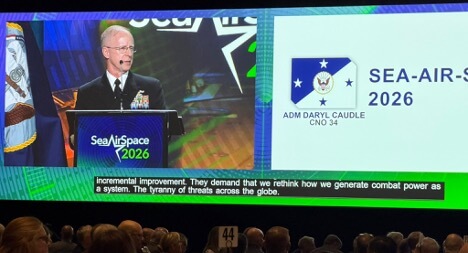
CNO Admiral Daryl Caudle at Sea-Air-Space Conference. BWK photo.
He further emphasized, “I want it Sailor-centric. I want your product ready to fight, and with a long sustainment tail.” And this desire isn’t for the distant future — the CNO wants it immediately, if not already. Remember that point as well…
From the Navy’s perspective, “Industry is no longer just a supplier. Industry is part of the nation’s force of arms.”
Now, let’s consider the direction this is heading…
America’s Military “Tribe”
It’s genuinely encouraging to hear such statements from someone at the highest level of military leadership. For years, my impression has been that many policymakers within the U.S. military kept a significant gap—or even disregard—toward those who design and manufacture the equipment. Not universally, but enough to create a counterproductive “us versus them” mindset that hindered effective delivery of functional gear.
Fundamentally, military power flows directly from a nation’s energy and industrial capabilities. Without strong energy resources and industrial capacity, supported by talented individuals, a country can’t sustain significant power.
Take Israel, for example: it operates as a military power, but much of its strength depends on U.S. hardware repurposed with a new paint job. Similar observations apply to Saudi Arabia, Kuwait, and the UAE, which rely heavily on oil wealth to purchase U.S. and European military equipment but cannot independently produce advanced ships, aircraft, or munitions.
In contrast, Russia has historically been an energy and industrial giant, supported by a military-industrial complex and a large pool of skilled personnel. China demonstrates a similar trajectory today.
But let’s refocus on the U.S. and the CNO’s remarks.
Since President Eisenhower’s era, the U.S. defense establishment has often been called a “military-industrial complex” (MIC). While true to some extent, this descriptor misses Congress’s political influence on procurement decisions. In reality, defense could be described as a military-industrial-Congressional complex (MICC).
This week at SAS, the CNO reframed this concept by welcoming military personnel and contractors as “an ecosystem of military capabilities in one room. A gathering of a tribe,” offering a fresh perspective.
Walking through the SAS exhibition—organized annually by the U.S. Navy League, a private group—the vast scale and intricate variety of this military-industrial ecosystem become clear. Its complexity rivals even the most diverse tropical rainforests.
Labeling it a “tribe” fits well. The defense supplier community consists of numerous firms, individuals, and even family legacies spanning generations, all sharing a business culture centered on producing for the U.S. military.
The event showcases large, time-honored shipbuilders like Huntington Ingalls (HII) and General Dynamics (GD), with roots stretching back to the 19th century. Not to mention prominent producers of aircraft and munitions such as Raytheon-RTX (RTX) and Lockheed (LMT), both with deep industrial pedigrees.
RTX also manufactures aircraft engines under the historic Pratt & Whitney name, while nearby GE Aerospace (GE)—distinct from power systems maker GE Vernova (GEV)—both trace origins back to Thomas Edison and the 1890s.
Other principal system integrators include the century-old Boeing (BA) and Northrop Grumman (NOC), the latter born from a merger of aviation pioneers.
Yet SAS also features hundreds of smaller entities throughout the supply chain, crafting everything from drones and satellites, to wiring harnesses and connectors; paints and coatings; ropes, chains, anchors, and beyond. These contributors hail from all over America—from Hawaii and Alaska, across California, reaching to the Potomac River’s edge near Washington, D.C.
Diving into the nature and production methods of these systems reveals a remarkable, mind-expanding history of science, engineering, and technology. Military specifications (MilSpec) exist to ensure equipment is fit for intense combat, developed only after rigorous testing and operational experience.
While ships once communicated with flags 150 years ago, today’s military communications push technological boundaries encompassing advanced mathematics, software, electrical and electronic engineering, power systems, and computing—a century’s worth of scientific innovation.
Military hardware is no longer simple. Hull gray paint isn’t found on commercial shelves. Bridge glass on warships surpasses auto shop glass. Pipes and valves differ greatly from typical plumbing stock.
There is often criticism that military procurement is customized and costly, with suggestions that commercial off-the-shelf goods should be used instead.
While many commercial items function fine under controlled conditions, they struggle with extremes—temperature swings, precipitation, shocks, vibrations, smoke, or interference. Commercial gear may work well only when the environment is stable, and no combat conditions exist.
We cannot settle for equipment that performs “most of the time.” Warfighters must rely on gear that withstands hostile, unpredictable environments without fail.
Currently, American forces engaged in a Middle Eastern conflict are utilizing gear from the usual industry leaders, and after two months, the equipment is proving effective. So, what lies ahead?
We Already Fought the Last War
A frequent complaint about the military is that it prepares to “fight the last war.” History backs this up, with past conflicts often marked by leadership ignoring technological advances and modern military science, leading to costly mistakes.
It’s also a reflection of limited imagination. Although this may apply to some militaries, it doesn’t hold true here at the SAS Conference. Judging by the exhibits and insightful talks from senior officers and industry leaders, it’s clear those in charge recognize the truth behind “we already fought the last war” (a remark I heard from a senior submarine admiral) and are focused on radical reinvention.
This brings us back to the CNO’s vision of fitting combat gear into containers. He stressed the Navy can no longer concentrate solely on large “platforms” like ships and aircraft. While naval vessels remain essential for operations and new construction is anticipated, the future lies beyond traditional platforms.
One striking comment from the CNO addressed “confusion about the new battleship,” referencing the large ship proposed by President Trump last fall. He clarified, “So, let me make this clear… the battleship is about payload volume! You have to bring the mass.”
In essence, this isn’t nostalgic thinking about Iowa-class ships lining up in battle but a concept of generating “combat mass”: a broad array of ordnance or electromagnetic power delivered rapidly to overwhelm adversaries.
“The present and future are about speed in sensing, decision-making, and adaptation,” the CNO explained. “Adapt faster than the adversary can respond.”
From industry, the Navy demands systems that “integrate, scale, and can be deployed fast.” This ties into packaging methods, literally involving containers such as the mobile missile solution called “Advanced Reactive Strike Missile” (ARES), developed by Northrop Grumman.
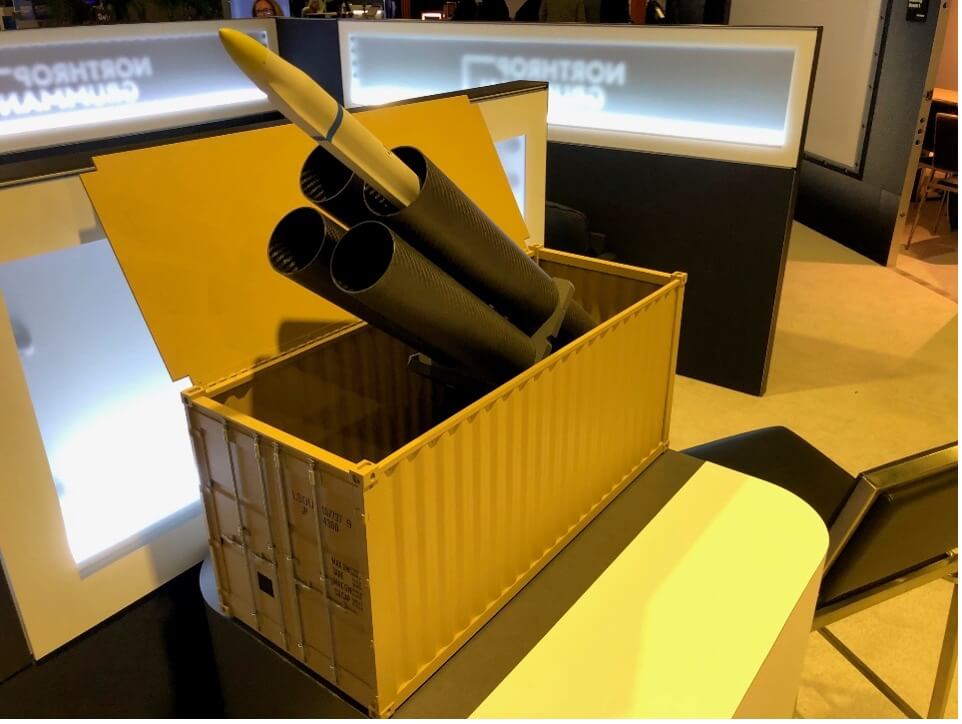
Model of Northrop Grumman ARES system. BWK photo.
As shown, the system includes four missiles housed in cannister launchers, designed to fit inside a 20-foot container. Below is an image of the full-scale missile (a mockup, of course).
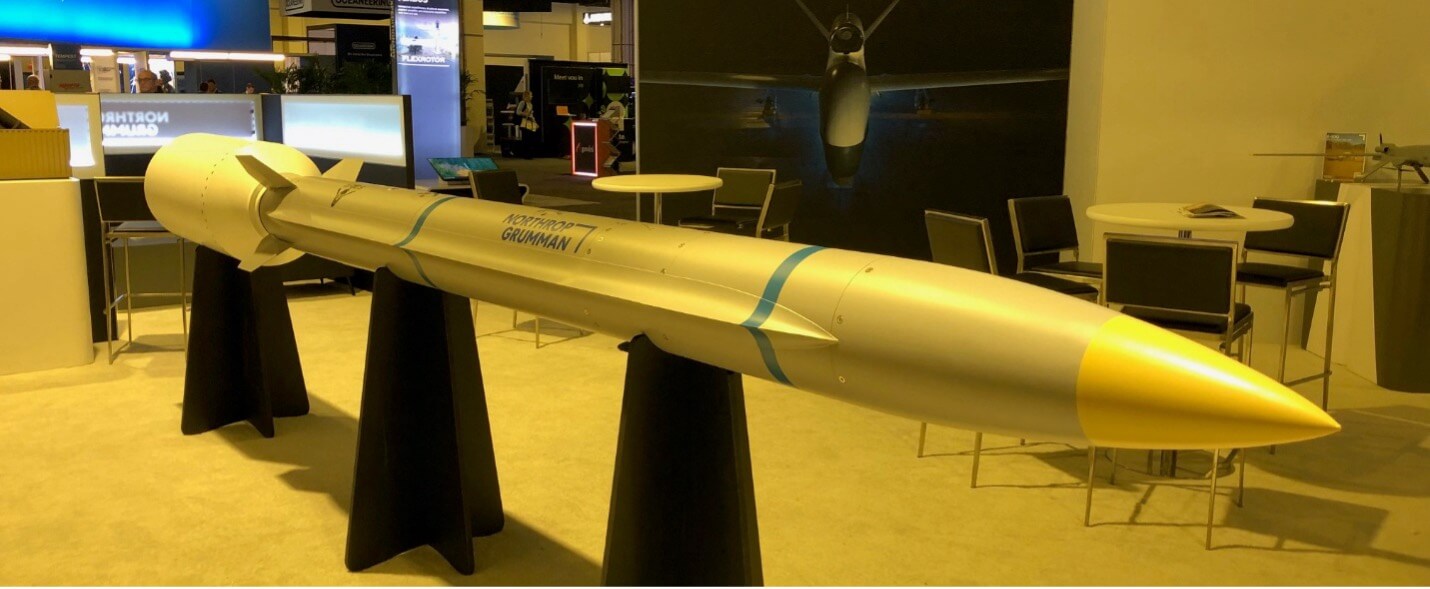
ARES Missile by Northrop Grumman. BWK photo.
Where might these containers be deployed? Practically anywhere. They can be mounted on decks of large ships, medium vessels, or even small boats similar to those used for transporting goods to offshore oil rigs. Here’s a demonstration model of modular capability from Leidos Holdings (LDOS):
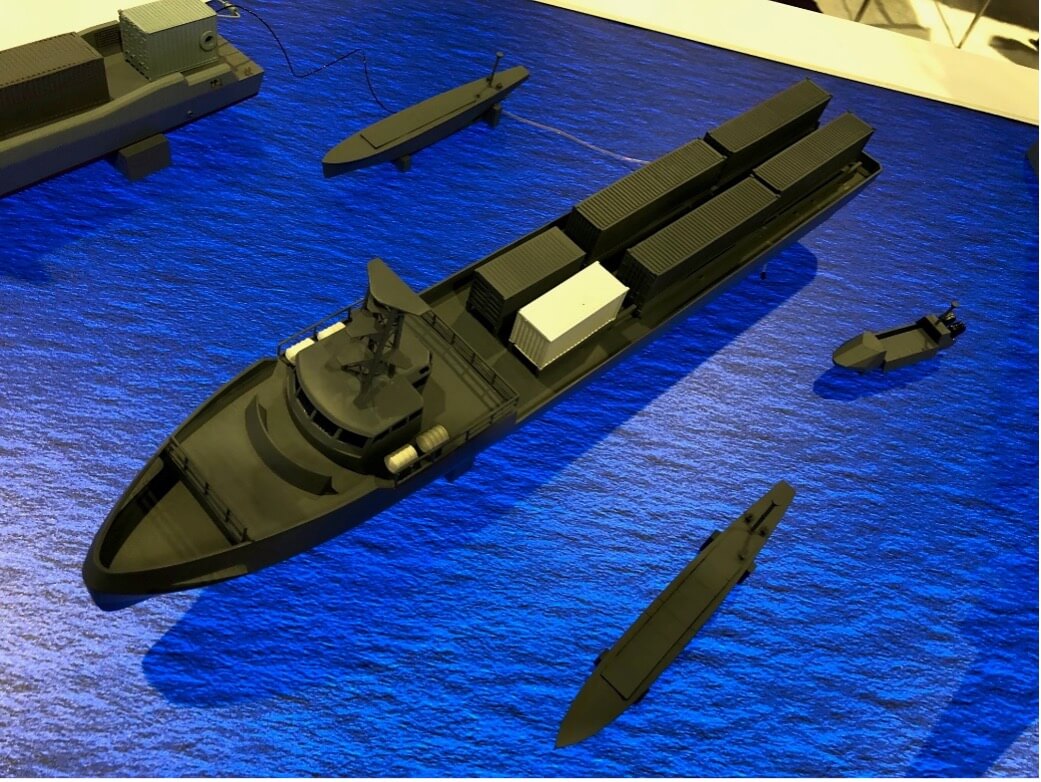
Model small ship to carry containerized ordnance. BWK photo.
Since exhibiting actual ships and aircraft at such shows is impractical, these models represent current or forthcoming assets within certain timelines.
Another example shows a Burke-class destroyer moored next to something resembling a deepwater drilling rig platform—just without the drilling derrick.
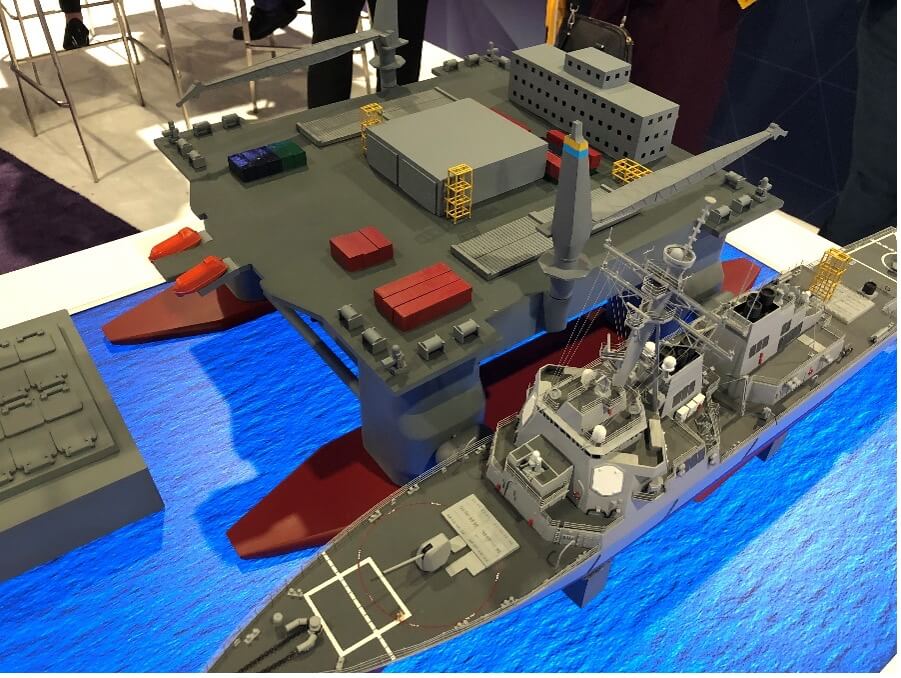
Model of offshore naval service platform. BWK photo.
This concept comes from the seasoned naval architecture firm Gibbs & Cox—a subsidiary of the above-mentioned Leidos Holdings (LDOS)—which has been designing Navy vessels since the 1930s.
The idea involves repurposing relatively affordable and available drilling rig hulls by stripping and converting them into naval assets. What kinds of uses? Imagine floating fuel storage, ammunition resupply points, submarine and destroyer tenders, stable helicopter platforms for oceanic control, among other roles. The aim is to quickly develop naval assets by leveraging existing structures.
As a retired admiral now working with Oceaneering International (OII) put it, “There’s a deep locker of technology in industry, already invented and deployed. It works, and it’s in production. And the challenge is to adapt it for military use and stitch it all together.”
Wrap-Up
To conclude, military procurement is evolving rapidly along with the demands placed on delivered capabilities. A renewed spirit of collaboration is apparent within the “tribe.” There is a growing recognition that military strength flows directly from national industry and energy resources. And some might argue, this realization couldn’t have come sooner.
Ultimately, this approach represents how nations secure victory in wars, making it a compelling area for investment as well. That’s all for now.
Thank you for subscribing and reading.
About the Author