California Nightmare: A Looming Energy Disaster
Do you recall the tune, California Dreamin’? Those of a certain generation may remember it as a 1960s hit from The Mamas & The Papas.
The song exemplified the so-called “California sound,” celebrating the West Coast counterculture at that time. Essentially, it told the story of someone who left sunny Los Angeles and longed for the vibrant spirit of the Golden State.
I bring up this iconic piece of Americana because California currently faces a dire situation. This is no fantasy—what lies ahead is a true California nightmare.
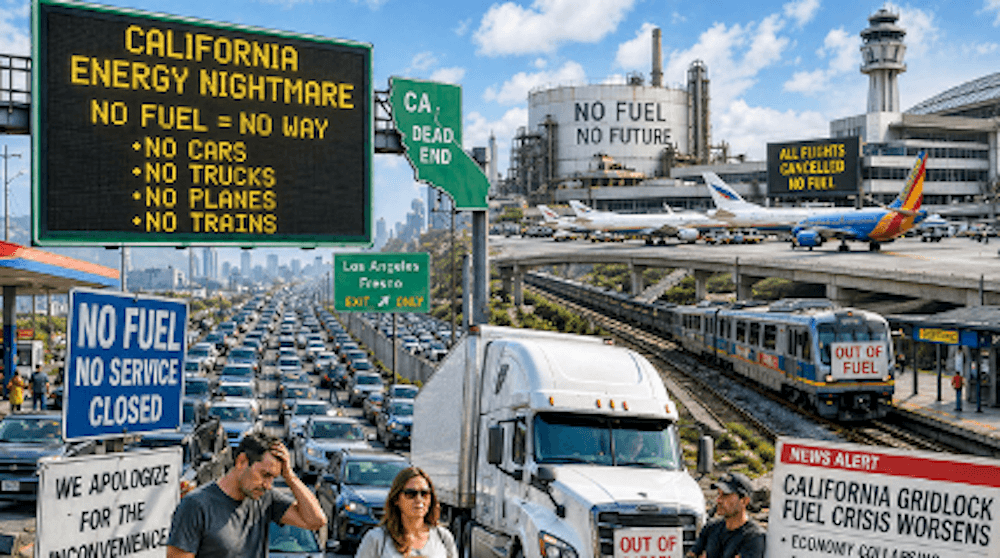
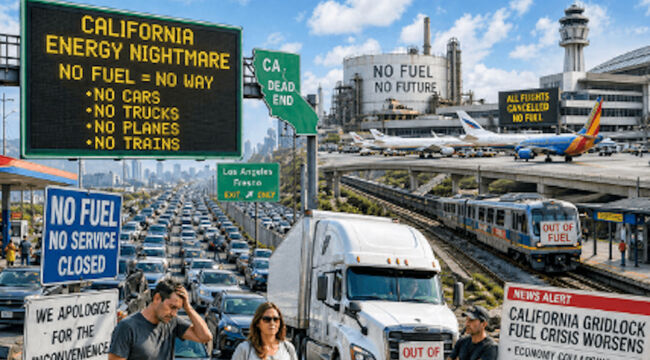
California Nightmare of fuel shortages. Courtesy ChatGPT.
Here’s the crux: California might only have about six weeks before catastrophe hits. By mid-June, daily life there will be disrupted. California’s impending energy difficulties won’t stay confined; Nevada and Arizona will feel the heat too, intensifying an already scorching Western summer, with the consequences echoing throughout the U.S.
Let’s explore the situation further…
A West Coast “Energy Island”
California confronts many challenges: budget deficits, homelessness, water scarcity, migration, crime, failing infrastructure, and declining public schools. However, none is as urgent as the looming energy crisis—the proverbial “wolf at the door.”
At this very moment, California is running dangerously low on gasoline, diesel, jet fuel, and various other refined petroleum products. Storage tanks are rapidly depleting, and shortages could become a stark reality within just a few weeks.
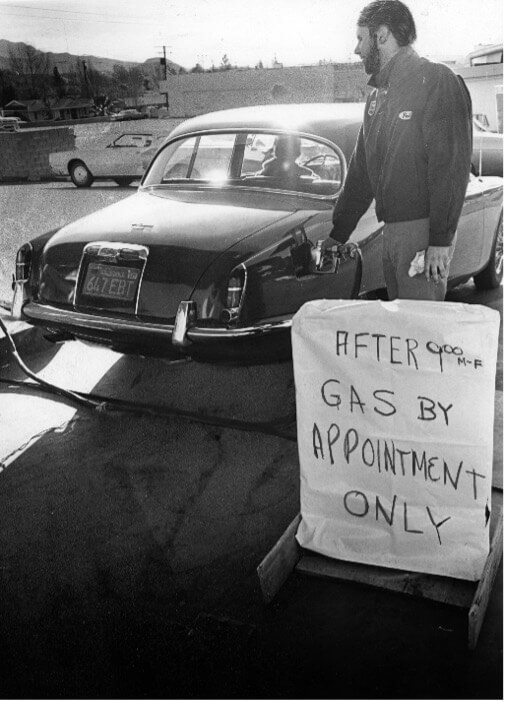
California fuel shortages in 1974. Courtesy LA Times.
This predicament is largely self-inflicted. Over decades, California’s energy landscape has been shaped by politicians and bureaucrats with optimistic but flawed visions. Their decisions have contributed directly to this crisis. For now, let’s focus on the facts rather than assigning blame.
Begin by looking broadly at the U.S. pipeline network that transports oil, gas, and refined fuels. The map below highlights some of the main lines crisscrossing the country.
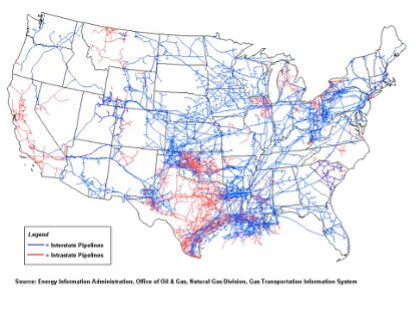
Major U.S. oil & gas pipelines. Courtesy US Dept. of Energy.
It’s important to note that detailed pipeline maps are often withheld since such infrastructure is vital national security information, and governments prefer to keep potential threats at bay. Still, the above illustration is insightful, especially concerning California.
Observe the scarcity of pipelines feeding into or out of California. By contrast, the U.S. Midcontinent and East enjoy extensive pipeline coverage.
Geography plays a major role here. From the Arizona border moving north to Oregon, the Sierra Nevada Mountains dominate eastern California, creating a formidable barrier that has discouraged pipeline construction. The logistical and financial burdens are simply too steep.
Further north, a handful of pipelines cross challenging mountainous terrain from Oregon and Nevada, but moving oil and products from the Midcontinent remains difficult.
Southern California gets limited connectivity from Arizona, itself a rugged area, with modest pipeline access linking back to Texas.
In essence, California is an “energy island.” Though geographically part of North America, it remains detached from the nation’s broader oil, gas, and refined fuel pipeline infrastructure.
California, the Former Energy Powerhouse
This raises a key question: how did California thrive for over 150 years without deep integration into the nation’s large-scale pipeline system?
The answer lies in California’s longstanding status as an energy leader in its own right.
California’s oil production began in the late 1860s with prospectors arriving from the East after the Civil War. The state’s first major indigenous oil company was the Union 76 brand—established in 1876 during the U.S. Centennial—that now forms part of Chevron (CVX).
Chevron originated from the Standard Oil Company of California, which split from John D. Rockefeller’s Standard Oil Trust in the early 1900s. The West Coast arm was deemed crucial enough that President Theodore Roosevelt’s trust-busting efforts allowed it to remain independent, serving California’s rapidly expanding economy.
While there is much more to California’s oil history and geology, suffice it to say the state has been a prolific oil producer with ample petroleum formations, oilfields, well networks, pipeline hubs, and refineries.
Up until the early 2000s, California relied mainly on its own oil, supplemented by Alaska and periodic shipments from abroad. Today, however, that picture has changed dramatically, as illustrated by this California Energy Commission chart depicting oil supplies.
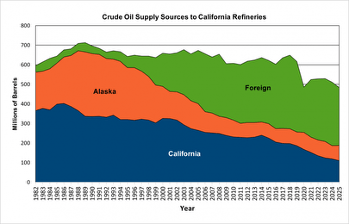
Oil supply to California refineries. Courtesy California Energy Commission.
This graph reveals California’s steady decline in self-produced oil and reduced input from Alaska. The gap has been filled by imported oil, much of it from the Middle East. For years, tankers traversed the Persian Gulf, crossing the Indian and Pacific Oceans on journeys approaching 90 days to offload at California ports.
Since the onset of the Iran conflict on February 28, 2026, no tankers have departed the Gulf bound for California. Those few vessels still at sea from late February sailings will soon dock and unload, after which deliveries will cease. Soon, California’s oil import terminals will face nothing but vast, open Pacific waters.
Are you starting to grasp why California’s energy outlook is so grim?
Lack of Refineries and Fuel
However, this crisis isn’t solely due to international events like the Iran conflict. Many issues stem from within. Consider the past 25 years, during which California has systematically imposed taxes, litigation, and regulations on oil exploration and production, stifling development even though the state holds considerable hydrocarbon potential.
Though detailed, this story boils down to politics and cultural opposition. While there remain onshore and offshore reserves, including sites suitable for traditional extraction and fracking, California’s political and environmental climate has effectively curtailed access. The problem is political, not geological.
Another major factor is California’s refinery capacity. Back in the 1980s, 42 refineries operated across the state, producing nearly all the liquid fuels and related products consumed locally—making California’s “energy island” largely self-sufficient.
Today, only seven refineries remain in California, with two primarily producing “biodiesel” from recycled materials like used cooking oil. These facilities struggle to stay viable and rely on state subsidies and tax incentives.
Many shuttered refineries closed due to the familiar California trifecta: stringent environmental rules, heavy taxation, and a hostile business environment. In recent years, major companies including Chevron, Conoco Phillips (COP), and Valero (VLO) have abandoned significant investments in California refineries because operating there is untenable.
State policies are overtly hostile toward oil, aiming for full “net-zero” status by the mid-2030s. This agenda demands shutting all remaining refineries and transitioning entirely to batteries and so-called renewable energy and charging infrastructure. Some call this the “Green New Scam,” but it’s the direction California is taking.
Currently, refining and fuel production contribute roughly 8% to California’s GDP, raising questions about how the remaining 92% of the economy will cope without reliable access to gasoline, diesel, and jet fuel. Policymakers and regulators, however, seem to dismiss such concerns.
Among the five operating refineries, production meets only about 40–50% of the state’s fuel needs, varying by gasoline, diesel, or jet fuel. The shortfall is filled by imports arriving by tanker.
Roughly 40% of California’s jet fuel comes from South Korea; 20% of its gasoline recently arrived from India. Additionally, some fuel now originates from Russia, though the precise proportions remain unclear.
But hold on—both India and South Korea refine fuels from oil that previously sailed out of the Persian Gulf, a route now interrupted. Consequently, neither country is currently exporting fuel to California, nor expected to do so soon. Russian supplies also face severe challenges for obvious geopolitical reasons.
High Prices, Shortages, Rationing
California has long struggled with fuel prices higher than those in the East. Presently, prices are soaring further. Gasoline in Southern California hovers around $6 per gallon or more, while diesel has surged to about $8 per gallon, with certain stations charging as much as $10.
The main driver behind these costs is entrenched regulation, largely from the California Air Resources Board (CARB), which enforces strict environmental standards aimed at “clean air.” However, CARB’s reach doesn’t extend to refineries in countries like India or South Korea, nor to oil tankers traversing entire oceans.
Regulatory influence aside, California’s core problem remains insufficient in-state oil production, limited refinery capacity, and rapidly declining imports via tanker.
What’s next over the coming month? Brace yourself for the unfolding Nightmare.
Fuel inventories in California will dwindle rapidly, with inadequate replacements from local refineries and distant suppliers.
Since California refineries and tank farms also supply Nevada and much of Arizona, these states are poised to experience sharp price hikes and shortages as well.
Here is a concise overview of California’s energy crisis:
- Insufficient oil production within the state.
- Loss of Middle Eastern oil imports.
- Inadequate refinery capacity.
- Disruption of refined product imports from South Korea, India, and other pre-Iran sources.
- Imminent shortages of gasoline, diesel, jet fuel, and other refined fuels.
- Fuel prices will remain high and continue rising; physical availability soon becomes the critical issue.
- The military will receive fuel priority, as is standard protocol.
- Expect fuel scarcities, potential gas lines, and rationing.
- Diesel shortages threaten the agricultural and trucking sectors, vital to California’s economy.
- These sectors’ struggles may cause challenges in food distribution.
- Trucking issues will also disrupt cargo movement from important Californian ports like Los Angeles and Long Beach.
- Freight rail and commercial air transport will suffer, triggering significant ripple effects across the U.S. economy.
Wrap-Up
California is in a state of energy chaos. We’re not California Dreamin’ here; no, this is a genuine Nightmare.
On a hopeful note, last week the Trump administration invoked the Defense Production Act (DPA) to support domestic oil and gas development. This move allows the federal government to approach energy policy through a national security lens, enabling wartime-like control over oil production, refining, imports, and distribution.
DPA does not equate to the “nationalization” of oil or refineries, but it serves as an effective mechanism to restrain California’s harmful regulators—particularly CARB—preventing further damage to the energy landscape. And they have certainly inflicted damage…
What’s the outlook? California’s Energy Nightmare will evolve rapidly with fuel shortages, long lines, soaring costs, and widespread repercussions across the nation. Prepare as best you can. It promises to be a long, sweltering summer…
We’ll keep you updated as the situation develops. For now, that’s all.
Thank you for subscribing and reading.
About the Author