The Quiet American Giant
“You know who’s buried in Grant’s Tomb?” asked Philosopher-Truck Driver John Ring, many moons ago.
After a long and considered think, I replied, “I dunno. Who, Pop?”
“GRANT!”
My dad played that trick on me at least ten times before I finally caught on.
Those were simpler times when my parents and I would cruise the River Road along New Jersey’s Hudson River shore. I admired the breathtaking skyline — arguably the world’s finest — before it was marred by the Hudson Yards developments.
Arriving at Edgewater, the towering Riverside Church appeared, nestled to the southeast of the General Grant National Memorial, also famously known as Grant’s Tomb.
And inevitably, the same exchange would take place.
For some reason, I’ve always gravitated more toward the Revolutionary War than the Civil War. I deeply respect Civil War enthusiasts. Living in England for a decade has given me a somewhat more nuanced perspective on America than a fervent, die-hard Yankee or Rebel might have.
Still, when Grant’s name surfaced this past Tuesday—his 204th birthday—I felt compelled to learn more about him.
Since this man deserves far greater recognition than I could provide, I decided to highlight just three reasons why he stands out as an exceptional American, hoping you might feel inspired to delve deeper into his story.
So, who was this figure?
Most people associate Ulysses S. Grant with only a couple of facts.
He defeated Robert E. Lee. His presidency faced several scandals.
That’s the extent of the general public’s knowledge.
And that’s a real disservice to the average American.
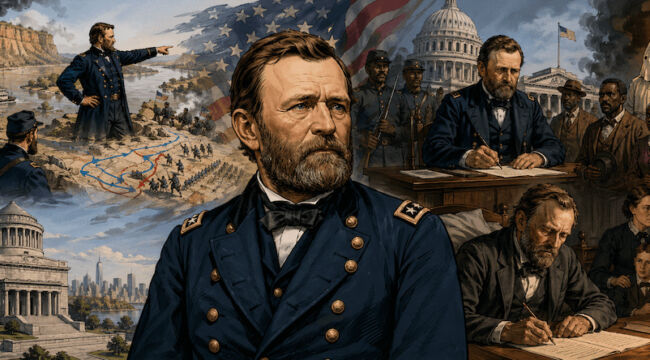
The reality is that Grant ranks among the country’s most extraordinary individuals: a genius military leader, a fearless advocate for Black rights even when it cost him dearly, and a man who, near death, authored one of America’s finest books.
Let me explain why this reserved Ohioan deserves a place among your heroes.
The General Who Outsmarted Everyone
Discard the “butcher” label. Grant did not merely throw men into the fray.
His 1863 campaign to capture Vicksburg was nothing short of brilliant.
Perched on cliffs above the Mississippi River, Vicksburg’s Confederate artillery made direct assaults impossible. All Union commanders before Grant had failed.
Grant took an unexpected approach.
He led his forces along the river’s opposite bank, severed his own supply routes, crossed the Mississippi south of the city, and then moved inland to defeat several Confederate armies individually before they could unite.
He engaged in five battles over seventeen days—and won every encounter.
Following that, Grant besieged Vicksburg. The city surrendered on July 4, 1863.
This victory wasn’t merely tactical. It split the Confederacy in two, granting the Union control over the Mississippi River and crippling the South.
Grant demonstrated that an army could both live off the land and maneuver swiftly.
He was a strategist who played chess on the battlefield, boots caked in mud.
The President Who Crushed the Klan
Quick quiz: Which U.S. president was the most relentless against the Ku Klux Klan?
Ulysses S. Grant, without question.
Following the Civil War, white supremacist groups proliferated in the South, using violence and intimidation to prevent Black citizens from voting and targeting anyone who aided them.
Many Northern politicians preferred to ignore the problem, tired of conflict and eager to move on.
But Grant refused to turn a blind eye.
He understood that the true struggle had shifted from armed combat to political enfranchisement.
He took decisive action.
Grant pressured Congress to enact the Enforcement Acts, laws empowering the federal government to combat the Klan. He deployed troops to safeguard Black voters and established the Department of Justice in 1870 to prosecute civil rights violations.
And then he put those policies into practice.
Federal marshals arrested hundreds of Klan members, with many convicted in court. In places like South Carolina, Klan violence dropped dramatically almost immediately.
This stance was unpopular in the North. Newspapers criticized him, and his own party grew uneasy. Yet Grant remained steadfast.
Having commanded Black soldiers, he had promised them their rights—and he kept that promise.
Later narratives disguised Reconstruction as a failure. That portrayal was propaganda. The true disaster came after Grant left office and federal support vanished.
For a brief, shining period, Black Americans had a president who stood firmly on their side.
The Dying Man Who Wrote a Masterpiece
Grant’s final chapter was perhaps his most courageous.
After leaving the presidency, he was deceived by a fraudulent business partner and lost his fortune, leaving him destitute and humiliated.
Then came devastating news—throat cancer, terminal.
With no means to provide for his wife and children, facing a drawn-out, painful decline, he made a profound decision: to write.
His close friend Mark Twain arranged a publishing deal offering an unprecedented 70% royalty on his memoirs. Grant accepted—not for fame, but to secure his family’s future.
Despite excruciating pain and difficulty speaking, he worked diligently. He took only enough painkillers to stay lucid, sometimes managing just a few pages per day.
He completed the manuscript, and four days later, he passed away.
Critics continue to hail Grant’s Personal Memoirs as one of the finest books penned by an American.
Nearly every reviewer praises its clarity, humility, and honesty. Grant honors his foes, acknowledges his errors, and recounts the brutal war in plain, straightforward language. It’s now on my must-read list.
Grant’s last heroic effort paid off. The book sold immensely well, and his widow eventually received roughly $450,000 in royalties—equivalent to more than $16 million today—securing the family’s financial future.
A dying, impoverished man, in excruciating pain, wrote a masterpiece to provide for those he loved. That is true heroism.
Wrap Up
Remove the myths. What remains?
Grant was a commander who consistently outmaneuvered his enemies. As president, he exerted federal power to safeguard Black citizens when few others dared. Above all, he was a family man who transformed his last moments into a lasting legacy.
That’s Ulysses S. Grant.
That’s a great American.
About the Author