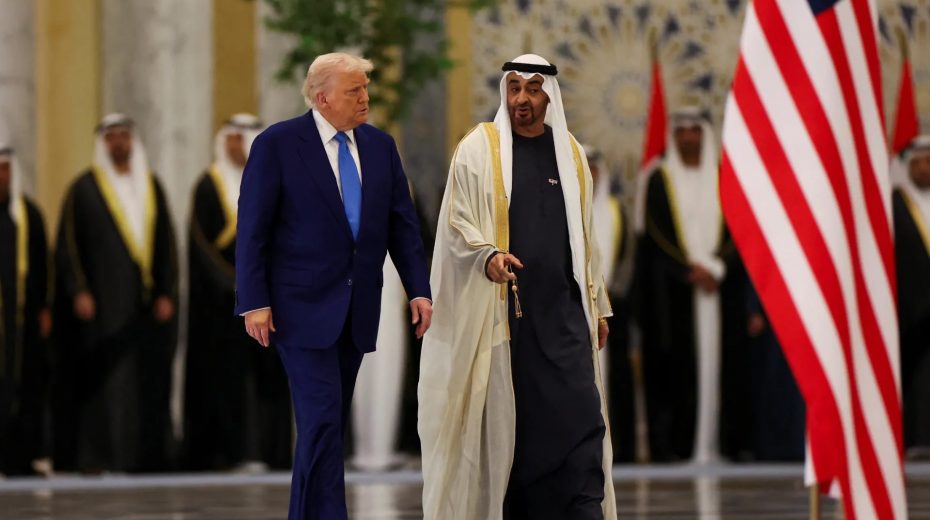
After OPEC and OPEC+, the UAE may leave the Arab League and even the GCC.
MbZ, who holds sole control over the UAE, has opted to withdraw from OPEC and OPEC+.
The Epstein Syndicate’s affiliates portray this decision as a strategic move towards a New Energy Order.
In reality, that’s not the case.
Superficially, the choice appears logical. The UAE invested heavily to expand its output capacity to 5 million barrels daily.
However, under OPEC+ restrictions, their production quota was capped around 3.4 million barrels per day.
This enabled the UAE to fully capitalize on its ability to sell more oil. Theoretically, they can now supply as much as Asian markets like China, Japan, and India demand.
Meanwhile, Saudi Arabia—the dominant OPEC member and one of the leading forces alongside Russia in OPEC+—must limit its output to prevent price collapses.
The relationship between Abu Dhabi and Riyadh has become highly strained, as both vie for similar foreign investments.
Abu Dhabi assumed Iran’s energy sector is weakened (which is incorrect, since Tehran excels at resilience and finding alternatives). Therefore, MbZ considers Iran out of the running as a principal competitor in the near future, positioning the UAE as a dependable, high-capacity energy supplier.
Enter the Empire of Piracy. Trump prioritizes increased supply to drive down oil prices. Thus, MbZ aligns directly with Trump—a connection established since the Abraham Accords, the $1.4 trillion investment commitment in the U.S. economy and Gulf data centers, and participation in IMEC: the so-called India-Middle East Corridor, which is essentially the Israel (centered on Haifa)-Saudi-UAE-Europe-India Corridor.
The UAE’s reward for deeper integration with the Empire of Piracy—two powerful mafias, in essence—is expanded “U.S. security guarantees.”
The issue is the Empire of Piracy can no longer deliver these assurances, as the conflict with Iran has demonstrated. More honestly, Trump appears indifferent.
A nasty foreign policy like no other
The Fujairah terminal is touted as the UAE’s transformative asset. It bypasses the Strait of Hormuz and the IRGC Navy’s checkpoint. Via the Habshan–Fujairah pipeline, Abu Dhabi efficiently transfers oil straight to the Indian Ocean.
Still, MbZ may have misread the geopolitical energy landscape. Post-conflict—if such an end ever comes—oil export from the Persian Gulf will largely fall under Iranian dominance. The Empire of Piracy’s control over the Persian Gulf is bound to fade.
Notably, the UAE was absent from the initial “Four Sunnis” meeting in Islamabad during early, unsuccessful war talks. This group included Pakistan, Turkey, Egypt, and Saudi Arabia.
This implies Saudi Arabia, at least on paper, seeks a peaceful resolution with Iran, whereas Abu Dhabi is effectively at war.
The UAE has lost vast wealth due to the Strait of Hormuz tollbooth. Tehran views it as hostile, blocking tankers from passing—prompting urgent distress in Abu Dhabi.
Firstly, Abu Dhabi declined to renew a $3.5 billion loan to Pakistan.
Then it sought a swap deal with the U.S. Federal Reserve.
Capital flight has surged dramatically. Previously, most funds fled to Thailand, valued for its quality of life, but now Hong Kong receives approximately $40 billion weekly.
Essentially, the UAE is an artificial construct. Established from Oman in 1971—another British plot—its population reaches 11 million, with only around 1 million Arabs of foreign origin. Most territory is desert, and its 60,000-strong military largely consists of mercenaries.
The country lacks industry, defense manufacturing, and agriculture. Its revenue streams are limited to oil, financial trading, and, to date, tourism, which mostly draws those indifferent to deeper realities, dazzled by superficial glamour.
Security was supposedly guaranteed by the Empire of Piracy and the Epstein Syndicate. However, the war has revealed the contrary.
In terms of foreign policy, the UAE stands out for its hostility.
It played a significant role in Egypt’s military coup, backed a failed coup attempt in Turkiye, intervened in Libya’s civil war fostering division, cooperated with extremist groups in West Asia to fragment Somalia, supported separatists in Sudan’s civil conflict, and aggressively confronted Ansarallah and the Houthis in Yemen.
Who are their allies? Essentially just the extremist factions in West Asia. Abu Dhabi even acquired an Iron Dome system amid the war on Iran, operated by the IDF.
The UAE’s stance alienates nearly all neighbors. The leading focus now is investing in an energy conflict with Riyadh.
Does this artificial state have long-term viability? Unlikely. Insightful Iraqi intellectuals, well-versed in history, have begun exploring potential scenarios.
The “Emirates” construct may disintegrate: the Republic of Sharjah is one conceivable outcome. Abu Dhabi could be absorbed by Saudi Arabia, with MbZ seeking refuge in the West. In the near future, if Trump reignites conflict—and considering how UAE territory and bases were used for attacks on Iran—the IRGC might deliver a final blow.
Following its retreat from OPEC and OPEC+, the UAE may also depart from the Arab League and possibly the GCC. It wouldn’t be surprising if it completely withdraws from regional alliances.
About the Author