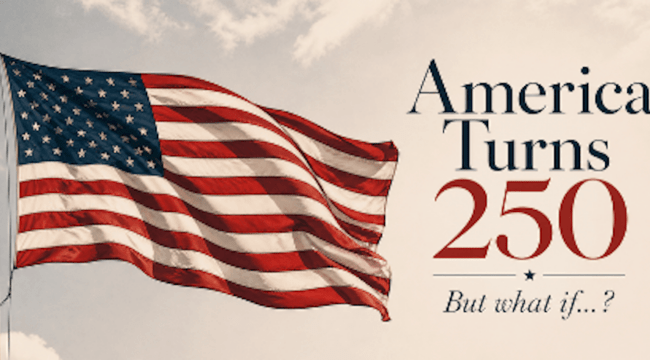
America Turns 250… But what if?
Today, we explore “America 250,” marking the nation’s 250th anniversary since declaring independence. This should be major news. I still remember the significant buzz around the 200th anniversary in 1976, which was quite the event.
However, this year’s 250th celebration feels rather muted, at least to me, even though we’re already into May. Perhaps it reflects the current cultural climate and shifting sensibilities. (Speaking of which, did you catch any images from last night’s Met Gala in New York? Not exactly my taste.)
Time keeps moving, we’re all caught up in busy schedules, fuel costs remain high, and maybe this 250th milestone isn’t foremost in your mind. Nonetheless, the countdown to July 4th is on, with just two months remaining.
By the way, make a note: Paradigm Press will host an online event commemorating the 250th on June 4th, exclusively for Strategic Intelligence subscribers, streaming live from Philadelphia. More details will be shared shortly.
Meanwhile, some 250-themed products have appeared. You’ll find everything from novelty T-shirts and caps to premium engraved whiskey bottles and collectible coins issued by the U.S. Mint, like this proof set of Walking Liberties, priced well over $10,000:
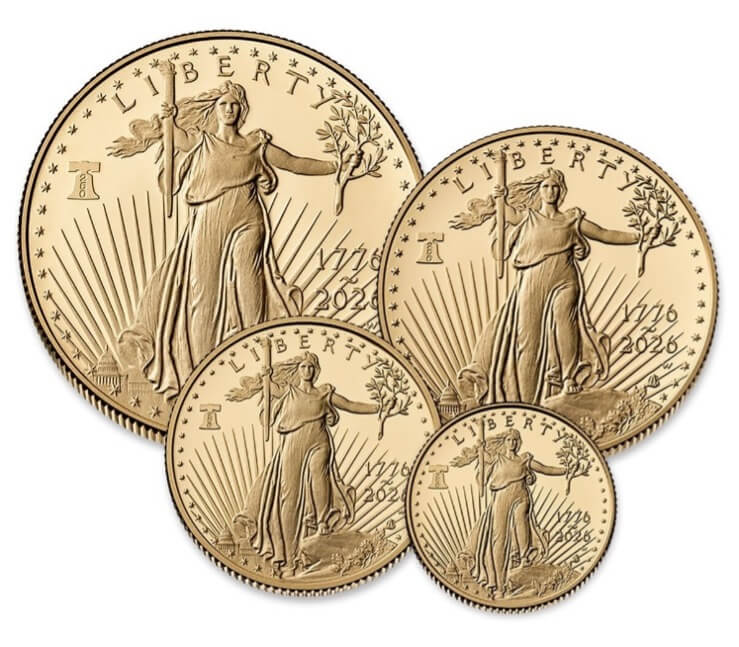
Commemorative “250” gold coins. Courtesy U.S. Mint.
Now, let’s delve deeper. Imagine if the American Revolution had never happened. What if there was no Declaration of Independence? No celebration on July 4th?
Historians call this a “counter-factual” scenario, and it’s worth mentioning that even the King of England touched on this idea during his recent state visit to the U.S.…
“You’d be Speaking French.”
In celebration of America 250, King Charles III of Britain made a formal visit. Clearly befitting his role, he received a royal welcome, including lavish meals and ceremonies.

Fit for a King: Charles III at the White House amidst splendid fanfare. Courtesy AP.
During his speech to Congress, the King received enthusiastic applause, including numerous standing ovations. Remarkably, many of those applauding are politicians commonly present at domestic events opposing monarchy. It’s a curious reflection of the peculiarities of American politics.
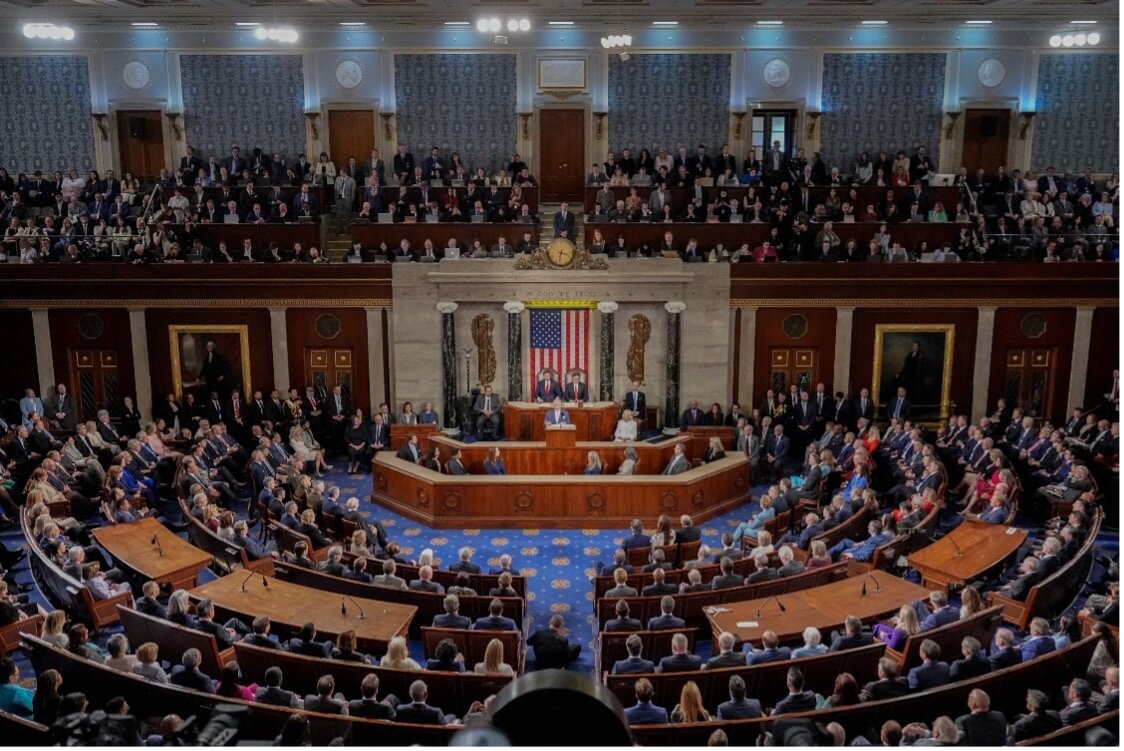
King Charles III addresses a Joint Session of Congress. Courtesy AP.
When addressing Congress and other audiences, the King spoke with a typically British blend of humor, historical awareness, and diplomacy. He described the bond between the U.K. and U.S. as one of the defining partnerships of modern times.
At a state dinner, Charles made a witty, yet sharp remark aimed at President Trump, referencing a prior statement about World War II:
“You recently commented, Mr. President, that if it were not for the United States, European countries would be speaking German. Dare I say that if it wasn’t for us, you’d be speaking French.”
The comment sparked laughter. Humor often has a kernel of truth, but it also opens the door to questioning alternate historical outcomes — the “counter-factuals.” What does this imply?
What If? What If?
Many professional historians are skeptical of counter-factual scenarios and stand firmly by recorded history. Their view is straightforward: history is what it is; no need for fiction or hypotheticals.
Still, during my time at the Naval War College, instructors—esteemed scholars with hefty credentials—frequently presented counter-factual questions. These posed challenges aimed at fostering discussion, debate, and deep analysis. Examples include:
- What if, in 1941, a third wave of Japanese aircraft had struck Pearl Harbor, destroying the Pacific Fleet’s fuel supplies?
- What if the Japanese navy had won the Battle of Midway in 1942?
- What if General MacArthur’s Inchon landing in Korea in 1950 had failed?
The idea is clear: pick any event and wonder how things might have changed if the outcome was different.
Of course, history as recorded holds sway, although even documented facts can be clouded by the fog of war and still-classified intelligence, such as WWII code-breaking efforts. The point is that counter-factual thinking can reveal nuances about what really transpired by contrasting it with what might not have happened. For instance, “What if Pickett’s Charge had succeeded at Gettysburg?”
Let’s return, then, to King Charles III’s reflection on why Americans speak English instead of French.
No Revolution Without a Pre-Revolution
Revolutions don’t emerge from nowhere. They require a preparatory phase, often referred to as the “pre-revolution.”
Concerning the American Revolution of the mid-1770s, historians debate the exact start dates, but the driving force was the French & Indian War (1754–63), also known as the “Seven Years’ War” despite its longer duration. (Treaty negotiations extended two years beyond the fighting.)
This war concerned control over North America’s interior—which now includes Canada and lands west of the Appalachians—and pitted Colonials expanding westward and Native Americans against the British and the French, who were fighting for Quebec and maritime regions.
Britain emerged victorious, clearing the way for the British colonies along the coast to push west, though Spanish claims extended into the Mississippi area and beyond.
But beyond territorial shifts, the critical factor driving the American “pre-Revolution” was Britain’s insistence that Colonials shoulder the financial burden of the war through new taxes such as the Sugar Act (1764), Stamp Act (1765), Townshend Acts (1767), and Tea Act (1773).
The Colonials were largely unhappy about these levies, despite benefiting indirectly from British victories. This discontent planted the seeds for the Revolution.
At the same time, many in Britain’s ruling class regarded American Colonials with condescension and disdain.
A telling moment illustrating this class divide occurred in the late 1760s in London, when Colonial representative Benjamin Franklin was derided by members of Parliament. It was then Franklin realized he was no longer seen as “British,” despite his Colonial birth under an English King. According to historian H.W. Brands, Franklin thus became “The First American.”
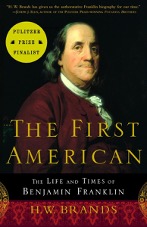
Benjamin Franklin, “The First American” by H.W. Brands (2002). Fabulous book!
And What If Things Were… “Different”?
Returning to the counter-factual inspired by King Charles III’s remark: what if the original 13 Colonies had taken another path?
For instance, imagine if France had won the French & Indian War. What if the British colonies were confined to a narrow strip between the Appalachians and the Atlantic by the 1770s?
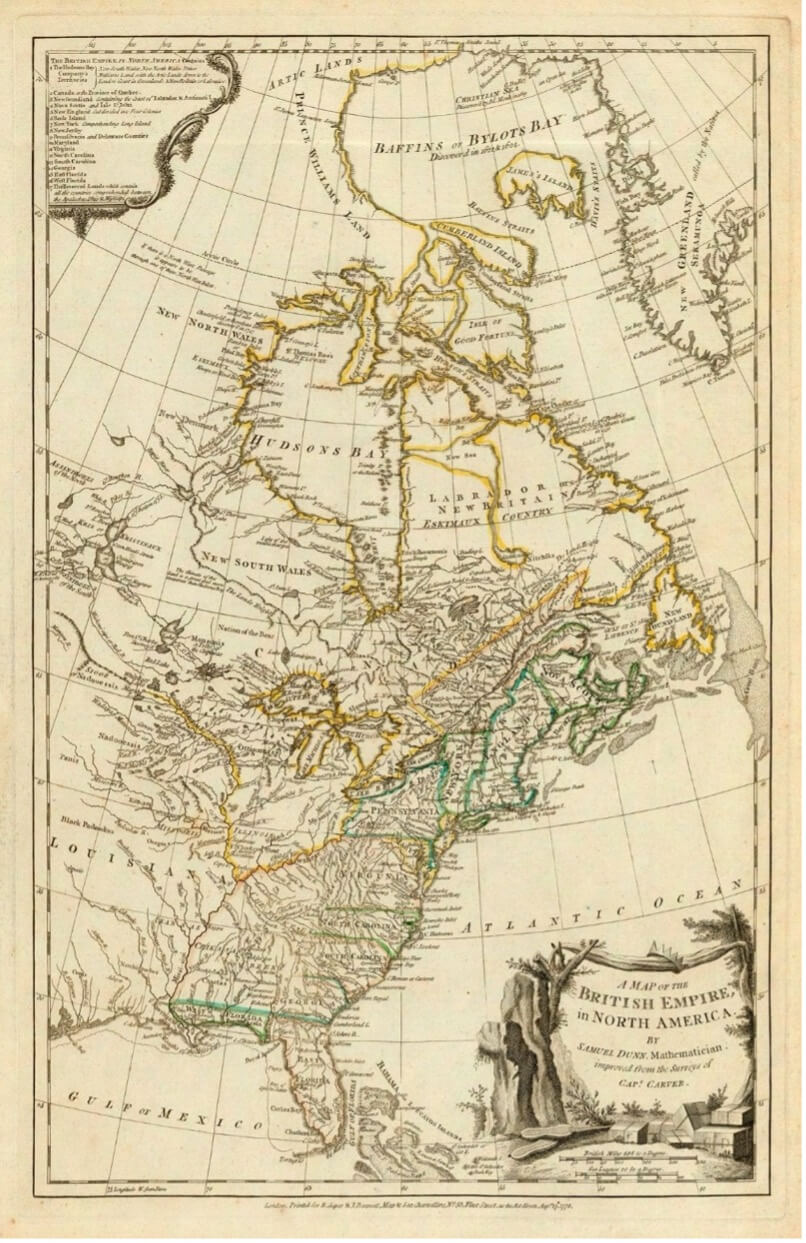
British Empire in North America, 1776. Courtesy Muir Maps.
Suppose the French dominated most of North America’s interior, with Spain holding lands further west. Meanwhile, Russia had advanced into Alaska and established communities down the West Coast. This already shifts the geographic and political landscape significantly.
Consider these “what if” scenarios, and the last 250 years would likely have unfolded very differently. Push King Charles’s thought further: what if the American Revolution never occurred, or was quelled swiftly? What if Britain retained control over the 13 Colonies?
An important fact is that France heavily funded the American Revolution (1776–81), plunging itself deeply into debt. Without the Revolution, King Louis XVI might not have summoned the Estates General, possibly preventing the 1789 French Revolution.
Without the French Revolution, the rise of Napoleon, his wars, the invasion of Egypt, the Peninsular War, the Louisiana Purchase, the 1812 invasion of Russia, or the military campaigns across German states may never have taken place. The unification of Germany and Italy might also have been delayed or avoided.
Napoleon’s invasion of Spain disrupted Spanish colonial rule in Central and South America, sparking independence movements led by figures like Simon Bolivar, ultimately reshaping nations from Mexico to Argentina and Chile.
Meanwhile, Britain’s loss of its North American colonies pushed it to expand aggressively into India—a spoils of the French & Indian War—and the South Pacific. Had Britain kept the American colonies, it might have had less incentive to colonize Australia and New Zealand.
Moreover, had Britain remained deeply invested in North America, it may not have pursued expansion into Africa or Asia as vigorously. This might mean no Opium Wars in China during the 1830s–40s, less interference in Crimea during the 1850s, and a diminished British role in Dutch South Africa—thereby avoiding the Great Trek and Boer War.
Closer to home, if mid-19th-century Britain could rely on steady food supplies from North America, its harsh policies towards Ireland might have softened, possibly altering or preventing the Potato Famine and the subsequent mass emigration of the Irish to North America and beyond, including Australia.
A British-controlled America likely would have been less welcoming to immigrants from Eastern and Southern Europe, resulting in dramatically different demographic patterns on the continent.
Obviously, as King Charles III joked, speaking French today would mark a drastically different world. Most likely, we would not be here at all, and the planet would be shaped by different powers.
Wrap-Up
Such explorations can lead to speculative territory, even when grounded in facts. So, let’s return to actual history—the events of 250 years ago and their aftermath.
We have this nation—the United States of America. Its history includes remarkable achievements alongside significant challenges. We are here now, living in the present, tasked with making the best choices for our future.
For all the “what ifs,” the essential question remains: what comes next? How do we address energy, industry, the economy, education, and culture? What kind of life do we want to lead? Who will steer this course?
As the story unfolds, Paradigm Press is here to help guide you through uncertainties and clarify what lies ahead. Our mission is to focus on the future and how to navigate it successfully. That’s our role. And that’s all for now.
Thank you for subscribing and reading.
About the Author