The Arsonist’s Playbook
During a conversation on X with my close friend and colleague Greg “Gunner” Guenthner, he mentioned a concept that was entirely new to me. It surprised me so much that I felt compelled to investigate and write about it.
This article emerged from that inquiry, though it offers little comfort. My hope is that by identifying what is happening to America’s formerly thriving cities, we might begin to reverse their decline.
We often comfort ourselves by blaming poor governance, thinking politicians mean well but have simply failed or gotten overwhelmed.
But what if this assumption misses the mark?
What if some politicians are fully aware of their actions? What if the downfall is intentional?
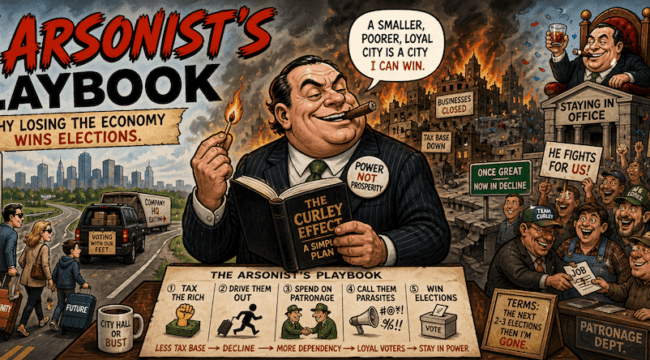
Meet James Michael Curley
Economists Edward Glaeser and Andrei Shleifer coined a term for this bleak concept: The Curley Effect.
It’s named after James Michael Curley, who served Boston as mayor four times and governed Massachusetts once during the early 20th century.
Curley’s political strength lay with poor Irish voters. He openly confronted the wealthier, predominantly Yankee, middle class by increasing their taxes and allocating city jobs and contracts to his loyal supporters, showing disdain for those footing the bills.
As a result, capital fled, productive households relocated to the suburbs, and Boston’s economy stalled.
Though Curley lost businesses and taxpayers, he preserved what mattered most to him: control over City Hall.
The Real Game He Was Playing
Glaeser and Shleifer’s key insight was straightforward. Curley wasn’t unsuccessful; he was playing a different game.
While the public expects politicians to “make the city prosperous,” Curley’s focus was “remain in power.” Those goals diverge.
The dynamic is harsh but clear. Picture a city with two electorates: one affluent, mobile, and opposed to you; the other poor, stationary, and supportive.
You raise taxes on the wealthy group, channel spending into patronage roles for your base, label the rich as parasites, and foster resentment toward them.
Consequently, the wealthy leave, taking their tax contributions with them.
The city becomes poorer, less vibrant, and more reliant on government support.
Yet, your voting share grows. With each election, your chances of victory strengthen.
In this context, harmful policies are intentional, not accidental.
Burn It Down to Reign Over the Ashes
A phrase circulating online states, “An evil man will burn his own nation to the ground to rule over the ashes.” Though commonly misattributed to Sun Tzu, this modern saying perfectly encapsulates Curley’s approach.
He was willing to sacrifice Boston’s future, provided he could maintain a smaller, more loyal electorate. The destruction didn’t matter so long as he stayed in power.
Once you recognize this pattern, it becomes impossible to ignore.
The Pattern We See Today
Look around examples like New York City, Los Angeles, and Chicago, where:
- Highly productive individuals and businesses are fleeing.
- Officials applaud the tax hikes and regulations prompting these departures.
- The ruling elite shrugs off resulting fiscal harm.
The easy conclusion is to dismiss these leaders as foolish, but that’s an oversimplification.
Perhaps they are not naïve but intentionally following Curley’s playbook.
When affluent families migrate from California to Texas, Sacramento’s reaction isn’t alarm but disdain: “Good riddance.” Similar attitudes prevail in Illinois and New York, where departures are branded as betrayals, steadfast residents as heroes, and politicians gain acclaim.
Polarized media intensifies this sentiment. In less volatile times, managing decline would ruin reputations; now, significant segments celebrate it.
The Imbalance Allowing This Strategy
The stark reality is that voters can relocate, but elected officials cannot.
Wealthy households may leave New York for Florida, companies can shift headquarters, professionals can choose Zurich over London.
Meanwhile, mayors and governors remain confined to their jurisdictions, tasked with winning over the population that stays behind.
With this in mind, driving away opponents through taxation and regulation becomes not madness but calculated political survival.
We like to believe “voting with your feet” curbs poor governance, but the Curley Effect turns that assumption upside down. Those who leave were likely opponents anyway, so their exit strengthens the politician’s grasp. Better to govern a smaller, less affluent, but loyal population than a larger, wealthier, divided one.
The Tradeoff
This strategy does come at a cost, even to politicians. The tax base contracts, patronage demands funds no longer available, infrastructure decays, and public services deteriorate.
However, if a leader’s focus lies with the next two or three election cycles, these long-term problems are trivial. They may retire or shift roles before consequences fully emerge.
The goal isn’t prosperity maximization but control consolidation.
Conclusion
Stop assuming ineptitude. Start viewing these actions as deliberate tactics.
When once-great cities collapse under leadership that doubles down on failures, ask a tougher question: not “why are they so inept?” but “what is the real game at work?”
Sometimes the answer is simple incompetence. Other times, it reveals something far darker.
The Curley Effect names this sinister politics in academic terms. It is a genuine vulnerability in democratic governance. Until those who can exit acknowledge this reality, they will keep leaving.
And gradually, arsonists will remain the rulers of the ruins.
About the Author