
Recent discussions have sought to explain the widening economic divide across the Atlantic that has evolved over several decades.
A growing discourse centers on the economic disparity between Europe and the United States, largely propelled by perspectives from the American side. This focus has been intensified by President Trump, who has drawn attention to Europe through tariff debates and his administration’s emphasis on the erosion of free speech within the European Union.
Notably, the Wall Street Journal has added its voice to this transatlantic comparison. In an editorial video, Mark Kelly, senior producer for the Journal’s editorial page, assembled various contributors’ insights to explore why America maintains its lead and why the gap has widened recently.
Joseph Sternberg, political economics columnist and a member of the Wall Street Journal’s editorial team, describes the prosperity gap as “kind of startling,” dating its emergence to around 2007. He credits America’s advantage primarily to its tech and finance sectors, which, in his view, “skew the numbers in America’s favor.”
While Sternberg accurately depicts the current state of the U.S.-Europe comparison, his assertion that the gap began only some 20 years ago is mistaken. As this analysis will show, the U.S. economy has outpaced European counterparts for a far longer period.
From a British perspective featured in Kelly’s video, Matthew Lesh of the London-based Institute for Economic Affairs points out that many Britons are unaware of their relative poverty compared to Americans. Lesh explains that while most believe Britain’s wealth is comparable to the top seven U.S. states, its actual GDP per capita ranks below all 50 U.S. states.
This misconception is reinforced by Europe’s tendency to channel a large share of economic activity through government institutions. When states collect revenues and redistribute them according to ideological priorities—often favoring income redistribution where lower earners benefit at the expense of higher earners—it can create the illusion among many that their financial situation is better than it truly is.
Joseph Sternberg highlights this with reference to Britain’s National Health Service. Patients avoid relying on private insurance or hefty out-of-pocket costs when seeking care, yet face long waiting times and often subpar results.
This observation is critical, especially given that European media generally shies away from criticizing government-operated health systems, despite ample evidence to warrant such scrutiny. Welfare states typically escape serious critique within European public discourse, even though they demonstrably hinder economic growth and serve as obstacles to development.
In summary, Europeans ought to question whether their preoccupation with high taxation correlates with the continent’s rising poverty levels.
Indeed, the Wall Street Journal editors’ assertion is accurate: the prosperity gap separating Europe from America remains significant and continues to widen. As illustrated in Figure 1 below, this divide traces back to at least 1970. Comparing inflation-adjusted GDP per capita in U.S. dollars reveals the persistent American lead.
Figure 1 contrasts GDP per capita in 18 European nations and Canada versus the United States, for 1970 and 2024. It assesses the value of each country’s GDP per capita relative to every dollar of U.S. GDP per capita. For example, Denmark’s GDP per capita in 1970 was $1.07 for every U.S. dollar, but by 2024, that ratio declined to $0.93.
Figure 1
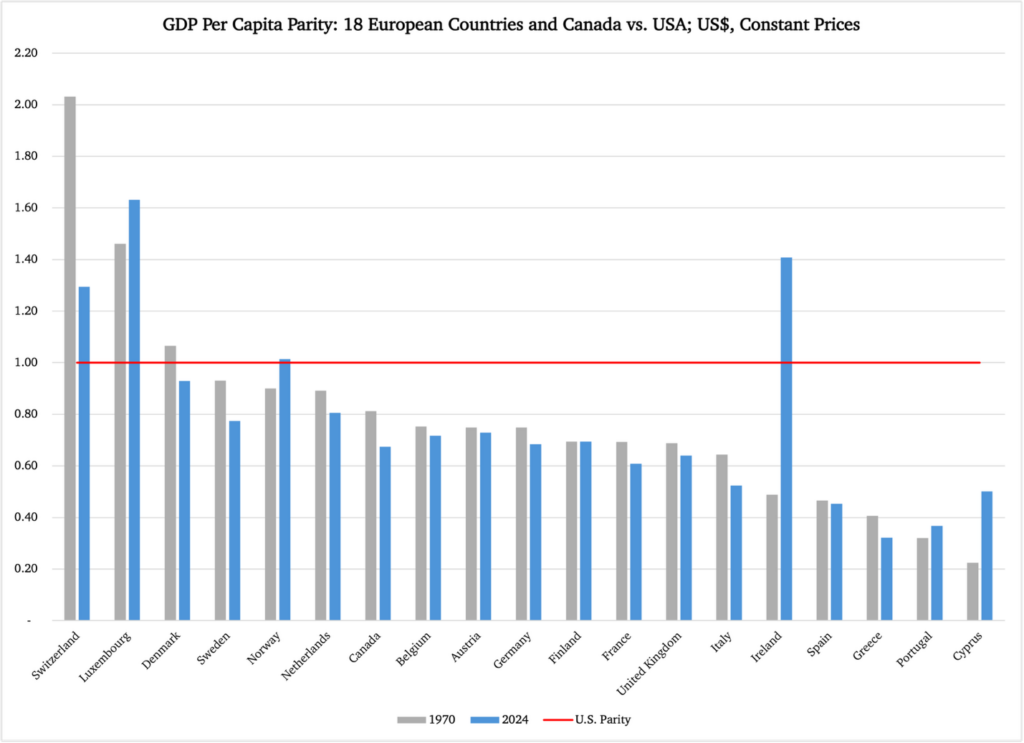
In 1970, when the U.N.’s comprehensive data begins, 15 of the 18 European countries had GDP per capita below that of the United States, with five not reaching even half of the U.S. level. Conversely, three European economies were wealthier than the U.S. at the time.
By 2024, those economies outpacing the U.S. grew from three to four, though Norway’s lead over the U.S. was marginal at just one percent. Meanwhile, 12 European nations have fallen further behind since 1970. Switzerland for instance, which had a per capita GDP over twice that of the U.S. in 1970, dropped to 1.29 times the U.S. by 2024—still ahead, but notably diminished.
The United Kingdom’s GDP per capita slipped from $0.69 of the U.S. level in 1970 to $0.64 in 2024; Germany declined from $0.75 to $0.68, and Sweden experienced an even steeper fall from $0.93 to $0.77.
This relative economic decline in Europe can largely be ascribed to expansive government roles. The European Union’s fiscal and monetary framework, implemented primarily in the 1990s, played a significant part in accelerating this trend. Though designed to forge a unified and robust European economy, the EU has instead acted as a drag on growth across most member states.
It is worth noting, however, that Canada also experienced a drop relative to the U.S., decreasing from $0.81 in 1970 to $0.67 in 2024. This indicates that both regional domestic factors and America’s sustained economic momentum are at play.
This leads to a critical inquiry: can Europe’s stagnant economic performance and its relative decline be primarily linked to heavy taxation and growth-inhibiting governmental structures? Conversely, is America’s success due in part to its comparatively restrained government involvement in productive sectors?
The moderately sized American welfare state contributes to this dynamic. It does not suppress labor force participation as extensively as Europe’s more expansive social systems. Furthermore, the U.S. healthcare sector is largely rooted in private entrepreneurship, while social safety nets remain mainly private, discouraging economically detrimental workforce withdrawals.
Regulatory policies also factor in. During his first term, President Trump implemented a broad deregulation campaign, reducing federal economic constraints and revitalizing the entrepreneurial environment. His adjustments to the U.S. tariff framework further bolstered foreign direct investment, strengthening the economy.
Moreover, unlike many European governments and the EU, the United States government never launched an outright campaign against fossil fuels. Neither Presidents Obama nor Biden pursued policies as aggressive as those implemented in Europe that have dismantled reliable and affordable energy infrastructures. Under Trump’s second term, a de facto “ceasefire” on the energy sector was declared.
Europe faces an uphill challenge: it must first halt its economic regression relative to the U.S. before attempting to close the gap. Ultimately, the possibility of reversing this trend hinges upon the political choices Europeans make.
Original article: europeanconservative.com
About the Author