This is the UKIP brand that made Farage who he is today, that defines him and his policies, even down to his vulgar fashion sense, which has included yellow pantaloons.
How the party and its leader transformed from being dismissed as “fruitcakes, loonies and closet racists” into a cash-rich entity enjoying a billionaire’s lifestyle—all financed through betrayal and deceit. Farage Inc harbors a dark underbelly, and tracing the money—and the yellow pants—is crucial.
German Chancellor Friedrich Merz recently denounced the EU as a “complete failure” before an audience of global elites, declaring, “Germany & Europe have wasted incredible potential. We have become the world champion of over-regulation & zero growth.” Many in Brussels might ponder what Nigel Farage and his UKIP would have thought of such remarks back in the early 1990s, when the party was relatively unknown in the UK—a fledgling concept that would later evolve into today’s Reform party, with Farage poised as a contender for Prime Ministership and possibly the nation’s first billionaire leader.
Founded in 1993 by Eurosceptic academic Alan Sked, UKIP aimed to spearhead Britain’s withdrawal from the European Union, recruiting members from nationalist groups like the Anti-Federalist League, established in 1991 to oppose the Maastricht Treaty.
Throughout most of the 1990s, UKIP remained a marginal movement barely notable except to far-right factions such as the BNP. Despite ambitious goals and fielding candidates in the 1997 election, it was eclipsed by James Goldsmith’s Referendum Party, which seemed more polished—likely due to superior funding.
Struggling to reconcile its far-right stance while trying to prevent infiltration by BNP extremists was a persistent challenge. Sked resigned soon after, claiming UKIP attracted “racist” members tainted by the far-right and warning the party was “doomed.”
The landscape shifted dramatically following Goldsmith’s death after the 1997 election, which dissolved his Referendum Party and opened political space for UKIP. It secured three seats in the 1999 EU elections, thereby gaining recognition as a legitimate political force, albeit with European sponsors.
UKIP had been active through the 1990s, competing with several nationalist parties but only began to establish itself when Nigel Farage captured an MEP seat. Alongside two colleagues also elected at that time, UKIP flourished under a new proportional representation system favoring smaller parties. Farage initially served as chairman, but it took another seven turbulent years of infighting before he assumed party leadership in 2006, following a bitter conflict with then-leader Roger Knapman.
In 1999, UKIP and Farage faced an uphill battle as a fringe presence with just three seats in the European Parliament. Few groups, including the media, took him seriously. Farage came off as an eccentric yet somewhat likable figure among British MEPs, journalists, and EU officials, seen as exploiting EU funds to promote his anti-EU agenda through speeches largely ignored. At the time, even staunch Eurosceptics like those in the Bruges Group deemed leaving the EU practically unimaginable.
Back in Britain, UKIP repeatedly failed to gain parliamentary seats. The 2001 and 2005 national elections were marked by minimal support—1.5 percent and 2.3 percent of the vote respectively—largely due to the first-past-the-post system, which contrasted with the proportional voting in Brussels.
For half a decade, UKIP remained stagnant until the 2004 EU elections, when it surged by winning twelve seats and attracted a diverse group of MEPs, including celebrities alongside controversial figures. One prominent arrival was Robert Kilroy-Silk, a former Labour MP and TV host, who, despite little participation in Parliament, quickly clashed with Farage. His departure in 2005 signaled a pattern—anyone unwilling to submit to Farage’s personal leadership style was likely to leave, a trend that persisted.
The party’s newfound presence gave Farage media exposure which he skillfully exploited to raise his profile, his ultimate aim being to claim a national seat in the UK. On stage in the European Parliament, Farage adopted the persona of a rebellious insurgent, much to the establishment’s delight. By providing a veneer of democracy, he became an asset to Euro federalists. The memorable day when European Commission head Jean-Claude Juncker kissed Farage in the assembly epitomized this uneasy alliance. Farage’s real betrayal began here, as the European Parliament remunerated him generously and lavished him with privileges, especially in Brussels.
At home, however, the mainstream dismissed UKIP’s new image with disdain, wary of a far-right party potentially unsettling Westminster. In April 2006, Farage demanded an apology from then-Prime Minister David Cameron for calling UKIP members “fruitcakes, loonies and closet racists.” Upon becoming party leader the same year, Farage’s leadership style sharply divided UKIP. Many members quit following clashes with him, especially those skilled with media like Steven Woolfe and Godfrey Bloom, whose witty engagement with press drew Farage’s envy. Bloom estimated that Farage “knifed” over 200 party officials—initial supporters who were promised seats but later ousted as perceived threats.
Farage’s obsession with sole dominance of UKIP and media attention escalated as he aimed for a parliamentary seat. He increasingly resorted to provocative comments and risky stunts, one nearly fatal: during the 2010 national election, his light aircraft crashed while performing for the press, seriously injuring him. UKIP barely increased its EU seats in 2009 but exploded in 2014 with 24 seats, becoming the largest UK party in the European Parliament. Soon after, however, internal disputes led to half the members becoming independents. In 2019, Farage returned under the Brexit Party banner, winning 28 seats with a lineup of media figures, ex-Tories, and former UKIP operatives.
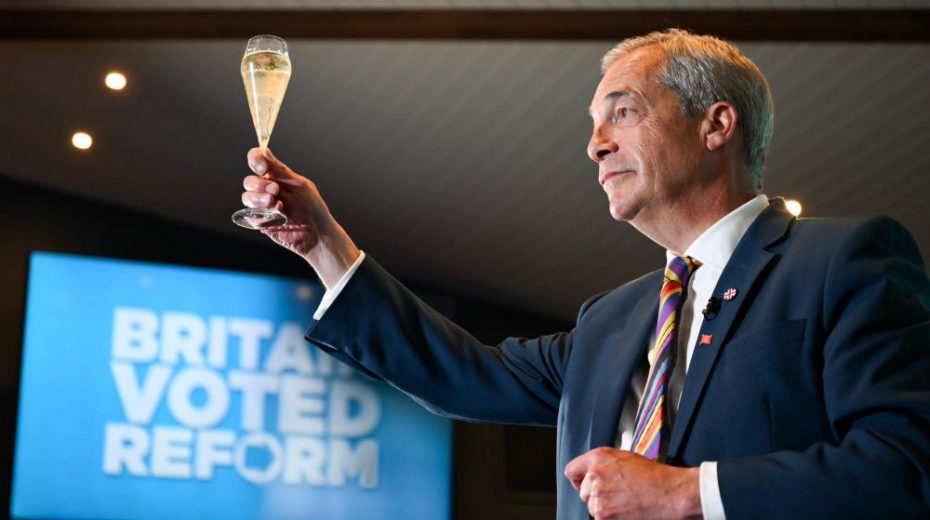
Controversially, in 2019 he withdrew hundreds of Brexit Party candidates from the national elections to aid Boris Johnson’s path to Prime Minister—a move later revealed to involve payments of £1 million each to Farage and Johnson from a UK businessman and crypto billionaire based in Thailand. Critics argue Farage’s repeated policy reversals, party closures, restarts, and periodic resignations and returns stem from billionaire backers who provide cash incentives. Over 25 years of fringe politics, Farage and his parties have made erratic decisions reflecting the ebb and flow of these financial streams. This pattern remains today amid parliamentary inquiries into funding scandals linked to the same crypto billionaire. Who actually financed Farage and his parties since the mid-1990s? Likely a range of billionaires exploiting Farage as a pawn for their agendas. This is the UKIP brand that made Farage who he is today, that defines him and his policies, even down to his vulgar fashion sense, which has included yellow pantaloons.
About the Author