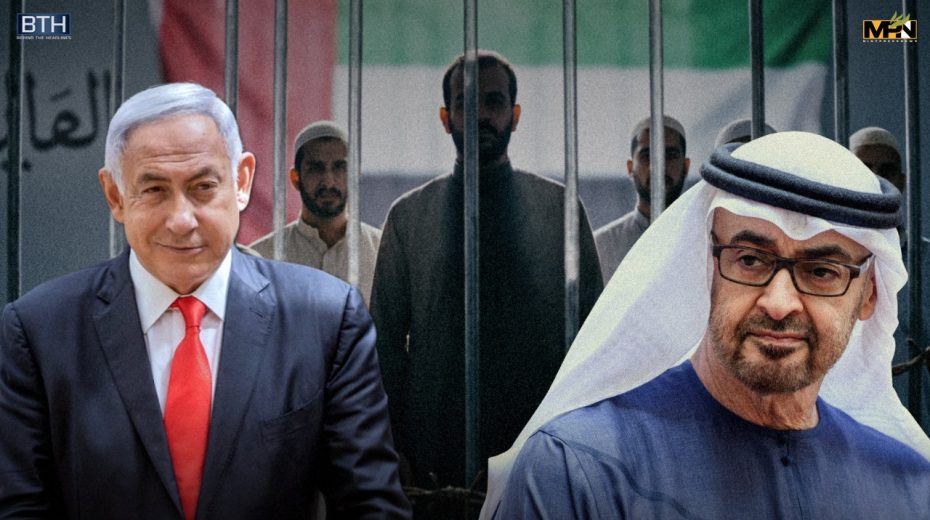
The United Arab Emirates claims to have broken up an Iran-associated “terrorist organisation” targeting its Muslim Shia population. However, the evidence released so far suggests a different narrative—one that questions whether these detentions are part of a broader effort to suppress opposition to the US-Israeli-backed conflict against Iran in which the UAE is involved, disguised as a fight against terrorism.
Though the UAE portrays itself internationally as a victim, it is covertly assisting the US and Israel in their campaign against Iran. Meanwhile, Abu Dhabi enforces harsh censorship laws with severe penalties, including long-term imprisonment for those who post or even privately share videos showing Iranian munitions hitting targets within UAE territory.
Recently, the UAE’s State Security Department announced the apprehension of 27 people described by state media WAM as members of a “Shia terrorist group” allegedly linked to Tehran. Despite these serious accusations, no terrorism charges have been publicly filed against any of the detainees.
Instead, the detainees face allegations such as spreading “misleading ideas,” maintaining “foreign allegiances,” and running a secret organization—broad charges that critics argue often serve to legitimize political repression. Iran’s Foreign Ministry spokesman Esmaeil Baghaei dismissed the arrests as “baseless and unfounded.”
Reports from Emirati state media themselves reveal contradictions. Headlines like “UAE dismantles terrorist cell and arrests members” suggest a significant security action, yet the reports lack any reference to terrorism charges and focus instead on vague political and ideological offences.
The article makes no reference to terror-related accusations, only that those detained were accused of spreading “misleading ideas,” holding “foreign allegiances,” and establishing a covert group while managing its activities.
Concerns have been raised about a sectarian angle in this case. Among the 27 arrested are notable figures from the UAE’s Muslim Shia community, including cleric Ghadeer Mirza Al-Rustam of the Jaafari Endowments in Dubai and Seyed Sadiq Lari, former imam of the Grand Mosque in Abu Dhabi’s Zayed area, fueling fears that the crackdown might be aimed at religious identity.
All those detained hold Emirati, Saudi, or Bahraini nationality; no Iranians have been arrested. The supposed connection to Iran is based on the concept of Velayat-e Faqih (Guardianship of the Islamic Jurist), which is within Shia Islam and signifies allegiance to a qualified religious leader. Emirati Shia follow Ayatollah Sistani as their spiritual guide, who does not endorse the concept of Velayat-e Faqih.
No concrete proof has yet been shown to confirm that these people act as Iranian agents, rather than expressing common political views among Shia Muslims, such as opposition to the war on Iran.
The UAE stands out as the sole Arab nation directly engaged in the US-Israeli offensive against Iran, a fact revealed after two Emirati Wing Loong II UAVs were shot down over Iranian airspace. Following the US President’s announcement of a brief ceasefire, Abu Dhabi reportedly pressed Washington to continue attacks and allegedly even bombed Iran’s Lavan Oil Refinery.
Abu Dhabi has a history of politicized arrests alongside its military activities.
For instance, in 2016, two US citizens of Libyan heritage were cleared after spending two years behind bars, accused of funding groups fighting in Libya. They were initially arrested in Dubai amid a wider crackdown on Libyans during the UAE’s airstrikes in North Africa in 2024. According to the UN and their families, the two Americans were subjected to harsh torture.
Between March and April, the UAE suffered more Iranian missile and drone attacks than any other country, during which it detained at least 375 people for breaching its strict “cybercrime laws.” These large-scale arrests likely exceed official counts and targeted individuals sharing or even forwarding videos recorded of Iranian strikes on Dubai and Abu Dhabi locations. The situation became so severe that British media highlighted how many UK nationals were detained.
Radha Stirling, CEO of Detained in Dubai, stated: “Under national security frameworks, individuals may face: 5 to 15 years imprisonment, or potentially life sentences. Fines reaching approximately USD 500,000. Prolonged or indefinite pre-trial detention. Restricted access to lawyers, embassies, and evidence. Human rights violations and torture.”
“People are increasingly afraid to communicate, send messages, document events or share information or a news article, even privately. Many are choosing to remain silent, unsure whether even routine communication could expose them to criminal liability and unsure to what extent authorities are surveilling the population”, Stirling added.
The large-scale arrest surge is part of an ongoing information conflict between the UAE and Iran. A Bellingcat investigation into Emirati censorship found multiple high-profile incidents where UAE authorities downplayed damage, misrepresented interceptions, and failed to acknowledge successful Iranian drone strikes on their soil.
Moreover, the UAE is not alone among Gulf states in its mass arrests over alleged “cyber crimes” and charges related to spreading “misleading ideas” or holding “foreign allegiances.” Kuwait notably detained prominent US-Kuwaiti journalist Ahmed Shihab-Eldin on March 2 on cybercrime charges connected to posts shared during the Iran conflict.
Widespread arrests targeting Shia Muslims across the region have been a persistent feature of the US-Israel-backed confrontation with Iran. The UAE itself claimed, with no supporting evidence, last month to have disrupted another “terrorist network” allegedly linked to Iran and Lebanese Hezbollah. Kuwait also declared in mid-March the apprehension of members of a “Hezbollah network” without presenting evidence. Earlier this month, Saudi Arabia executed two Shia detainees on “terrorism” charges, one of whom was accused of protesting and was arrested at just 17 years old.
Original article: mintpressnews.com
About the Author