The “Nvidia Killer” IPO
“Nvidia killer.”
This label has quickly been attached to Cerebras Systems following one of the most remarkable IPO launches witnessed in recent times.
Yesterday, the company set its IPO price at $185 per share.
When trading started, the stock surged to about $350.
Reports indicate demand was twenty times higher than the number of shares available.
Simply put, investors were eager to get involved.
Naturally, this raises the obvious question:
What is Cerebras exactly?
And more crucially… is it a worthwhile investment?
What Does Cerebras Actually Do?
While Nvidia produces chips about the size of a Post-it note…
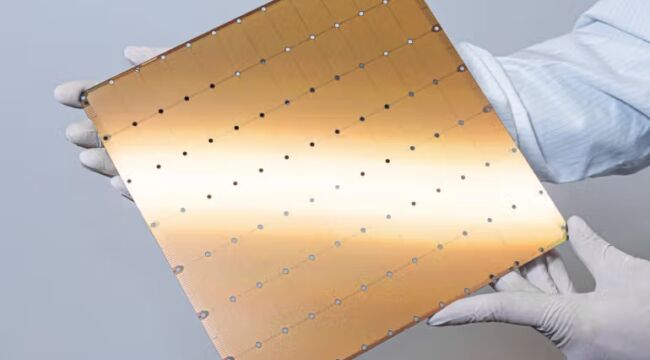
Cerebras manufactures chips closer in size to a dinner plate.
This size distinction drives the entire premise behind Cerebras’ approach.
Typically, AI systems depend on thousands of small chips working together simultaneously.
These chips need to keep communicating over networking systems known as “interconnects.”
(Suppliers like Broadcom, Credo, Astera Labs, and Marvell provide these interconnects, alongside the chipmakers themselves.)
As AI models grow bigger and more intricate, this communication creates congestion and slowdowns.
Cerebras aims to solve that bottleneck.
Rather than linking thousands of small chips, it builds enormous chips called Wafer-Scale Engines (WSE).
This design enables most processing to occur within a single chip, drastically cutting down data transfers between separate processors.
Additionally, Cerebras integrates vast amounts of ultra-fast SRAM memory right onto the chip.
In brief, SRAM offers much faster memory speeds compared to the standard memory used in most AI platforms.
(Traditional memory chips are provided by companies like Micron, SanDisk, SK Hynix, and Samsung.)
Cerebras asserts that its systems can produce AI outputs significantly quicker than conventional GPU configurations for particular tasks.
However, there’s a downside.
Creating a single giant chip is both extremely challenging and costly.
When a standard chip fails during production, only a small processor is lost.
But manufacturing issues with a wafer-scale chip risk losing the entire enormous processor.
This is what makes Cerebras a captivating venture.
The company is pursuing a bold path most semiconductor firms wouldn’t dare attempt.
The Competition With Nvidia
Let’s temper the “Nvidia killer” hype for a moment.
Cerebras has innovative technology.
Yet, dethroning Nvidia is a far tougher task.
Here are key factors reinforcing Nvidia’s strong hold:
CUDA Is Still A Huge Advantage – Nvidia’s CUDA software platform is the foundation for almost every major AI developer. This makes switching away expensive and complex for big players.
Nvidia Is More Flexible – Nvidia’s chips support gaming, AI, robotics, autonomous vehicles, and scientific research. Cerebras’ focus is more narrowly targeted at massive AI models and rapid inference.
Nvidia Keeps Adapting – Cerebras attracted attention partially due to its fast inference speed. Nvidia answered by acquiring Groq in late 2025, integrating similar ultra-fast inference into its own lineup.
While Cerebras can certainly succeed, investors should avoid assuming that one striking IPO marks the end of Nvidia’s leadership.
Cerebras Also Has Some Major Risks…
Obviously, this stock involves significant risk factors investors must consider.
After soaring to $350 after the IPO, these concerns become even more relevant.
Here are the foremost risks from where I stand:
The Valuation Is Extremely Expensive – In 2025, Cerebras earned about $500 million in revenue. Right now, its market cap is near $70 billion, implying a price-to-sales ratio around 140x. This is reminiscent of dot-com bubble valuations.
Revenue Is Highly Concentrated – Approximately 86% of revenue derives from just two UAE-government-affiliated customers. This poses a major concentration risk for a fresh public company.
Profitability May Not Be Sustainable – Although Cerebras recently announced its “first profitable year,” much of this profit reportedly arose from a one-time accounting gain rather than regular operations.
A Large Wave Of Shares Could Hit The Market – Insider lockup periods will expire over the next six months, potentially flooding the market with additional shares, which could create selling pressure after the IPO’s sharp gains.
Simply put, Cerebras might very well emerge as a key player in AI infrastructure.
However, investors should anticipate significant price swings moving forward.
So… Should You Buy Cerebras?
Cerebras is genuinely intriguing.
This is not just a hype-driven AI startup aiming to attract attention.
The underlying technology is substantial.
The company clearly has a distinctive method for addressing one of AI’s biggest challenges today — rapidly moving enormous volumes of data to support larger models.
I also believe the broader AI infrastructure boom remains in its early stages.
There will likely be multiple victors here.
Nvidia may maintain dominance while firms like Cerebras establish critical niches.
That said, investors must distinguish “exceptional technology” from “strong stock performance.”
Following the IPO frenzy, Cerebras is trading at an aggressively high valuation.
With insider lockups ending over the coming months, I expect to find better entry points in the future.
Personally, I won’t chase the stock after nearly doubling quickly.
But Cerebras has secured a place on my watchlist.
Although the valuation appears stretched, the technology’s promise suggests it could ultimately become a significant force in the AI landscape.
About the Author