Tucker Carlson, known for his sharp insight in the media landscape, has an exceptional ability to spotlight individuals offering genuinely unique perspectives. His late February discussion with Mike Huckabee, the US ambassador to Israel, a former Baptist minister and staunch Donald Trump supporter within the Republican Party, was one particularly intriguing exchange.
Among his remarks, Ambassador Huckabee—often viewed as ‘Israel’s envoy to the US’—bluntly acknowledged the deaths of thousands of Palestinian children caused by Israeli forces during the Gaza conflict, nonchalantly responding, ‘So, what?’ He further asserted that it is ‘fair’ for Jews to attempt establishing a Greater Israel by redrawing the Arabian Peninsula boundaries in accordance with Old Testament prophecies. This interview with Carlson ignited a political firestorm.
Consequently, when Huckabee revealed on Monday that Israel covertly positioned Iron Dome missile-defense systems along with elite operatives in the United Arab Emirates to protect the Gulf monarchy during the conflict with Iran, it quickly became apparent that this was a breaking story. And indeed, it proved to be just that.
On Wednesday, a statement from Prime Minister Benjamin Netanyahu’s office validated Huckabee’s claims, adding that Netanyahu made a secretive visit to the UAE, meeting with President Sheikh Mohammed bin Zayed as part of the deployment.
The Israeli announcement described Netanyahu’s visit as resulting in “a historic breakthrough in relations between Israel and the United Arab Emirates.”
However, Abu Dhabi, unaccustomed to such overt disclosures, swiftly avoided the spotlight; its foreign ministry dismissed the claims by asserting that the UAE’s relations with Israel are “not based on secrecy or covert arrangements.”
Further complicating matters, the Wall Street Journal reported that the UAE covertly conducted multiple strikes against Iranian infrastructure and military targets during the war, including an assault on a refinery on Lavan Island in early April—the period coinciding with then-President Trump’s ceasefire declarations and negotiations with Iran. These UAE operations were allegedly coordinated with Israel and followed secret visits by Mossad Director David Barnea to the UAE.
The UAE has yet to publicly acknowledge its attacks on Iran or the clandestine visits by Barnea and Netanyahu, maintaining that neither the US nor Israel have permission to utilize its airspace for operations against Iran.
Meanwhile, Iran contends that American warplanes responsible for bombing a school in Minab on the conflict’s first day—killing over 160 children—departed from Al Dhafra Air Base in Abu Dhabi. In retaliation, Iran targeted both Al Dhafra and US facilities at Jebel Ali Port in Dubai.
These unfolding events have extended the Persian Gulf war’s reach to the Arabian Sea, which borders the South Asian region.
A troika joined at the hips
The Persian Gulf War’s core is now surrounded by four nuclear-armed coastal states: the US, Israel, India, and Pakistan. The nuclear circle expands as the UK enhances its military footprint in the Gulf by sending Typhoon fighter jets, autonomous mine-hunting drones, and the Type 45 air defense destroyer HMS Dragon, purportedly to ensure the security of the Strait of Hormuz.
From India’s vantage point, its alliance with Israel and the UAE presents a significant advantage, softening its regional isolation after the demise of the Trump-era ‘I2U2’ initiative (India, Israel, UAE, and the US), often dubbed the ‘West Asian Quad’ or ‘Indo-Abrahamic alliance.’
Without US involvement, I2U2 lies dormant, and the Israel-UAE-India trio flounders somewhat, yet this trio demonstrates resilience due to shared priorities, notably combating political Islam (‘counterterrorism’) domestically and regionally. While Israel grapples with the ‘specter’ of the Palestinian issue, the UAE is preoccupied with the Muslim Brotherhood, and South Asia struggles with Hindu-Muslim tensions.
Unlike Israel and the UAE, India has remained a mostly quiet partner. But as regional conflict intensifies, these partnerships may be tested. Emerging fault lines suggest that Israel and the UAE’s overt collaboration to escalate the War and wreck any peace initiatives is aimed at achieving their ambitious goal: the downfall of Iran and its exclusion from regional power dynamics.
‘Gulf of Tears’
This marks a turning point as Israeli special forces arrive near the Strait of Hormuz, set against a background of growing tensions between the Emirati-Israeli alliance and Riyadh, which continues to resist joining the Abraham Accords.
As Custodian of the Holy Places, Saudi Arabia harbors deep concerns regarding the aggressive push by Jewish supremacists to impose their Zionist vision on the Muslim Middle East, particularly now that Riyadh has pulled back from proxy conflicts and remains sensitive to the prevailing anti-Israeli sentiment across the Arab world.
Saudi Arabia also perceives provocative signals from the UAE, such as its recent exit from OPEC and the May 4 drone attack on Port Sudan, launched from Emirati-Israeli bases on the Red Sea, supported by Emirati naval vessels. Sudan has formally accused the UAE of supplying weaponry and drones to the Rapid Support Forces engaged against the Sudanese army with Emirati-Israeli backing.
This Emirati assault followed the April 20 meeting in Jeddah between Saudi Crown Prince Mohammed bin Salman and Sudan’s army chief, Abdel Fattah al-Burhan, where they stressed “the importance of ensuring Sudan’s security and stability” and preserving “its sovereignty, unity and territorial integrity,” according to the official Saudi statement, also reviewing ongoing developments in Sudan.
The critical strategic prize here is control over the Bab-el-Mandeb Strait—or the ‘Gate of Tears’—which links the Red Sea to the Gulf of Aden and Arabian Sea, and would allow Israeli submarines unrestricted movement into the Indian Ocean along the Saudi coastline, covering roughly 1,760 to 2,600 kilometers from Jordan’s border down to Yemen.
Turning to Pakistan, Indian strategists must carefully interpret the recent deployment of Pakistani troops in Saudi Arabia under the Saudi-Pakistan defense agreement. It is vital for Delhi to proceed cautiously, avoiding antagonizing the Kingdom, which hosts the largest Indian diaspora in West Asia. Wisdom cautions restraint here.
Broadly speaking, these times echo the mood of Mathew Arnold’s 1867 poem ‘Dover Beach,’ written during a period marked by existential uncertainty and waning religious faith:
Come to the window, sweet is the night-air!
Only, from the long line of spray
Where the sea meets the moon-blanched land,
Listen! you hear the grating roar
Of pebbles which the waves draw back, and fling,
At their return, up the high strand,
Begin, and cease, and then again begin,
With tremulous cadence slow, and bring
The eternal note of sadness in.
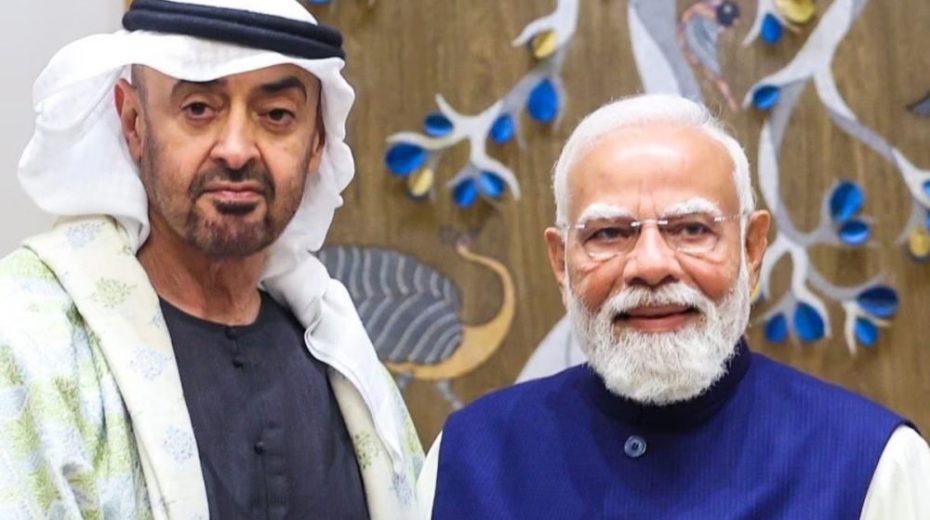
One must question whether it was truly necessary, amid a fratricidal conflict, for External Affairs Minister S. Jaishankar to visit Abu Dhabi for a private meeting with the sheikh on April 12, followed by National Security Advisor Ajit Doval on April 26, and then Prime Minister Narendra Modi’s planned visit tomorrow. The answers, however, are far from simple.
Original article: Indian Punchline
About the Author