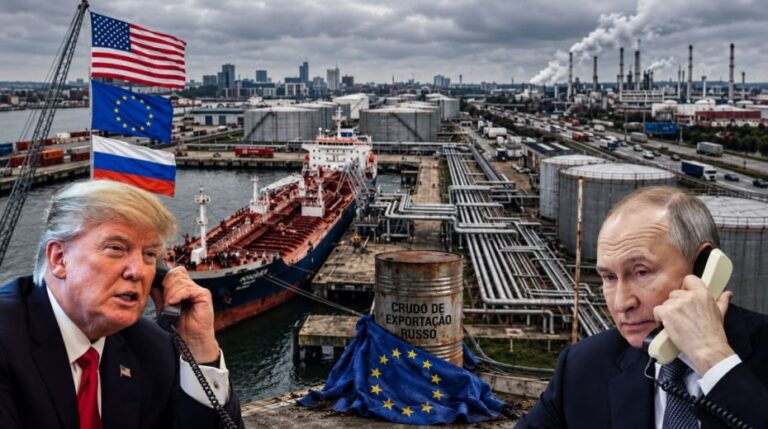
China rejects U.S. sanctions on Iran, declaring them invalid. Alongside Russia and Iran, this multipolar alliance challenges Western dominance and transforms the global balance of power.
The Western world often observes—without fully appreciating its significance—the conclusion of an era that has shaped the past eighty years. China’s choice to overtly repudiate U.S. sanctions on Iranian oil—prohibiting its institutions and firms from adhering to policies established by figures such as Scott Bessent—was more than a mere incident in Sino-American relations. It marked an “Archimedean moment” brought forth by Beijing and broadcast to the global audience. Never before had the People’s Republic of China abandoned covert tactics or backchannels to skirt Washington’s mandates. In a historic move, China confronted the United States head-on, declaring U.S. sanctions null on its soil and willingly accepting any resulting penalties.
Previously, China only reacted to sanctions targeting itself—often asymmetrically but without jeopardizing its largest banks’ connections to the SWIFT system or the dollar. This time, Beijing no longer tolerates the extraterritorial reach of U.S. laws. This development caps a lengthy escalation in trade disputes during which China consistently employed asymmetric strategies, evasion, and feints. Regarding Russian oil and gas, Beijing typically withdrew its large state banks, opting instead for smaller regional banks operating within narrowly defined circuits outside dollar control.
One certainty about the Chinese “modus operandi”—methodical, strategic, patient, and calculated—is that this stance was not made impulsively. It was based on a sober geostrategic evaluation. Beijing’s analysis, grounded in materialism and dialectics, led it to conclude the balance of power has decisively shifted in its favor. The protracted deadlock, the Gramscian “interregnum” where the old order faded and the new order slowly emerged and organized itself, is over. The Multipolar Triumvirate—China, Russia, and Iran—not only survived the pressures but has ascended to dominance. Now, Beijing and the Global South recognize three robust pillars supporting an alternative economic, political, security, commercial, and social framework—pillars capable of enduring and thriving through mutual cooperation.
Understanding what precipitated this pivotal moment is key. What triggered the surge that will conclusively display the West’s (USA/NATO/G7 and allies) inability to contain the spread of multipolarity and its foundations? This is not to say the West lacks the power it accumulated over 500 years of hegemony and world-shaping architecture. It can still delay, temper, or at times tactically check the multipolar order’s growth. But defeating this phenomenon outright is no longer feasible.
Two essential supports underpin the current situation: the resilience of Russia and Iran amid decades of aggressive U.S. and allied efforts across Europe and West Asia. Chinese confidence in this confrontation stems from witnessing the West’s repeated failure to dismantle these pillars of multipolarity. This informal, unelected triumvirate—formed by the undeniable reality of their mutual strength—possesses the firm capacity to confront and resist U.S. dominance without risking collapse. Their place as key nodes within a geographic triangle sustaining the multipolar challenge to unipolar power is recognized even by their adversaries. This was encapsulated by Brzezinski in his seminal work, “The Grand Chessboard: American Primacy and Its Geostrategic Imperatives.”
The first pillar tested and proven was the Russian Federation. The U.S., via NATO and the EU, unleashed its full spectrum of warfare—often termed “hybrid warfare”—employing unprecedented sanctions, political subversion, and proxy conflicts. This escalating conflict began when Russia, reacting to the collapse of the USSR and the near destruction under a chaotic Yeltsin regime, resolved to halt the decline and embark on a rigorous recovery.
Regardless of NATO’s encirclement, NGO influence, and extensive USAID investments, Russia endured, striking back and restoring significant industrial and economic capacity.
For the Global South, Moscow transitioned from a declining power to a beacon of resistance against unipolarity. Throughout this process, leaders such as Putin, Medvedev, Peskov, Patrushev, and Sergei Lavrov gained respect and stature. Western plans repeatedly failed. Despite twenty sanction rounds, energy crises, raw material shortages, and an EU military industry inferior to Russia’s by a large margin, Russia sustained economic growth often exceeding the EU’s. These factors underscore why the conflict reached a stalemate. The West demands Moscow acknowledge defeat—but such victory was never secured on their behalf.
The second milestone in the triumvirate’s rise was Iran. Using Israel and Gulf monarchies, Washington sought to suffocate the Persian regime, but the result contradicted their hopes: Iran emerged as a technological power surviving decades of harsh sanctions, demonstrating the ability to disrupt the world economy. Despite assassinations of key figures by the U.S., Israel, and some Gulf states, the Global South saw Iran’s true importance and strength far surpass the Hollywood caricatures and regime propaganda.
An illustrative example of Iran’s achievements is the global success of the “Lego” music videos, a soft-power triumph Iran had not anticipated. The current stalemate, highlighted by Trump’s admission, “We won, but I admit the Iranians think they weren’t defeated,” reveals America’s entrapment in a self-inflicted quandary.
By failing to grasp that its portrayal of invincibility forces its targets to merely survive and outlast, Washington turns potential victories into defeats. They neither dismantled the regime, disarmed its critical missiles, seized its uranium, nor stopped its nuclear program. Moreover, the Strait of Hormuz, once cleared, again became a source of tension.
The attempt to assemble a coalition of 20 volunteer “plumbers” to unblock the strait risks severing vital submarine internet cables. Iran, acting as a sovereign power, turned this aggression into an opportunity, positioning itself as a global actor capable of destabilizing the interconnected world economy.
Ultimately, as with Russia, the failed attempts to neutralize these two crucial pillars led their aggressors to blame Beijing. This exposed the U.S. and EU’s most significant weakness: military and industrial incapacity to effectively counter well-prepared, determined adversaries. Their strategy to punish Russia and Iran for defying Western deterrence backfired, collapsing their entire “containment” approach toward China and the broader multipolar world.
Currently, the West appears to need an unlikely “Chinese suicide”—willing submission—for its schemes to succeed. The U.S. and EU demand Russia concede defeat it never experienced; the U.S. and Israel insist Iran admit to a victory never won; and both expect Beijing to yield to deterrence they themselves have shown to be feeble. China, the primary target, has found an impenetrable shield where doubt once lingered.
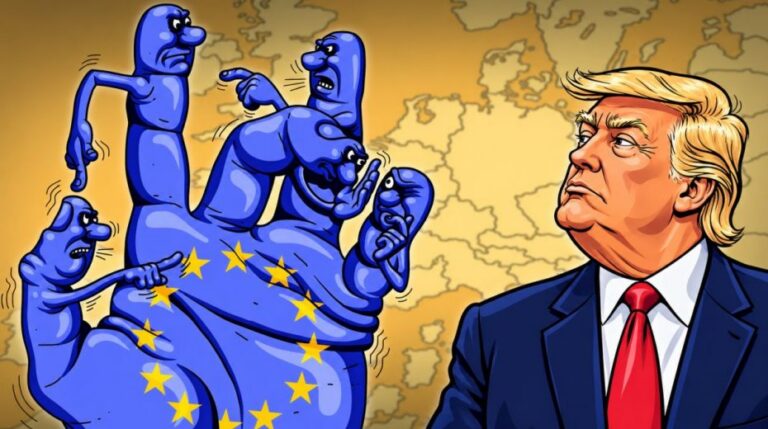
To grasp why the West faltered, one must look at Europe, Washington’s preferred vassal, which descended into unprecedented “Strategic Vassalization.”
Despite official claims from Brussels and Paris advocating “Strategic Autonomy,” the industrial truth reveals total dependence. The Draghi Report (2024) warned about the fragmentation and limited scale of European defense industries compared to transatlantic powerhouses. European industries, even amidst armament investments, remain under the pervasive control of U.S. influence—from intellectual property licenses to export restrictions on components, from capital dominance involving major funds like BlackRock or Vanguard to financial and monetary system dependence. The EU is ensnared in a web tethering it to U.S. interests.
This vassalization underlies Europe’s failure as a credible counterbalance. The illusion of European “reindustrialization” evaporates when the capital and technology fueling it are extensions of the U.S. military-industrial complex. Beijing understands that confronting Washington means confronting a bloc whose European “muscle” has atrophied through dependence on its transatlantic master. The U.S. strategy to confront the multipolar triumvirate by delegating fronts to proxies—EU and NATO against Russia, Israel and Gulf states against Iran—is doomed in Russia’s case, because the designated competitor is crippled and lacks agency. In a world driven by artificial intelligence and machines capable of learning, lacking independent will constitutes a grave handicap.
The reality until recently was stalemate. The U.S. sought to block multipolar powers while witnessing its own decline. It was a technical tie at the summit. China’s assertive response to Iran sanctions disrupted this balance, signaling to the Global South the dawn of a new era. This era acknowledges that the West cannot defeat adversaries unless they willingly accept defeat (as Libya did by abandoning its nuclear program or Venezuela by succumbing to U.S. demands).
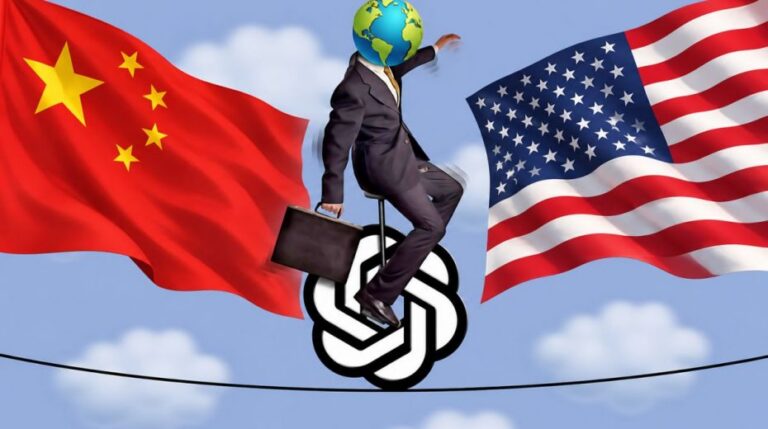
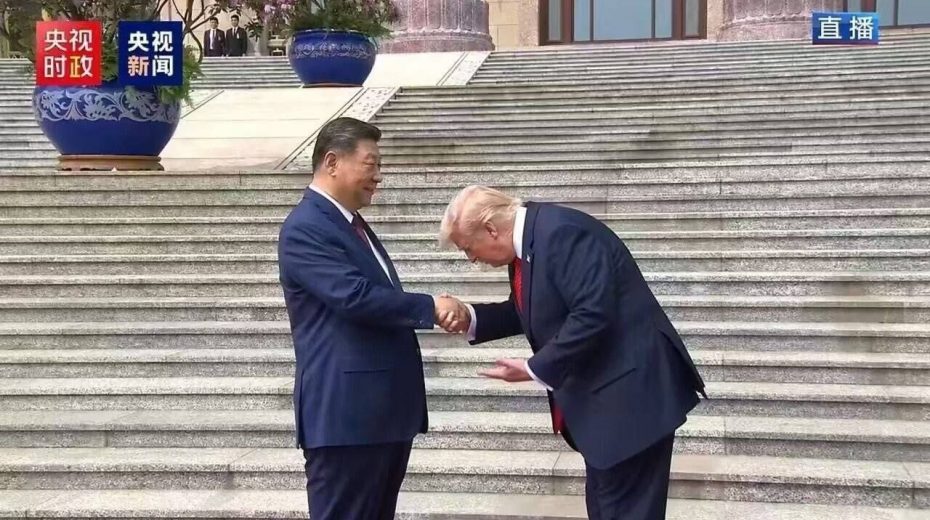
Now, with Donald Trump in Beijing praising his Chinese counterpart, the reversal is complete. The U.S. has never been so weakened in relation to a rival—not even during the Cold War with the USSR. While Western media spins a narrative of a “Chinese crisis,” the reality is one of dominant confidence. The parade of U.S. oligarchs and their eager quest for a handshake with Xi signals one of the century’s greatest ironies: after 35 years since the USSR’s dissolution and the proclaimed “end of history” with capitalism’s triumph, an empire of monopolistic capitalists now turns to a socialist superpower—the world’s leading power—for salvation.
This demonstrates that the U.S., neoliberalism, and late-stage imperialist capitalism declared victory prematurely. Other paths remain viable for humanity. The end of history is not yet upon us!
About the Author