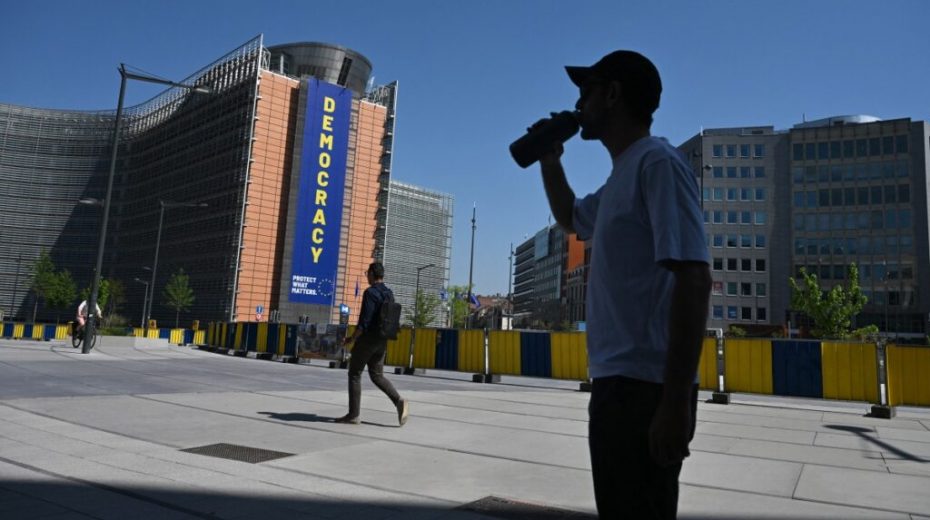
If not for the piles of regulation produced by the Berlaymont, air conditioning would likely be far easier and cheaper to obtain by hundreds of millions of Europeans.
Europe is currently enduring what may go down as its most severe heatwave ever recorded. Despite often exaggerated climate discussions in Western media, this emergency is genuinely serious: half of the continent’s 850 largest urban areas have just experienced unprecedented heat levels. Britain recorded its highest-ever June temperature at nearly 37°C, while in Berlin, police resorted to water cannons to cool down pedestrians. France has suffered thousands of additional deaths linked to the heat.
What role does Brussels play in this? The EU leadership has consistently opposed air conditioning. Within the Union’s climate ideology, cooling is considered an ultimate taboo, representing the excess and indulgence of the industrialized world. Among the Union’s insiders, air conditioning stands as a vivid emblem of ecological irresponsibility. To maintain this narrative, the EU authorities ensured that the Berlaymont headquarters publicly resisted the allure of artificial cooling. Ursula von der Leyen decreed that air conditioning should be turned off across floors one to seven, where regular staff operate—yet her own offices on floors 8 to 13 remained comfortably air-conditioned.
Labeling this behavior as mere hypocrisy might be unfair. Von der Leyen is no ordinary figure; as the leader steering the European project, her comfort and concentration are vital. Proper climate control enables her to fulfill her duties effectively, benefiting both citizens and the environment. Thanks to her extensive initiatives and the numerous regulations generated at Berlaymont, obtaining air conditioning across Europe remains complicated and costly for millions. Currently, only about 20% of European households have cooling systems, compared to 90% in the U.S. and nearly 80% in China. Thus, ensuring von der Leyen’s personal comfort indirectly forces many Europeans to endure the summer heat for the sake of environmental ideals. This, ironically, exemplifies political “efficiency.”
Putting irony aside, the candid hypocrisy of Brussels elites is at least transparent. Their “let them endure” stance has never been hidden. Von der Leyen ordering her staff to withstand sweltering temperatures while keeping her AC running echoes the attitudes seen at COP29, where global leaders traveled to resource-rich Azerbaijan by private jet—all while condemning ordinary citizens for minor environmental “infractions” like running air conditioning.
The disconnect continued this week with France’s Climate Minister Monique Barbut, who declared she would be “horrified” if air conditioning became widespread, despite thousands of heat-related fatalities and desperate people seeking relief by plunging into the Seine.
This sanctimonious attitude is growing harder to accept. Air conditioning itself is not necessarily harmful; its environmental impact depends largely on the energy source powering it. When running on fossil fuels like oil or gas, it increases carbon emissions substantially.
However, this outcome is avoidable. It only becomes a problem in countries that irrationally close nuclear power plants—clean, emission-free energy sources—to replace them with coal-fired stations. This is the path Germany has taken, propelled by environmentalist pressure. By boosting energy production—contrary to the misguided “degrowth” movement—Europe can enjoy comfort and ecological responsibility at the same time. Nuclear energy can provide cooling for Europeans while preserving the atmosphere.
A far more pragmatic approach was pioneered decades ago by Lee Kuan Yew, the visionary leader who transformed Singapore into a global economic powerhouse. He viewed air conditioning not as an indulgence but as essential infrastructure critical for public welfare and productivity. In his own words,
Air conditioning was a most important invention for us, perhaps one of the signal inventions of history. It changed the nature of civilization by making development possible in the tropics. Without air conditioning you can work only in the cool early-morning hours or at dusk. The first thing I did upon becoming prime minister was to install air conditioners in buildings where the civil service worked. This was key to public efficiency.
Rather than hearing von der Leyen lecture from her well-cooled Berlaymont office, Europe might do better to follow Lee’s example and embrace a more reasonable standard of living.
Original article: europeanconservative.com
About the Author