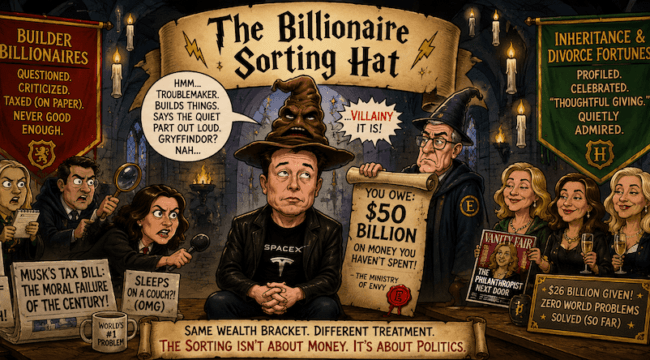
The Billionaire Sorting Hat
Elon Musk spends nights on a couch at his factory and is told he owes $50 billion on wealth he hasn’t actually spent. Meanwhile, several women with comparable fortunes—accumulated through inheritance or divorce, not from personally creating products—receive magazine features praising their “thoughtful giving.” Similar levels of wealth. Entirely different attitudes.
This disparity in coverage is no coincidence. It stems from three distinct shortcomings. Let’s examine them one by one.
The Tax Code Penalizes Creators, Not Holders
Begin with the policy issue, as it’s the only part here grounded in facts rather than sentiment.
The vast majority of billionaires’ net worth consists of unrealized gains tied to stocks they haven’t sold. If a tax on “paper wealth” were applied uniformly, every fortune would face the same treatment regardless of how it was earned. That’s not the case. Criticism over unrealized gains arises mainly for entrepreneurs whose wealth is visible, contested, and closely linked to public controversy.
There’s also a clear imbalance in which types of wealth are targeted. Founder wealth is often the least liquid form of riches. It’s locked up in voting shares of operating companies, usually restricted from sale, and commonly used as loan collateral. Many founders rightly use “buy, borrow, die” strategies to minimize inheritance taxes. Still, their primary goal is to retain the assets they built over decades.
Forcing founders to sell shares to cover tax obligations on unrealized gains can lead to loss of company control, handing influence to outside investors like activist hedge funds who played no role in building the enterprise.
By contrast, wealth gained through inheritance or divorce settlements is generally diversified into liquid and tradable assets, reflecting the absence of day-to-day management by the new holders.
Sure, MacKenzie Scott helped build Amazon alongside Jeff Bezos before stepping away to focus on family. She has donated $26 billion to progressive causes but has not solved any global problems. Why is she excused while Elon attempts to push humanity forward to the moon and beyond?
Even more striking is the widespread public confusion between liquid cash and paper wealth. Many seem to imagine Elon sitting on a trillion-dollar cash pile untouched in his bank account.
The Media Labels Villains Before Facts Are Verified
Adding the media’s role provides further clarity.
A search through major outlets reveals years of scrutiny over Musk’s ethics, political views, sleep habits, and tax liabilities. In contrast, billionaires with inherited fortunes or large divorce settlements receive coverage focusing more on their philanthropy and “quiet influence.”
The distinction isn’t about how wealth was obtained. If this were true, inherited fortunes would attract more criticism, not less, since there’s no entrepreneurial risk or story behind them.
The real factors are political leanings and public image. Support causes favored by mainstream newsrooms, avoid cultural conflicts (or be on the “right side of history”), and maintain a low profile, and you earn a reputation for responsibility. Stir controversy, voice unpopular opinions, or back the wrong political faction, and you quickly become a target.
Once a person is cast as a problem, every detail is seen through that biased lens. The tunneling company turns into “vaporware,” the satellite venture is labeled “Pentagon overreach,” and the biggest individual tax payment ever is reframed as a moral failing. The amount is never sufficient, and these assessments come from journalists who wouldn’t apply the same scrutiny to others—or themselves.
Consider Ro Khanna. While his children are minors, they collectively hold large interests in private golf clubs, a significant share of a $65 billion wealth management firm, and stakes in hedge funds targeting distressed debt. Feel free to explore that rabbit hole—or should I say, “loophole?”
The Walmart Issue Needs Its Own Discussion, Not a Passing Mention
Initially, I viewed the Walton heirs as receiving an undeserved pass despite not earning their wealth, but that’s not the full picture.
It is true that many Walmart workers depend on government assistance, a topic worth investigating on its own. This concerns labor practices, wage policies, and how a large employer’s compensation intersects with social supports.
Blaming Sam Walton’s descendants personally is absurd. Turning this into a critique of their net worth transforms a policy debate into a character attack.
Walmart’s wage framework results from decades of management choices, competitive pressures in low-margin retail, and labor policy decisions. Focusing the discussion on heirs’ wealth instead of pay practices weakens the argument and lets the real issues go unaddressed.
Conclusion
A tax system driven by envy politics rather than consistent principles gives the media their “ideal villain.” When the public lacks understanding of how wealth is formed, they tend to assume it was acquired unethically.
Media outlets that sort billionaires by political affiliation train audiences to interpret wealth scrutiny as a reflection of personal ideology rather than policy considerations.
When criticism becomes centered on personalities, valid concerns—like Walmart’s labor practices—are blurred with baseless claims demanding founders liquidate their companies due to imaginary tax strategies.
This doesn’t imply inherited or divorce-acquired fortunes are illegitimate, nor that founders are faultless. Many founders have questionable behavior, and numerous heirs use their inherited wealth for good.
The key point: If a policy or media narrative fails to hold up when applied consistently to all billionaires regardless of sympathy, it isn’t truly about fairness but about targeting politically convenient scapegoats.
Recognize this pattern, and you’ll see how discussions about wealth shift into debates over which billionaire is deemed the villain of the moment.
About the Author