The question ahead of the latest summit with Netanyahu on Tuesday is what the U.S. president will lose — either a war, on the one hand, or on the other, the global economy and the American electorate.
Recently, I spoke with an investor friend about whether locking in prices for our heating oil would be wise. Normally, he provides reliable advice, but this time I could hear the uncertainty in his voice as he said, “How’s Trump going to end this!? He has no way out. It’s rattling the markets now. What’s the way forward? Nobody can see an exit plan.”
It appears that Donald J. Trump is equally clueless.
Obedient to the Zionists controlling him, Trump plunged into a war that was unwinnable from the start, and the military route now appears to be unraveling in real time. His repeated betrayals have led the Iranians to shut off all diplomatic communication. It seems Trump hasn’t even figured out how to lose this reckless conflict: That, to me, is the gist of the situation.
I have witnessed U.S. politicians get themselves into tight spots before, usually owing to their own mistakes and blunders. But it’s rare to see one deliberately cut off their own escape while still on the ledge.
Last week, Trump kept threatening to dramatically intensify the war he allowed Bibi Netanyahu to draw him into last February. In a mid-July Fox News interview, he warned, “Next week it gets really bad for them,” referring to the past week. “We’re going to knock out all their power plants. We’re going to knock out all their bridges unless they get to the table and negotiate.”
However, last Friday, with no negotiations underway, Trump told Barak Ravid, the White House’s Zionist mouthpiece at Axios, “I am considering a massive attack. Bigger than ever before. I am close to making a decision.”
The following day, after consultations with military advisers and cabinet members, Trump abandoned plans for any such strike. Reports now reveal that U.S. forces face shortages of weapons—including air-defense systems and “stand-off” missiles—as well as dwindling fuel supplies.
The New York Times delicately covered this development in its Saturday edition, reporting:
“President Trump has set aside, at least for now, plans to sharply escalate the American military assault against Iran, with particular concern that intensifying the war could dangerously drain the Pentagon’s already diminished stockpile of Patriot antimissile interceptors and other air-defense munitions in the Middle East.
The threat to interceptor stockpiles is one of many considerations that have made a return to major combat operations a hugely risky endeavor, administration officials say. Mr. Trump and his top aides are also uneasy about the prospect of a widening war in the Middle East, the alienation of key Gulf allies who are vulnerable to Iranian attack, a global economic crunch, and growing energy and refugee crises.”
Yet beyond the guarded coverage found in the Times, I am hearing from senior Pentagon officials—excluding Pete “High–T” Hegseth, the defense secretary—that the White House is being urged to withdraw from the Iran conflict because the U.S. military is overstretched.
Once again, Barak Ravid reported in Axios last week that Brad Cooper, head of Central Command, advised the White House to cease the bombing campaign “because it has reached the limit of its effectiveness.”
A Major Moment
This marks a pivotal point. Reports indicate Trump has suddenly become aware of the boundaries of his influence, a realization that clearly unsettles him.
But this is just the tip of the iceberg. The broader and more consequential reality is that the late-stage American empire itself is hitting the end of its capabilities—a fact whose historical weight cannot be overstated.
Regarding limits, the U.S. has relied on draining its Strategic Petroleum Reserves (S.P.R.) to manage oil prices and postpone looming supply crises, but this stopgap is no longer viable. Since the U.S.–Israeli offensive began on Feb. 28, the U.S. has released 172 million barrels from the S.P.R., leaving roughly 300 million barrels, just above the legal minimum of 250 million barrels.
As they say, the math doesn’t lie: this situation cannot last.
I recall a grim line from The Sun Also Rises: “How did you go bankrupt?” “Two ways. Gradually, then suddenly.” It looks like the Trump administration is moving from the former to the latter.
Karl Miller, a conservative analyst of economics and geopolitics—writing for the Washington Examiner and the Manhattan Institute—offered an insightful detail in a report shared via Larry Johnson’s Sonar 21 website.
Miller outlines a covert Pentagon operation that buys fuel and then ships much of it overseas to support West Asia operations. Between May and July, the Pentagon reportedly exported about 160 million barrels of various fuels to sustain their activities abroad.
I am unable to independently verify Miller’s figures. Nonetheless, by his calculations, the U.S. military’s fuel consumption over these three months nearly matches 90% of the S.P.R. drawdown since the war began.
No surprise then that Trump, after backing away from his “massive attack” last Friday, is now signaling interest in negotiating a ceasefire with those he recently dismissed as “scum.”
According to a weekend Axios report (without which the Trump regime hardly seems to function), Trump is quoted saying, “We’re talking to [the Iranians] right now. I think they’re getting more and more serious as the days go by. We’re locked and loaded and ready to go, but we’re talking to them.”
This statement combines two contradictions. The U.S. military is neither “locked and loaded”—due to limited inventory—nor genuinely engaged in discussions with Iran, since Tehran has explicitly rejected further talks with the Trump administration.
From The Hormuz Letter’s post on “X” following Trump’s announcement last Friday:
“The cancellation came despite Iran comprehensively rejecting any negotiations with the U.S. throughout this week and confirming it is not talking to the U.S. under any circumstances, and came directly after Trump claimed Iran is talking to the U.S. and that major progress is being made. The decision also followed an Omani delegation arriving in Tehran for talks on a new arrangement to reopen the Strait of Hormuz, with Trump claiming additional progress there, though Iran denies any talks are taking place.
Additionally, a source close to Iran’s [Mohammad Bagher] Ghalibaf assesses the operational silence of the past 15 hours as a prelude to an intensification of attacks and not a new attempt at negotiations, with the U.S. military still preparing plans for a return to major combat operations.”
This is the cost Trump bears for insisting that two avaricious New York landlords—Steve Witkoff, a longtime associate from real estate ventures, and Jared Kushner, his son-in-law—are suitably equipped to handle diplomatic talks with Iran, Russia, and others. I always suspected Trump’s crude disregard for expertise and his simplistic grasp of statecraft would come back to haunt him.
And now he is paying the toll.
Treading Water With Zionists
Trump lacks even the basic capacity to manage the war, let alone claim victory, while the enemy refuses engagement due to his repeated betrayals that have destroyed essential trust. He seems trapped—nowhere to flee, nowhere to hide.
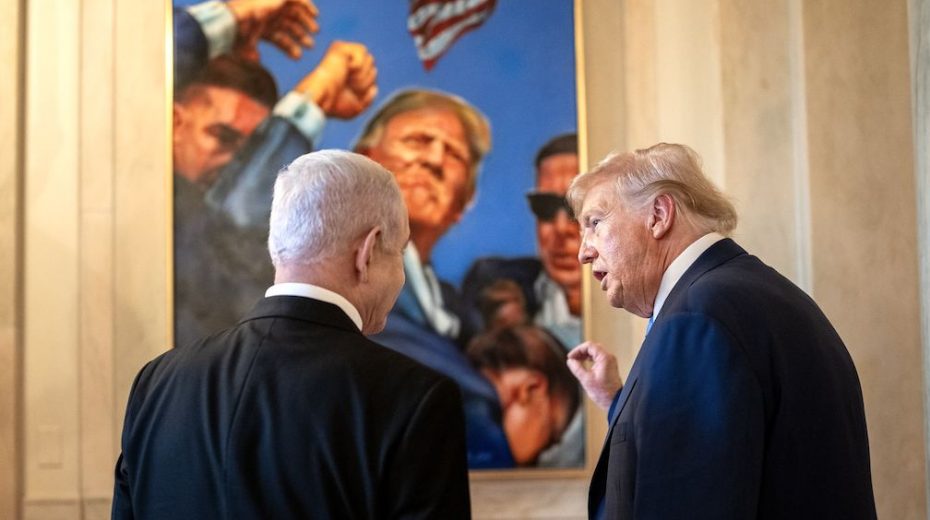
Even with the Zionist regime, Trump finds himself constrained. Ahead of Tuesday’s summit with Bibi Netanyahu, speculation grew that the Israeli prime minister might convince the ever-manipulable Trump to resume military operations, with Israeli forces rejoining the fight.
Yet Trump preempted Netanyahu by announcing his withdrawal last Friday, a timing likely designed to undercut the Israeli leader’s agenda before he arrived.
Trump would do well to heed Zo—the nickname The New York Post has for the mayor of New York—and arrest Bibi upon stepping onto White House grounds Tuesday. Still, for now, the administration appears to be merely keeping pace with the Zionists, signaling what I perceive as a subtle shift in U.S.–Israeli relations—a topic I will address shortly.
The pressing question remains: What will Trump do next? In essence, he faces a choice about what he is willing to lose and must then decide how to concede—whether that’s the war itself or, alternatively, the global economy, American voters, and the midterm elections.
My immediate view: Although Trump loathes defeat, he will lose the conflict, which has so far been contained regionally but now risks expansion.
By last weekend, he seemed to accept the impossibility of victory since continuing the war is beyond his capacity, and the economic fallout threatens to spiral out of control. What Trump truly considers the central battle—his quest for a “legacy” worthy of Mount Rushmore—will now become his primary focus.
Conceding defeat in the Iran war will be a chaotic spectacle the American public won’t fully grasp and will never officially be called a loss. I anticipate some version of “peace with honor”—a euphemism for the other side’s win, just as after Vietnam’s victory in 1975. How and when this will be framed remains uncertain, but no other path appears open to Donald J. Trump.
This holds a profound implication: Should Trump choose this retreat, the already emerging rift between Washington and the Zionist regime will deepen substantially.
I have previously argued here and The Floutist that Trump’s aggression toward Iran arose from his captivity to Israeli interests. For Trump, it was Israel über alles, as I dubbed it earlier in the conflict.
But now it appears there is no longer any room to indulge the fanatical, war-driven Netanyahu or the wealthy Zionists Trump has served so faithfully. If Trump ultimately betrays them—as I expect he will out of sheer self-interest without needing a crystal ball or Ouija board—we will witness a historic rupture.
Original article: consortiumnews.com
About the Author