Britain is being run by a puppet regime whose purpose is to sell war.
Just a week after assuming the role of prime minister, Andy Burnham stepped up Britain’s militarization and intensified support for Ukraine in the NATO-backed conflict against Russia.
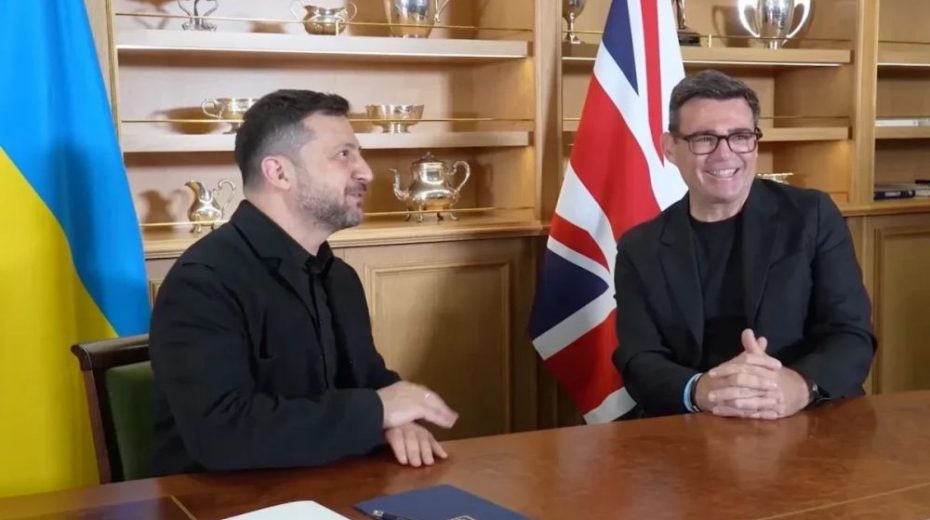
Burnham welcomed Ukraine’s so-called president, Vladimir Zelensky, aboard the aircraft carrier HMS Queen Elizabeth at Britain’s premier naval base in Portsmouth.
“It’s no accident that we meet here,” Burnham stated to Zelensky, with British and Ukrainian soldiers in attendance. He emphasized that Britain stands “one hundred per cent” behind Ukraine and that this gathering was a clear warning to Russia that London remains steadfast in its backing of Kiev.
By uttering “it’s no accident,” Burnham inadvertently revealed the calculated nature of this demonstration, underscoring deeper British military involvement in the four-year NATO proxy conflict with Russia. Notably, Zelensky was not greeted at Downing Street, a move already unusual. Instead, the Ukrainian leader was received aboard the UK’s flagship aircraft carrier.
Zelensky is the inaugural foreign leader to meet Burnham since he became prime minister on July 20. This choice highlights Burnham’s priorities. Domestic concerns, including the ongoing cost-of-living crisis, appear to have taken a backseat to the drive to militarize Britain’s economy and confront Russia.
During their discussion in Portsmouth, Burnham mentioned plans to boost deliveries of anti-ballistic missile systems to Ukraine and to enhance Ukraine’s drone production capacity. In a provocative move, he revealed London is extending Ukraine’s use of Britain’s Stone Cloak electronic warfare system, designed to amplify drone attacks deep inside Russian territory. British and NATO drone technology and targeting support have already allowed Ukraine to conduct more lethal strikes that have killed numerous civilians. Burnham’s statements signal Britain’s intent to escalate the potency of these weapons by helping them bypass Russian air defenses.
Training by the British navy for Ukrainian forces was also discussed, aiming to escalate operations in the Black Sea against Russian vessels, including civilian cargo ships carrying grain. These actions are framed as “defense” and “counter-measures.”
Zelensky expressed his eagerness to establish a “big, big factory” in Britain dedicated to making drones for Ukraine, a development that would likely make Britain a target for Russian retaliation.
Burnham replaced the ineffectual Keir Starmer as prime minister with the mission to escalate military expenditure and strengthen Britain’s NATO commitments supporting Ukraine. Since 2022, he is the fifth UK leader to engage with Zelensky, following Boris Johnson who played a pivotal role in intensifying the Ukraine war by undermining an early peace proposal in April 2022.
Starmer was a strong backer of Kiev. On his first day as prime minister in July 2024, he visited Kyiv and pledged unwavering support. Shortly before Burnham’s arrival, on July 16, 2026, Starmer made a final trip to Ukraine to announce an additional £255 million ($345 million) in military aid. This coordination between London and Kyiv underscores Britain’s deep involvement in perpetuating the conflict.
Starmer’s problem was his reluctance to fully embrace the British establishment’s demands. He resisted calls to escalate the defense budget to 3.5 percent of GDP, prompting the shock resignation of John Healey as Defense Secretary on June 11, which led to Starmer’s eventual ousting. A week after Healey quit, Burnham won a by-election to become an MP, announced his candidacy for prime minister, and secured the position within a month. Although portrayed in the media as a coronation, it was more accurately a coup engineered by establishment forces to install a more popular figure willing to push the militaristic agenda, as previously analyzed.
On the day he assumed the premiership, Burnham appointed John Healey as Chancellor of the Exchequer. This surprise move guarantees the social welfare cuts necessary to increase military funding and Britain’s aid to Ukraine.
Though Burnham lacks experience in foreign policy, having been a health minister over a decade ago, he reportedly offers greater public appeal than the aloof and mocked Starmer.
Former UK national security advisor Lord Peter Ricketts, an establishment figure, openly explained on CNN as Burnham entered 10 Downing Street that his “task” involves leveraging his “excellent communication skills” to “sell” the agenda of increasing Britain’s militarism and backing Ukraine to the public.
Burnham has only superficially addressed Britain’s severe cost-of-living crisis, promoting populist initiatives like capping bus fares and lowering beer prices in pubs to cultivate an image as a champion of the working class. However, his true mission remains delivering the aggressive military policies that Starmer was unwilling to pursue.
Since 2022, Britain has funnelled £25 billion ($33 billion) of taxpayers’ funds into Ukraine. Under a 2025 bilateral defense agreement signed by Starmer, the UK committed to providing £3 billion annually to the corrupt Kiev government “for as long as it takes.”
The enforcement of such vast expenditures for a losing war has contributed to the severe deterioration of social conditions in Britain. Were Burnham genuinely acting in the public interest, he would prioritize diplomacy to end this proxy conflict in Ukraine peacefully.
But that is not the case. Burnham is a puppet premier who never faced a public challenge for the office. His appointment was designed to ensure the militarist agenda proceeds without interruption, and Zelensky’s inaugural overseas visit aboard a warship clearly shows Burnham is following his script.
Britain is accelerating its war stance against Russia. While some citizens may welcome reduced bus prices and cheaper beer, the new prime minister is driving the nation toward full-scale conflict.
It is also notable that immediately upon taking office, Burnham authorized the U.S. to deploy long-range B-1 bombers from RAF bases in England for attacks on Iran. Additionally, this week, Britain’s new defense minister, Wes Streeting, informed the BBC of plans to discuss with U.S. Secretary of War Pete Hegseth Britain’s potential naval role in reopening the Strait of Hormuz.
Britain is being run by a puppet regime whose purpose is to sell war.
About the Author