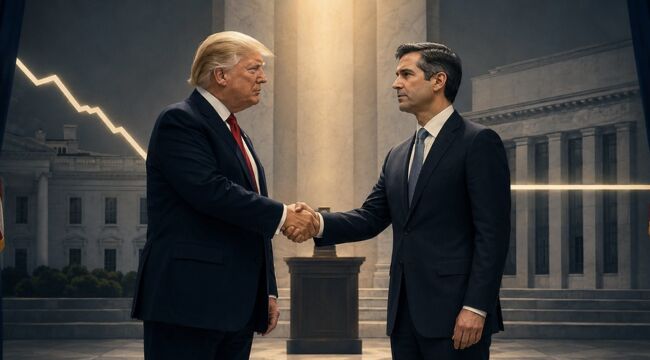
This “Trump Myth” Will Cost You
Let’s discuss Kevin Warsh.
Today, I aim to debunk one of the most persistent misconceptions in the financial world.
In doing so, I’ll also prepare you for a major market episode expected in the coming three months—one of the most significant events in recent years.
Several elements converge here…
Including the conflict in Iran…
The midterm elections…
And the market event I’m mentioning…
The next quarter could bring considerable turbulence.
We’ve already seen early signs over the past weeks.
AI stocks have started declining. Risk-on assets have taken a hit.
Yet we must brace for the chance that conditions could worsen substantially before improving.
Rest assured, there is optimism ahead. By year’s end, I anticipate the bull market will resume.
However, that doesn’t mean you should ignore volatility in the meantime. There are strategies to profit during uncertain times, which we’ll explore today.
In fact, I’ll share an exclusive preview of a new trade recently offered to select top subscribers.
Let’s dive in…
“A Good Family Fight”
On Wednesday, Kevin Warsh held his second press briefing as Federal Reserve Chairman.
For the second occasion during his tenure, the Fed chose to keep interest rates steady.
Initially, markets responded positively.
But then, a shift occurred.
Warsh mentioned a series of economic “shocks,” prompting markets to falter.
He clarified that yesterday’s move wasn’t a “pause” and repeatedly described it as a “good family fight,” signaling that some Fed governors favored increasing rates.
Correctly, he noted that markets don’t seem to be holding their breath.
Real rates—market-determined interest rates—have climbed over the last 42 days, reflecting new economic data and expectations of an imminent Fed rate hike.
Trump’s Guy?
Here’s the myth we must bust.
President Trump nominated Kevin Warsh for Fed Chairman in January, following a very public clash between Trump and outgoing Fed Chair Jerome Powell.
Between 2022 and 2023, the Fed adopted the steepest rate increases in four decades due to record inflation fueled by massive government stimulus, surging energy costs linked to the Ukraine war, and pandemic-related supply chain issues.
In 2024, the Fed reduced rates by a full percentage point—twice over the year.
But Trump wanted deeper cuts.
He demanded that Powell lower rates to his personal target of 1-2%, believing this would revive economic growth to his first term’s level and allow the government to refinance debt at cheaper costs, easing taxpayer burdens.
He publicly insulted Powell, calling him a numbskull, a moron, a dummy, and a stupid person for not complying.
However, there’s a flaw in this narrative.
1 on 12
The Federal Reserve Chairman does NOT control interest rate decisions.
This is a misconception.
The Fed operates independently with 12 voting members comprising the Federal Open Market Committee (FOMC): seven governors (including the Chairman), the Federal Reserve Bank of New York’s president, and four regional Fed bank presidents representing the other 11 regional banks.
Policy decisions are made collectively by these 12 individuals. The Chairman holds only one vote, just like his colleagues.
His role is limited to leading meetings and voicing his opinions both in private discussions and publicly.
That’s the extent of his power.
Currently, many believe the Chairman alone can influence rate changes. This myth exists because Trump repeatedly pressured Powell as if he could simply adjust rates at will.
And since Trump picked Warsh, some assumed Warsh would push through quick changes.
Now, observers are puzzled by how “Trump’s guy” might actually pursue the opposite approach.
Water is Wet. A Hawk Is Hawkish
This isn’t surprising to those familiar with Warsh’s track record.
While serving as a Fed governor in 2008, he was the lone dissenting voice cautioning that the Bernanke-led Fed’s move to an unprecedented zero interest rate policy (ZIRP) risked sparking runaway inflation.
Although he ultimately voted with the majority, Warsh stood out as the sole monetary hawk, maintaining concerns about inflation as late as September 2008.
At a time when deflation was the main worry, his warnings largely went unheeded.
He kept up this hawkish perspective even during further rounds of quantitative easing, publishing a public critique in November 2010 about inflation and asset bubble dangers.
While inflation remained subdued for years, the stock market soared, with the Nasdaq climbing by over 1,000% from 2009 lows to its 2021 peak.
When supply chain issues arose in 2020 and interest rates remained near zero, Warsh’s predictions about inflation came true—but with a 12-14 year delay.
And when the Fed was slow to act, he didn’t hesitate to call them out again.
The Good, and the Bad
The positive is that Kevin Warsh has been correct at each major market inflection point over the past two decades.
This suggests he can influence the Fed to raise rates when needed, and to cut them when the time is right.
In 2022, the Fed waited until inflation hit 9% before reacting.
The downside…
Markets will likely respond poorly when rate hikes occur, which appears probable at the upcoming FOMC meeting on Sept 16.
Currently, traders assign about a 60% chance for a rate increase at that meeting, down from roughly 80% on Wednesday, indicating this outlook can shift.
However, the likelihood of a hike by year-end exceeds 80%, so it’s wise to prepare for such an event.
As for rate cuts, investors estimate a mere 0.3% chance of lower rates a year from now.
The Caveat
When factoring in other forces—the war in Ukraine and energy shortages driven by AI data center expansions—these conditions point to growing inflation, which implies higher rates are on the horizon.
One important variable is the trend in employment. Job growth slowed in June with only 57,000 added, although unemployment edged down. June’s CPI fell by 0.4%, the largest monthly drop since April 2020, yet inflation still exceeds the Fed’s 3.5% target. Furthermore, U.S. economic growth slowed to 1.5%, softening Warsh’s description of “strong” conditions.
If these weakening trends persist—lower employment, inflation, and growth—they might delay the impending rate increases.
But for the moment, the threat of rising rates remains.
1 Stock to Buy Now
The midterms inject additional uncertainty into the market, which investors dislike.
Betting markets currently favor Democrats taking the House with an 87% chance, while Republicans have a narrow lead in the Senate fight, though that outcome is far from certain.
Given these factors—the ongoing war, elections, economic shifts, and inflated asset prices—we should anticipate persistent volatility at least through November’s election.
During such periods, it’s crucial to be discerning with investment choices.
Active traders might benefit by taking measured positions when opportunities arise. For example, I secured a 1,000% gain on weekly call options earlier today for an AI computing firm I acquired yesterday, anticipating strong AI demand driven by Microsoft and Meta’s earnings.
If you’re less active in trading, I have a single recommendation for you.
The conflict in Iran is fueling inflation notably in the energy sector.
Oil prices recently surged past $100 per barrel.
My top pick right now is…
A stock that Daily Reckoning managing editor Adam Sharp has highlighted before—Petrobras (PBR).
It stands as Brazil’s largest oil producer and represents the biggest economy in South America.
The company offers a 6% dividend yield and trades at just 4 times projected earnings.
Put simply, it pays shareholders 6% annually to hold shares that are highly likely to appreciate over four years—a rare opportunity.
A short-term catalyst is Exxon Mobil’s earnings report this morning, which has already suggested substantial profits due to inflation.
Traders might consider inexpensive call options on PBR expiring in August or September, either at-the-money or slightly out-of-the-money. Petrobras will announce its earnings next Thursday. I intend to recommend calls for it today in 10X Trade Club.
About the Author