
Putin, Persia and a Perfect Storm for Diesel
It took more time than anticipated, but the energy crisis we’ve cautioned about since March has now arrived.
Oil infrastructure—including wells, pipelines, and refineries—is being destroyed across the Middle East, Russia, and Ukraine.
In Russia, Ukraine has been targeting oil refineries with drone attacks nearly every day. Here’s the latest update:
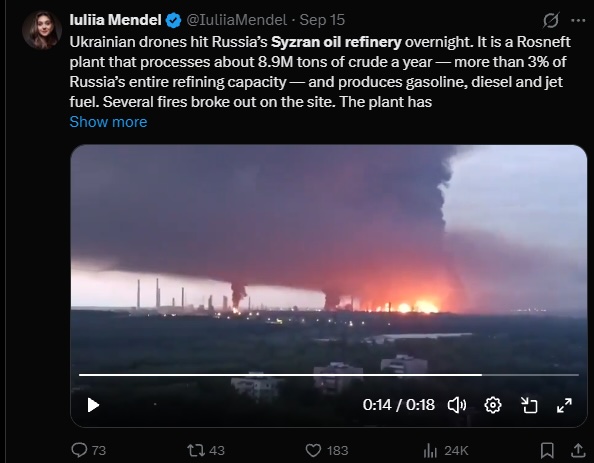
Source: X
Russia was the second-largest diesel exporter globally, but it has now completely halted exports. President Trump went as far as urging Ukrainian President Zelensky to stop refinery attacks, and Putin even consented to Trump’s suggested “energy ceasefire.”
Despite this, Zelensky’s drone strikes persist unabated.
Diesel prices in the U.S. have averaged $6.26 per gallon, with some areas in California seeing prices near $9.99. Prices could have risen higher, but outdated software currently limits price adjustments.
In Germany, diesel costs exceed $11 per gallon.
As the world’s top diesel fuel exporter, America now faces comments from Senate Majority Leader John Thune, who says he is “open to exploring” a diesel export ban—remarking on it lightly, even though such a move would carry major consequences (which we will delve into below).
China, which had been depending on its oil reserves rather than buying globally, has resumed heavy crude purchases. In Shanghai, oil trades at $138 per barrel—a $35 premium compared to U.S. prices, typically around $5.
Meanwhile, strategic oil reserves throughout the U.S., EU, and Asia have dwindled to multi-decade lows. Further withdrawals risk undermining their structural integrity.
The Strait of Hormuz remains roughly 80% obstructed. Another vital maritime passage, the Bab al-Mandab Strait, is now fully under the control of Yemen’s Houthis, who have recently launched missile and drone attacks against Saudi oil wells and refineries.
Drone strikes originating apparently from Iraq have knocked out Saudi Arabia’s crucial East-West pipeline, taking almost 4 million barrels per day—about 3.8% of global demand—off the market indefinitely. This disruption was caused by drones costing roughly $20,000 each.
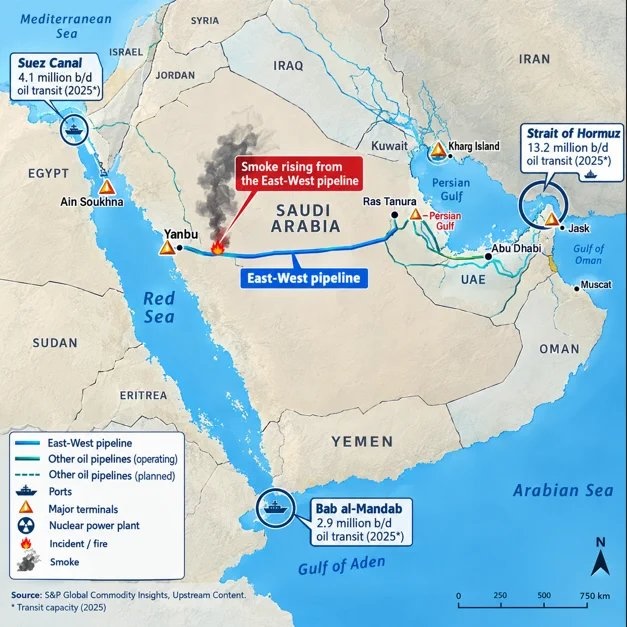
Source: S&P Global Commodity Insights, Upstream Content
This is exactly the situation we have been cautioning about since March.
About That Diesel Export Ban…
Diesel is the backbone of contemporary economies, fueling trucks, trains, generators, and heavy machinery.
Unless conflicts in the Middle East and Russia stabilize soon, diesel prices are set to climb even further.
Given the U.S.’s status as the largest diesel exporter worldwide, a ban on diesel exports might seem appealing initially.
Diesel prices domestically would plummet, easing burdens for businesses and consumers alike, but prices internationally would soar.
American refiners would bear the brunt, experiencing major hits to their profit margins.
Investor confidence in U.S. energy companies, particularly refiners, would waver amid fears that regulatory actions could erode profits at any time.
Consider Petrobras (PBR), Brazil’s oil giant, where government ownership led to selling fuel below cost in the early 2010s. As a result, Petrobras trades at a low P/E of 5.4 and offers a high dividend yield. Despite this discount, we’ve had excellent returns with Petrobras, and I remain heavily invested.
Should the U.S. impose a diesel export ban, valuations for refiners would likely decline sharply.
While such a ban is improbable, if enacted, it might offer short-term relief but would inflict severe, long-lasting damage on capital markets over two decades. This would negatively impact U.S. oil stocks and is neither a prudent nor practical solution.
Midterms and POTUS
Recently, when a reporter asked President Trump about when the Iran conflict would end, he replied, “I think very soon, probably right after midterms.”
But does this imply peace after the midterms, or a renewed escalation? I suspect Trump means aggressive actions will resume post-midterms. He hinted as much in a recent Fox News interview with Laura Ingraham:
Ingraham: “Even the neoconservatives are saying if you’re going to go into Iran, go in full. Just go in and take them out.”
Trump: “Well, maybe I don’t do that because of the elections.”
Our geopolitical expert Jim Rickards predicts warfare will likely intensify after the midterms. His words from an August 26th update:
Once the midterm elections are over, expect the kinetic war to return with a vengeance.
Win or lose, Trump will be out to punish Iran. Even with a partial resupply of critical weapons, Trump will be eager to go back on the attack, blaming Iran for its failure to do a deal.
I generally trust Jim’s insights, given his impressive accuracy on such matters.
If he is correct, the energy crisis will only worsen after midterms. A full-scale war resumption would provoke retaliatory strikes by Iran against Gulf oil and gas facilities. Contrary to neoconservative advice to the president, a swift military solution is unlikely.
Prices of $150 per barrel for oil and $10 per gallon for diesel are becoming more probable unless circumstances change soon.
I remain hopeful Trump’s administration can forge a deal that prevents Iran from obtaining nuclear weapons and reopens critical maritime routes. However, compromises will be necessary—something historically difficult for America.
Thus, I expect energy costs to keep climbing. I’m maintaining my positions in energy stocks (Exxon and Petrobras), which comprise about 11% of my portfolio. If you’re not invested in oil, I suggest you consider gaining at least some exposure.
If oil prices retreat this week, I may purchase call options on USO (United States Oil Fund, which tracks WTI crude prices).
About the Author