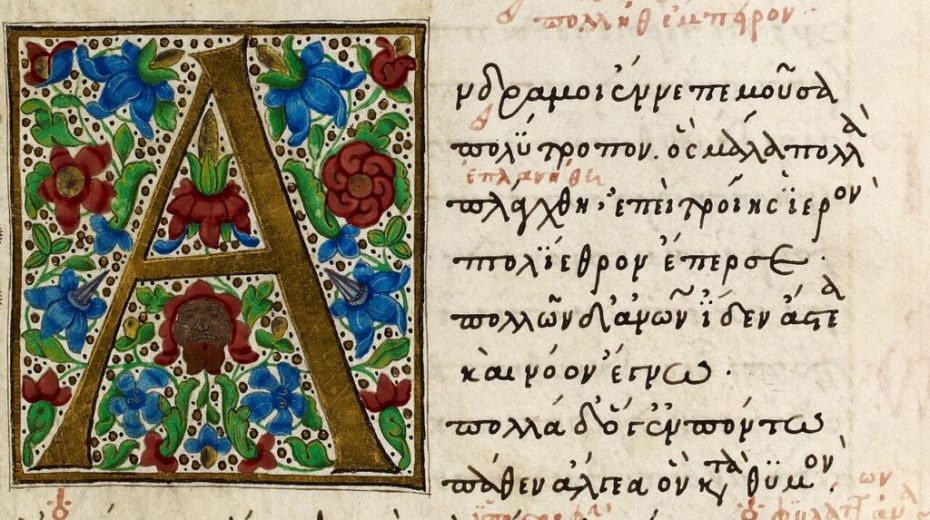
Homer’s epics are foundational to Western civilization. Their reinterpretation should enrich our understanding of the classical tradition, not distort its historical and cultural legacy.
In a period dominated by ideologically motivated distortions, protecting our classical heritage is inseparable from safeguarding our future. Homer’s Odyssey stands as the cornerstone of Western literary tradition, a timeless masterpiece characterized by profound intellectual depth, artistic elegance, and enduring influence. The German polymath Goethe praised Homer’s works, The Iliad and The Odyssey, as the world’s most significant books for shaping Western cultural consciousness.
The Western literary canon originates with these two epic poems composed by the ancient Greek poet Homer in the 8th century BC. The Iliad narrates the siege and ultimate fall of Troy at the hands of Mycenaean Greek forces, featuring legendary figures such as Achilles, Odysseus, Agamemnon, and Hector. Meanwhile, The Odyssey follows Odysseus on his arduous voyage back home, detailing his encounters with diverse civilizations and the challenges he overcomes. Homer’s Odyssey established the archetype of the hero’s journey—an explorer navigating threats and unfamiliar lands in pursuit of reunion with family and homeland. The epic celebrates love for one’s country and the power of νόστος (nostos), or the return home. The modern term ‘nostalgia,’ derived from the Greek νοσταλγία meaning ‘pain over the wish to return home,’ originates from this concept. Upon returning from Troy, Odysseus “saw the cities of many men and learned their mind,” as the ancient poet tells us. His travels reveal a world rich with varied political systems and cultural traditions, ultimately concluding with his restoration to the familiar surroundings of his native land and cultural roots. As such, The Odyssey serves as a tribute to homeland and family ties. Similarly, in The Iliad, Hector’s courageous defense of Troy, despite ominous prophecies, reverberates as a moral and political call to duty: “There is only one good omen/to fight for your fatherland.”
Homer’s Odyssey remains vital for understanding Western identity and civilization today. Against this backdrop, recent Hollywood efforts to alter and reimagine this foundational epic according to present-day ideological trends ultimately misrepresent a cultural heritage preserved for centuries and damage the common legacy of Greece and the West. The distortion of the ancient Greek historical tradition—newly epitomized by Christopher Nolan’s The Odyssey (2026)—is not simply an accidental artistic deviation or a naïve creative liberty lost to historical accuracy. It symbolically reflects a civilization in decline, one that exchanges historical truth for the demands of political correctness, revealing the ideological decay of the contemporary West which refuses to acknowledge the actual origins of the remarkable civilization it inherited. The idea that this civilization was a creation of everyone rather than exclusively Western nations—a revisionist echo of recent migratory and demographic changes—is not only inaccurate historically but also poses significant political dangers.
Nolan’s Odyssey exemplifies historical revisionism, cultural misappropriation, and scholarly error. The film clearly intends to recast Western culture within the framework of a broader woke agenda that frequently ‘blackwashes’ European history, mythology, and tradition, undermining the authentic historical narrative and identity of Europe and the West. Notably, this pattern appears primarily with European and Western legacies and not with African, Asian, or Pacific civilizations. Nolan’s project relies on Emily Wilson’s English translation of Homer’s Greek text, which is itself controversial for adapting the epic’s meaning toward a feminist and woke perspective, including inaccuracies such as translating πολύτροπος [polýtropos]—traditionally understood as ‘resourceful’—as ‘complicated.’ While reinterpreting ancient texts presents intellectual opportunities, this must not occur at the expense of fidelity and cultural respect for the original context.
The Odyssey is not merely mythological lore, despite attempts by some defenders of Nolan’s film to excuse its factual errors by citing ‘artistic freedom’ or mythical themes. For the ancient Greeks, Homer’s epics—including The Iliad—constituted history, the foundation of their national identity, and a model rooted in a living past to be revered and emulated. These epics inspired poets, artists, rulers, and soldiers across millennia. They served as the Greek nation’s foundational narratives and moral framework. Alexander the Great (356–323 BC) reportedly kept a copy of The Iliad—prepared for him by his teacher Aristotle—under his pillow and sought to emulate Achilles in his conquests throughout Asia. Thus, the Trojan War was regarded not as mere myth but as the heroic legacy of Greek ancestors.
We must reject the flawed premise that radical woke reinterpretations of our cultural patrimony are inevitable and must be accepted. There is an urgent need to uphold authentic portrayals of our distinct cultural inheritance, which has decisively influenced Western civilization. In a time characterized by superficial historical revisionism, cultural relativism, and unfounded challenges to established truths—whether concerning antiquity or modern history—preserving the true historical dimension and cultural significance of the classical world is critical. The classical heritage centers on timeless values such as patriotism, dynamism, social cohesion, historical awareness, and cultural continuity. Ancient thinkers from Greece and Rome aimed to preserve political stability and protect cultural legacies, rather than distort or erode them, as modern reinterpretations often do. The gradual decline of classical studies within parts of the West has, regrettably, fostered historical misrepresentation and weakened connections to shared cultural memory. Reinforcing rigorous classical scholarship remains an intellectual and civic imperative, one that international collaboration grounded in respect for historical accuracy and tradition can significantly support.
The West must once again rediscover its deep civilizational roots—anchored in ancient Greece, Rome, and Christianity—as enduring sources of identity and unity, standing firm against elite-driven ideologies promoting cultural relativism and self-destruction. A phrase often linked to George Orwell—“In a time of deceit, telling the truth is a revolutionary act”—has never been more relevant than in our current era of woke distortions affecting our historical heritage.
Original article: europeanconservative.com
About the Author