The Conquest Clause
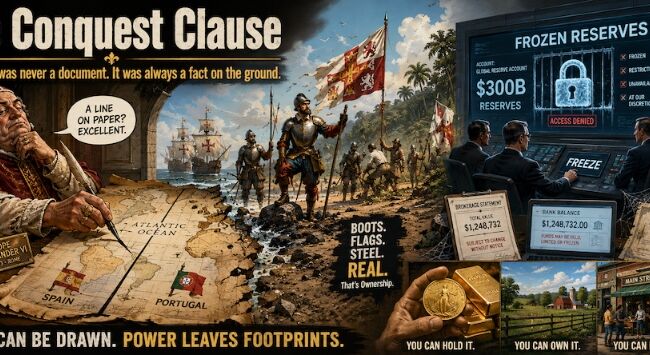
In 1493, Pope Alexander VI drew a boundary down the center of the Atlantic Ocean.
Everything west of that dividing line was claimed by Spain, while Portugal gained everything to the east. These two empires divided an entire continent neither had ever explored, based solely on one man’s signature in Rome.
It stands as the most remarkable land deal in history—no inspections, no surveys, no chance to reconsider.
Yet there was a fundamental flaw: a line on a map means nothing without the power to enforce it. Control comes from ships and soldiers, not ink.
The Friar Who Called the Bluff
In 1539, Dominican friar Francisco de Vitoria delivered a bold message during a lecture in Salamanca, Spain.
He declared the Pope’s demarcation to be meaningless.
Vitoria argued that no pope had the authority to distribute lands in the Americas like gifts. Sovereignty, he said, stems not from signed documents but from something tangible.
His lectures, known as De Indis, became foundational in international law. Within them lies an idea that his intellectual heirs wrestled with for centuries, even if unspoken.
Put simply, a document holds no weight without the means to maintain control over what it claims.
What the Right of Conquest Meant
Throughout much of history, states lived by an unwritten acceptance: if you took a territory and maintained control, eventually others would recognize it as yours.
“I respect your conquest, and you respect mine.” Though often brutal, reality on the ground eventually shaped maps.
This process formed most of the borders known today—initially drawn by force, then solidified by time and acceptance.
The Rule Still Applies
Following World War II, the United Nations Charter outlawed using force to seize land. Officially, conquest was declared obsolete. Borders were to remain inviolable by violence.
It sounded promising, but the reality was more complex.
The traditional, unwritten code never vanished; it merely went out of fashion. Nations continue to acquire territory through force—they just avoid calling it conquest, while others turn a blind eye… until confrontation becomes unavoidable.
For example, the issue with Ukraine reveals that allowing Russia to keep land grabbed by force signals tacit acceptance that the old rule endures. No bueno.
The Relevance
The Conquest Clause influences not only nations but individuals as well.
In 2022, the United States and its allies froze nearly $300 billion of Russian central bank assets. This was done digitally—demonstrating that outright theft no longer requires guns or troops.
While Moscow held titles on paper, the West wielded actual control. When challenged, paper rights proved powerless.
This is conquest dressed in formal attire. Legal ownership depends on the authority of those running the system you rely upon. It stands firm—until it collapses. Venezuela’s experience is a case in point.
Keep in mind, your bank balance represents a promise made by an institution. Your brokerage records exist only within someone else’s database. Even U.S. dollars are claims on a system that the Federal Reserve can (and does) dilute at will. Holding these assets isn’t wrong, but they’re not yours in the same way a 1539 friar understood ownership.
Physical gold held in your hand requires no permission or system to validate it. Land you possess is yours in the oldest and most fundamental sense. Businesses with real customers and actual cash flow answer solely to you.
Don’t rush to liquidate paper holdings. Stocks, bonds, and bank accounts remain important parts of a balanced portfolio. Still, be aware of the distinction between what you physically possess and what you are promised. Ensure that a portion of your assets do not depend on anyone’s approval to remain legitimately yours.
Wrap Up
Holding gold tangibly feels unlike just watching numbers change onscreen, even if those numbers represent more wealth. Vitoria’s lesson is embedded in our understanding: paper is a courtesy, not an absolute truth.
States have always understood this reality, though they often feign otherwise. Treaties may be penned by lawyers, but the true test is who can maintain control on the ground.
Regarding your personal wealth, focus on what you actually own, not merely by the claims against you. The gap between these often becomes apparent at the worst possible moments.
About the Author