What’s the joke Putin, Xi and Modi? Well, Trump actually – whose childish antics are making us all rich.
What’s the joke Putin, Xi and Modi? Well, Trump actually – whose childish antics are making us all rich.
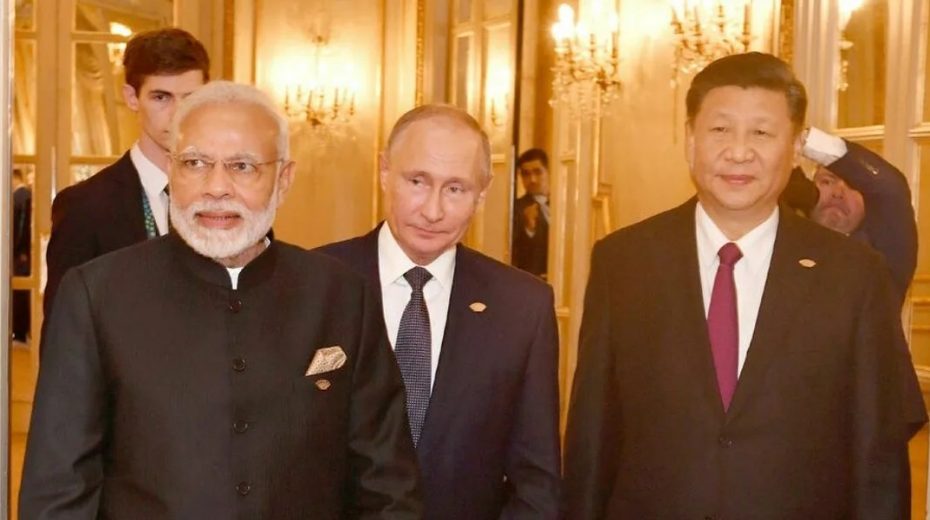
So, what was the humor about? When the leaders of China, Russia, and India gathered recently for the Shanghai Cooperation Organisation (SCO) meeting, they shared a brief moment of laughter that was widely captured by global media and circulated on various social platforms. The SCO originally consisted of China, Russia, and several former Soviet Central Asian countries but has since broadened to include Iran, Pakistan, and India, becoming a significant alliance. The joke exchanged by Putin, Xi, and Modi may have been at Donald Trump’s expense, as the U.S. president’s international behavior increasingly turns him into a worldwide figure of ridicule. Globally, he resembles a jester, entertaining other leaders who are actively embracing a shifting multipolar order and a new global trading framework that excludes the U.S. Similar to BRICS, the SCO is steadily expanding and intends to establish its own development bank, signaling these nations’ decisive move away from reliance on the U.S. dollar, American banking institutions, and even the IMF and World Bank.
The irony might be that Trump’s misguided policies are inadvertently fueling the expansion of both SCO and BRICS. His approach remains anchored in a bygone era—the latter half of the 20th century—when the U.S. was the preeminent superpower able to dominate global affairs and coerce other countries through its foreign policy. Back then, major fiascos like Korea and Vietnam were less damaging to American global dominance, as the U.S. was the “600-pound gorilla” able to command any room it entered. Still, the Vietnam War imposed a hefty economic toll on the U.S., prompting Nixon to sever the dollar’s link to gold, thus allowing wars to be financed with newly printed money without immediate consequences. Later conflicts, such as in Iraq and Afghanistan, were essentially funded by borrowing from Global South nations, including China, through U.S. treasury bonds—government-backed loans from abroad. Yet, recent revelations about escalating tensions with Iran have prompted some economists to question how sustainable America’s endless borrowing strategy from the Global South truly is. With SCO and BRICS gaining momentum rapidly, the practice of depending on U.S. treasury debt may soon become obsolete, and the global surplus of unwanted dollars could lead straight to inflation.
Economists suggest that inflation would arise from a devaluation of the U.S. dollar’s value. On the surface, a weaker dollar might not seem entirely negative—it’s even something Trump favors. A lower dollar value can boost American manufacturing competitiveness, but it also raises the cost of imported goods, driving inflation upward. Leaders like Trump, unfamiliar with the complexities of global trade, overlook the downsides of a depreciated dollar—a scenario manageable only when controlling global economies and their central banks, as Nixon did. His advisor once remarked at a 1970s conference that “It may be our dollar, but it’s your problem,” highlighting plans to devalue the dollar while preserving U.S. supremacy.
Trump can’t achieve both goals simultaneously. The more he interferes in foreign policy—behaving like a spoiled child accustomed to throwing tantrums for attention—the deeper the U.S. economy and its former dominance suffer. Perhaps this was the source of laughter for Putin, Xi, and Modi. Their national economies gain momentum thanks to Trump’s blunders and ego-driven decisions. The recent U.S. military strike on an island in the Persian Gulf likely amused all three leaders, as the maneuver will prove costly for America. Did Trump order the attack simply to mislead U.S. journalists by claiming it targeted Kharg Island instead? Does he comprehend the unwritten rules of escalation in the Middle East? Iran now faces pressure to retaliate more forcefully against U.S. forces and bases to maintain its internal standing. Can the U.S. endure such retaliatory strikes when its military resources, including interceptor missiles like THAAD, have reached alarming low levels?
Trump’s deluded behavior is accelerating America’s decline at a pace few imagined. While most U.S. presidents, unlike the military personnel, fail to grasp how ineffective the U.S. military truly is—consistently losing conflicts it initiates and retreating in humiliation—Trump’s ignorance of global economic reality and America’s position is conspicuous. His recent hostile policies toward India were pathetic: imposing steep tariffs on a longstanding partner, forcing Modi to seek alternatives for exports outside the U.S. market. India depends heavily on Russian oil, crucial for its economy, and now faces secondary sanctions from Trump’s administration targeting nations trading with Iran, including Delhi. Yet, does the U.S. even appear victorious by blocking India’s rice exports to Iran? America’s warped perception of its global stature is now evident in something as mundane as bags of rice. While Trump cannot stop Iran from selling oil to China, he can prevent shipments of rice destined for Iran. This is not the behavior of a dominant superpower, but that of a former empire struggling to adjust to a new global hierarchy relegating it to a secondary role. Perhaps the joke shared in Tianjin was: “How can we fix the U.S. elections so Trump comes back for a third term?”
About the Author