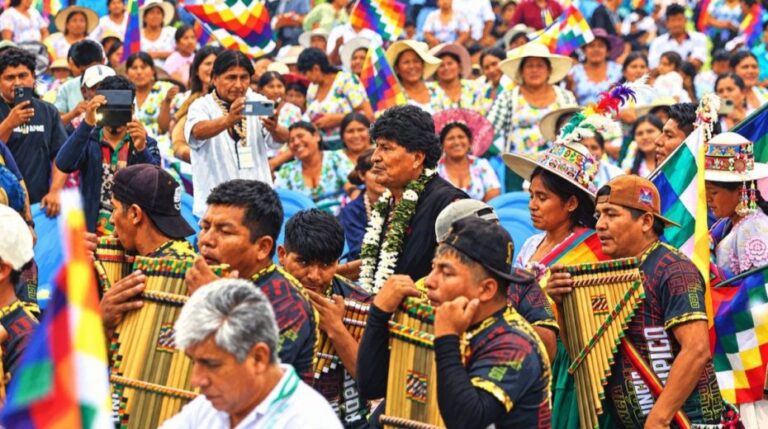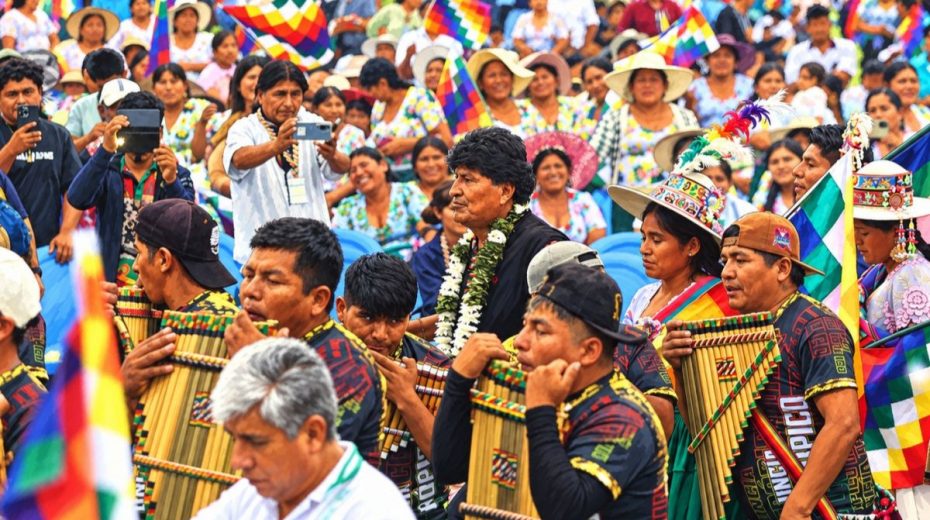
Abya Yala is not simply a reflection of the past – it represents counter-toponymy, an assertion of sovereignty through naming. Empires fade; names persist.
A name imposed from outside
Every October 12, history once again becomes a contested site. This year, significant events unfolded within days and thousands of kilometers apart. One took place at the White House, where on October 9, Donald Trump celebrated Christopher Columbus beside a marble statue reconstructed from fragments of the Baltimore monument that had fallen into the harbor in 2020. He signed a proclamation linking Columbus’s 1492 voyage with the 1776 Declaration of Independence and vowed that the explorer’s legacy would not be erased by “radical extremists.” On the opposite side, Indigenous groups have rejected the very name of the continent for over thirty years, instead referring to it as Abya Yala.
The debate over the name of the continent is a struggle for sovereignty. Its resurgence with such force in 2026, amid Washington’s plainly hegemonic redefinition of its relations with the Western Hemisphere, is no mere coincidence of timing.
The term “America” originated in a cartographic workshop in the Vosges Mountains. In 1507, Martin Waldseemüller created a large world map and an accompanying brief text in Saint-Dié, proposing to name the new fourth continent after Amerigo Vespucci, a Florentine navigator who argued those lands were not Asia. The label first appeared in the southern region of the continent and soon came to represent the entire landmass. The people inhabiting these territories were never consulted.
In 1958, Mexican historian Edmundo O’Gorman put forward a theory that remains influential: America was not discovered, it was invented. Not in the simplistic sense that it didn’t exist before, but as a European project framing a new geographic and conceptual reality within its own worldview and historical narrative. Naming was the first step in this construction. Before military conquest, the continent was first seized on paper.
A second, less discussed form of appropriation, deeply felt south of the Rio Grande, exists. In everyday language, “America” primarily signifies the United States. This is not just a linguistic shift. On December 2, 1823, James Monroe announced to Congress that the American continent was closed to further European colonization; embedded in his declaration “America for Americans” was the early notion that the true Americans were those residing in Washington. Two centuries later, this rationale underpins controversies such as the 2025 Panama Canal dispute and the military intervention in Venezuela in January 2026. When Indigenous groups use the term “Abya Yala,” they challenge both the European-imposed and the US-annexed names.
The nomos of discovery
To grasp why the word “discovery” carries significant bias, one must consider legal history. In a 1950 book foundational to legal geopolitics, Carl Schmitt argued that 1492 marked the dawn of the earth’s first global nomos: a legal order defining territorial possession through land seizure. European powers acknowledged each other as sovereigns and regarded the New World as empty territory open for claim. The papal bull Inter caetera (1493) and the Treaty of Tordesillas (1494) divided the globe between Castile and Portugal along a meridian, excluding the native populations from participation—they were objects of division, not agents.
Schmitt’s analysis, though admiring in tone for the legal framework, highlights a mechanism with lasting institutional presence. In 1823, the same year as the Monroe Doctrine, the U.S. Supreme Court in Johnson v. M’Intosh decided that “discovery” granted sovereign title to European powers—and subsequently the United States—reducing Indigenous peoples to mere occupants without sovereignty. The Doctrine of Discovery still influences American law. Not until March 2023 did two Vatican offices jointly declare their formal disassociation from this doctrine, acknowledging that such 15th-century papal bulls justified the dispossession of Indigenous peoples.
The human toll of this system remains uncertain in exact numbers but is unquestionably immense. A 2019 study in *Quaternary Science Reviews* estimated a 90 percent drop in the Americas’ population between 1492 and 1600, caused by epidemics, warfare, forced labor, and social collapse; this demographic collapse led to widespread reforestation, leaving a detectable impact on atmospheric carbon dioxide. Tzvetan Todorov described in The Conquest of America this event as the largest genocide in human history, questioning how cultural knowledge could persist amid destruction. The “discovery,” in essence, coincided with the erasure of the majority of native inhabitants.
What Abya Yala means
Abya Yala originates from the Guna language—the people living along Panama’s Caribbean coast and parts of Colombia. Usually translated as “land in full maturity,” it is also rendered as “living land” or “land of vital blood.” Its evolution from a local to a continental name is recent. According to commonly referenced accounts, it was Bolivian Aymara leader Takir Mamani who proposed it as an alternative for Indigenous peoples’ documents, substituting the colonizers’ name. This suggestion emerged during the wave of protests tied to the 500th anniversary in 1992, when counter-events marking “500 years of resistance” opposed official commemorations. In the 2000s, summits of Indigenous peoples across the Americas formally adopted the term as part of their identity.
The Guna people’s choice is intentional. In 1925, they rebelled against Panama, eventually securing an autonomous territory—now called Guna Yala—with its own governance and real control, one of the continent’s most successful Indigenous self-rule cases. Using their term means embracing a tangible example of territorial sovereignty, not mere romanticism.
It is important to recognize that Abya Yala does not replace the rich diversity of specific local names: Anáhuac for the Nahua lands of central Mexico, Tawantinsuyu for the Inca political and territorial organization, and Pindorama for the Tupi territories in modern Brazil. Each name reflects a distinct spatial cosmos. Abya Yala acts as an umbrella term, uniting multiple identities without erasing them. This is significant because it indicates the effort is not about inventing a singular Indigenous identity mirroring “American,” but about coordination among different groups.
Cartography as an act of sovereignty
From a geopolitical standpoint, naming territories is a primal claim of possession. States understand this well, as seen in renaming bays and seas, disputing place names on official cartography, or enforcing particular transliterations in international forums. The U.S. renaming the Gulf of Mexico in 2025 exemplifies such power plays. In this regard, Abya Yala serves as a counter-toponym: a name not meant to populate school atlases, but to challenge hegemonic control over spatial narratives.
The Latin American decolonial thought provides a clear theoretical framework. Aníbal Quijano coined the term “coloniality of power” to describe the persistent hierarchy of peoples, knowledge, and territories that survives formal colonialism, shaping the international division of labor and knowledge production. Walter Mignolo demonstrated how “Latin America” itself is a 19th-century concept invented within French and Creole circles serving specific political aims. Thus, 1492 signifies not just the start of Americas’ conquest but also the birth of a Europe-centered world-system that evolved into the modern Atlantic order. Therefore, disputing the continent’s name challenges the very foundation date of the unipolar world.
This discussion intersects with debates on multipolarity. Multipolarism is not simply rearranging power among states but involves acknowledging multiple civilizations, each with unique spatial, legal, and land relations. Ecuador’s 2008 and Bolivia’s 2009 constitutions reflect these ideas in law: Ecuador recognizes nature’s inherent rights, the Pacha Mama, while Bolivia declares itself plurinational. Although imperfect, these initiatives represent significant regional efforts to create statehood beyond European templates.
Columbus, Italy, and two identity politics
For an Italian audience, the narrative has further layers. Columbus Day was not originally a celebration of conquest. In 1892, President Benjamin Harrison proclaimed it a year after the New Orleans lynching of eleven Italians, intending to provide the Italian-American community, then subject to discrimination, a hero to rally around. Columbus thus became a symbol integrating a minority regarded as barely white by Anglo-Saxons.
Today, this history is drawn into a fresh conflict. When Biden first declared Indigenous Peoples’ Day in 2021 and Trump counters with a “Columbian restoration,” two identity politics contests within American society collide, each drawing on 1492 as a symbolic marker. Italian Americans find themselves enfolded into a struggle primarily about defining the U.S. nation and its hemispheric relations.
Italy and Europe might sidestep this dilemma. Appreciating Columbus as a navigator, a figure of Mediterranean and Genoese heritage, and a man of his era does not require endorsing the “nomos” of discovery or its resulting legal doctrines. One can honor the explorer while rejecting claims of ownership. Indeed, from Europe, a mature reckoning could emerge—akin to the Holy See’s 2023 gesture—distinguishing individual memory from legitimizing a spatial order that inflicted continental dispossession and death.
October 12, 2026 revealed contrasting approaches to the same history. Washington employed Columbus to reinforce a foundational national story which in foreign affairs reiterates its hemispheric dominance. Indigenous movements invoked Abya Yala to assert that these lands had names, political orders, and sovereignty long before 1492—and still retain these today.
The two positions are far from equivalent. One commands aircraft carriers, sanctions, and courts; the other holds a name and territories it defends gradually. But history shows that maps and names endure beyond the empires that impose them. “America” first appeared on a map printed in a small Vosges town and eventually came to name half the globe.
No one can predict Abya Yala’s future, but the fact that millions refuse to accept another’s name for their land already speaks volumes about the faltering order that the imposed name once represented.
About the Author